

A trading journal should include the market and settlement terms, your estimated probability, planned and actual entry prices, position size, total exposure, costs, exit or settlement result, emotional state and rule-compliance checks. Record the decision before the outcome is known, then review execution errors and rule breaches separately from profit or loss.
Why record more than profit and loss?
A winning position can contain a poor decision: paying above your limit, increasing size impulsively or exceeding account exposure. A losing position can follow a well-defined plan. Your journal needs enough information to distinguish decision quality, execution quality and the eventual result. Otherwise, a profitable breach can become a habit you mistakenly reward.
Research offers a reason to record emotions alongside orders. A PLOS ONE study of stock day traders analyzed trading decisions alongside instant messages and found a curvilinear association between emotional activation and decision errors. That is not proof that a particular mood causes losses, nor direct evidence about sports traders; it supports examining emotional state rather than treating it as irrelevant.
What fields should every trading journal include?
- Identity and settlement: trade ID, timestamp, event, market, side, contract terms, settlement source and relevant deadlines.
- Decision: estimated probability, evidence available at entry, key assumptions and what would invalidate the trade.
- Execution plan: intended price, maximum acceptable price, order type, intended quantity and cancellation conditions.
- Actual execution: order and fill timestamps, fill prices, filled quantity, partial fills, cancellations and any rejected orders.
- Risk: position size in money and account percentage, exposure before and after entry, related open positions and the account’s displayed drawdown measure.
- Costs and outcome: applicable charges, exit proceeds or settlement payment, net profit or loss and settlement status.
- Psychology and compliance: emotional state before and after entry, any urge to chase, rule-check results and a short corrective action.
A spreadsheet or document is sufficient if entries are consistent and timestamped. Keep planned values separate from actual values, and preserve the original probability estimate. If new information changes your view, add a dated update rather than rewriting history. Save order confirmations or screenshots where useful, without treating screenshots as a substitute for searchable fields.
What does a completed journal entry look like?
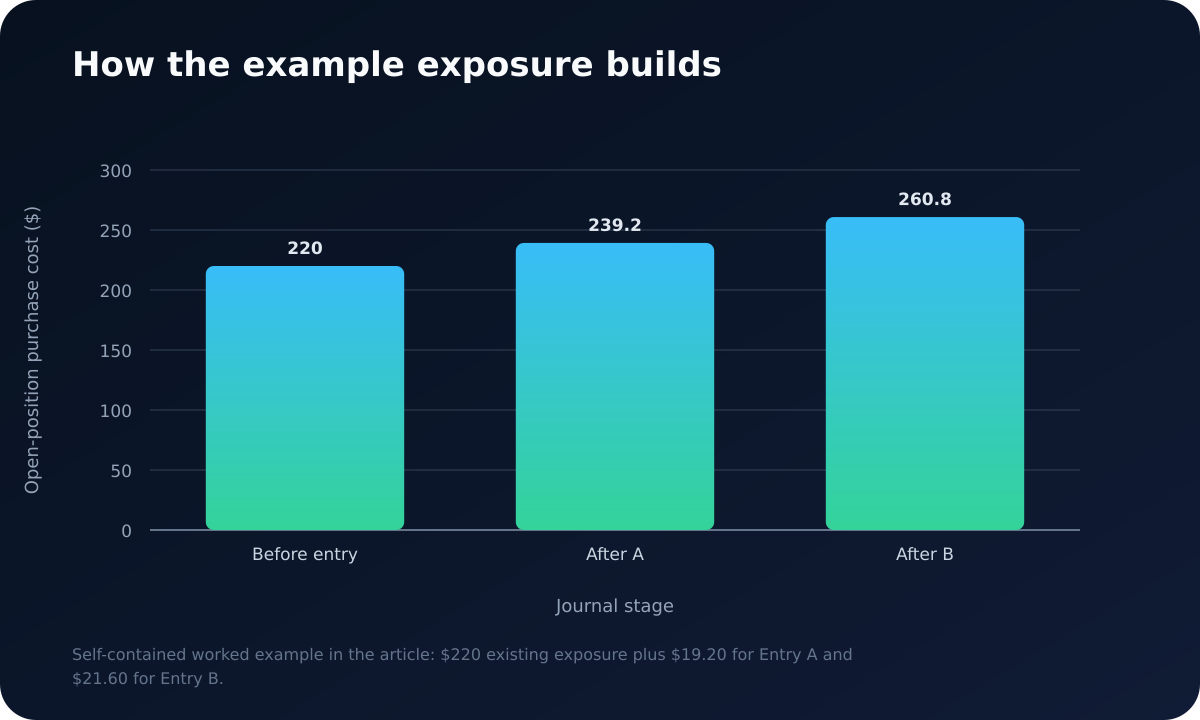
Example: a $1,000 account with two football prediction-market positions. Each YES contract costs its quoted price and pays $1 if its condition occurs, otherwise $0. For this example only, exposure is tracked as the purchase cost of open positions, and transaction costs are set to $0 to isolate the arithmetic. Existing unrelated open positions cost $220. This ledger convention is not a definition of OddsFantasy’s exposure calculation.
Entry A: what does a planned trade record?
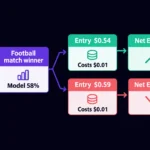
- Market and estimate: three or more goals in the match, YES; estimated probability 52%, based on the trader’s recorded pre-match assessment.
- Plan and fill: buy 40 contracts at $0.48; actual fill $0.48. Position cost: 40 × $0.48 = $19.20, or 1.92% of the starting account.
- Exposure: $220 before entry and $239.20 afterward, equivalent to 23.92% of the starting account under this example’s convention.
- Emotional state: calm, activation 3/5; no recorded pressure to increase size.
- Settlement: YES; payment $40; profit $20.80 before costs. No entry-price deviation.
Entry B: what does a flawed trade record?
- Market and estimate: a goal after the 80th minute in the same match, YES; estimated probability 56%, with the supporting reasoning recorded.
- Plan and fill: maximum entry price $0.50 for 40 contracts; actual fill $0.54 after chasing the market.
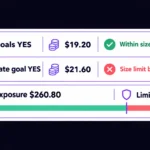
- Position cost: 40 × $0.54 = $21.60, or 2.16% of the starting account. Exposure rises from $239.20 to $260.80, or 26.08%.
- Emotional state: urgency, activation 5/5; note reads, “Did not want to miss the move.”
- Settlement: NO; payment $0; loss $21.60 before costs. Actual entry exceeded the planned price by $0.04 per contract.
The match finishes with three goals, all scored before the 80th minute. Combined profit or loss is $20.80 − $21.60 = −$0.80 before costs. That small net loss conceals important process failures. The positions also share one match, so the journal should flag their connection rather than imply that two market names provide independent risk.
How should you review execution errors and rule breaches?
Did the records and settlement reconcile?
Start with reconciliation, not interpretation. Match each fill to its order, confirm quantity and price, and check the settlement against the recorded contract terms. Calculate net profit or loss from actual proceeds, purchase costs and applicable charges. Mark unresolved positions as open or pending; do not count an expected settlement payment as realized profit.
Did you execute the plan at an acceptable price?
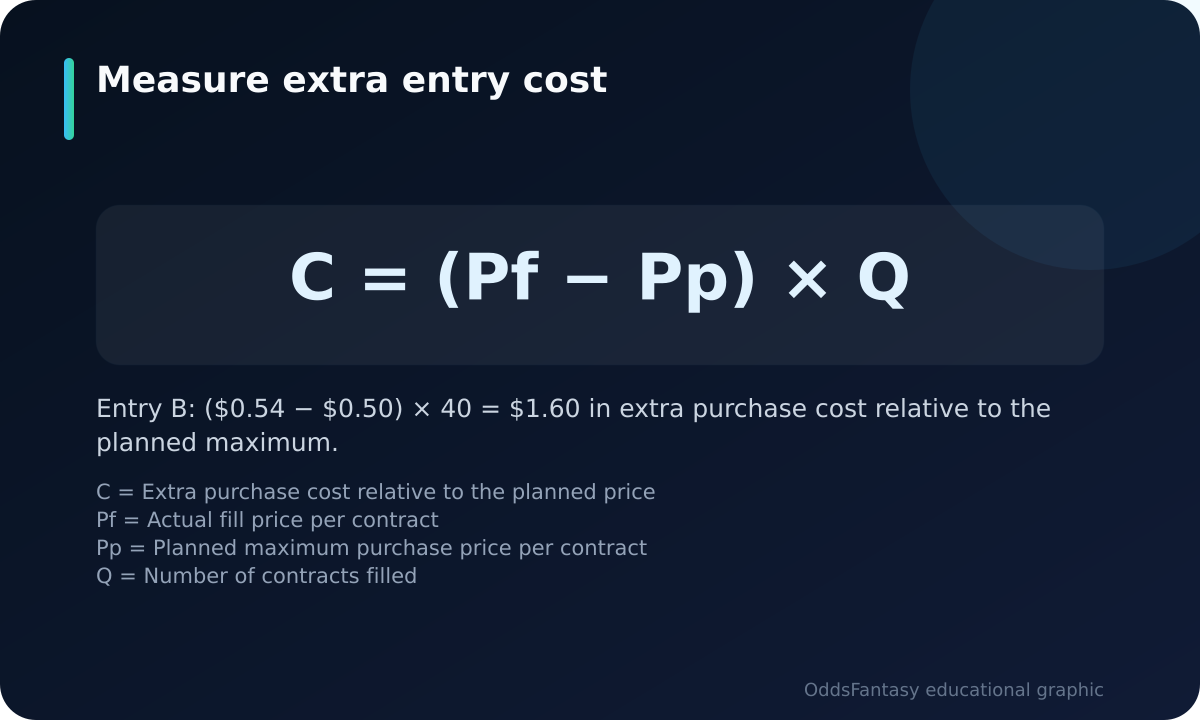
For a purchase, measure the extra entry cost as actual fill price minus planned price, multiplied by filled quantity. Entry B costs ($0.54 − $0.50) × 40 = $1.60 more than the planned maximum. Record whether this came from a changed order, delay, partial fill or deliberate chase. A fill above your cap is a process failure even if the position later wins.
The PLOS ONE study assessed execution against the best possible prices within a short time window. A personal journal should distinguish that retrospective benchmark from a price genuinely available for your quantity when you acted. A later, better quote does not by itself prove that your execution was avoidably poor.
Did the position comply with funded-account limits?
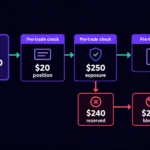
Every OddsFantasy funded account has a 2% maximum position size, a 10% maximum drawdown and a 25% maximum exposure. Record a separate check for each rule before placing an order and after fills. Using the example’s $1,000 starting reference, 2% is $20 and 25% is $250; these are separate checks, not interchangeable allowances.
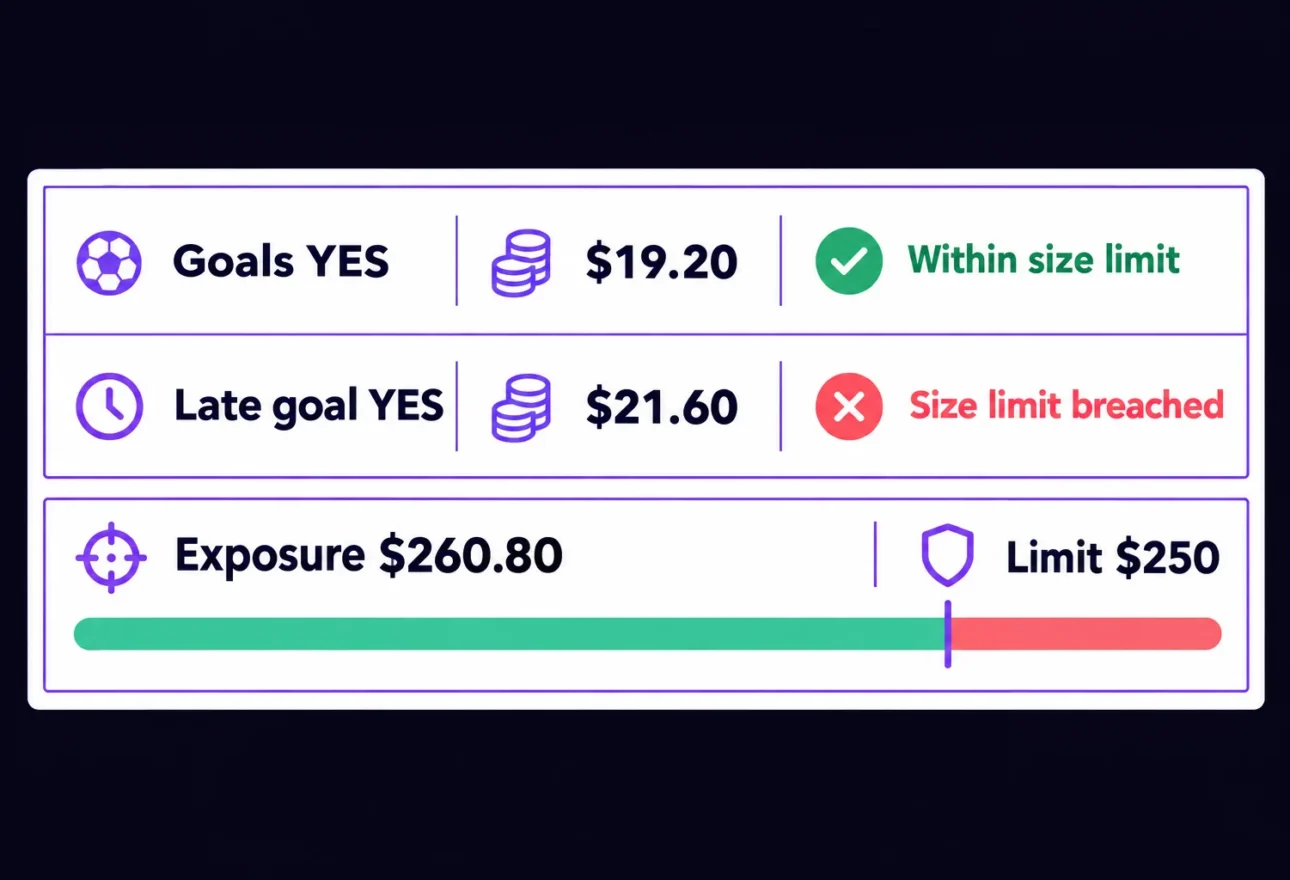
- Position check: Entry A costs $19.20; Entry B costs $21.60 and exceeds the example’s $20 position threshold.
- Exposure check: the example ledger reaches $260.80, above its $250 threshold. Existing positions cannot be ignored when assessing a new order.
- Drawdown check: retain the account’s recorded drawdown measure at the decision time. The two settlement results alone do not establish whether a drawdown breach occurred.
- Timing check: identify when the limit was crossed. A later settlement that releases exposure does not erase an earlier breach.
For the applicable calculation methods, including drawdown and exposure treatment, consult the Terms and Conditions published at trade.oddsfantasy.com. Do not substitute a homemade ledger definition for the account rules.
Did emotion change the order?
Compare emotional notes with observable actions. In Entry B, urgency accompanies a price-cap violation and excessive size. That is more useful than writing “bad discipline.” The corrective action could be: cancel rather than raise an order above its recorded cap, then recalculate size and exposure before any replacement. Treat emotional ratings as prompts for investigation, not diagnoses or automatic explanations.
What should a repeatable journal review look like?
- Before entry, complete the probability estimate, price cap, size, exposure and emotional-state fields. An incomplete entry is a reason to pause.
- After execution, reconcile intended and actual orders. Record deviations while the sequence is still clear.
- After settlement, add payments, charges and net results without changing the original rationale.
- At a scheduled review, group trades by setup and error type. Count price-cap violations, missing checks and rule breaches separately from profitable trades.
- Choose one specific correction, then check the next review for recurrence. Keep the review schedule realistic for your available time.
The NFA’s Investor Best Practices, written for futures traders, recommends understanding market risks, order handling and charges, while considering experience, time, capital and risk tolerance. Those questions are useful journal-design prompts, although futures-account arrangements should not be assumed to apply to prediction markets.
How does journaling support an OddsFantasy funded account?
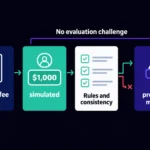
OddsFantasy funded accounts are instant, with no evaluation challenge, and start on simulated capital from day one. The $1,000 funded account has a one-time platform fee of $99.99. Traders who stay within the rules and trade consistently move up to live capital on prediction markets, where they keep up to 90% of profits as performance rewards. A journal documents your decisions; it does not guarantee that progression.
For foundational work, The Beginner’s Guide to Data-Driven Sports Trading covers probability, position sizing, exposure and market psychology. Use those concepts to make each journal entry auditable: what you believed, what you ordered, what filled and whether you followed the rules.
Frequently asked questions
Should I record losing trades differently from winning trades?
No. Use the same fields and review standards for both. A profitable position can breach a rule, while a losing position can follow a sound plan. Record the outcome separately from execution and compliance.
How should I record estimated probability?
Save the probability before entry, alongside the evidence, assumptions and timestamp. If your estimate changes, add a dated revision rather than replacing the original. One settlement cannot establish whether an estimate was accurate.
Does OddsFantasy provide trading journal software?
A journal can be maintained separately in a spreadsheet or document. OddsFantasy funded accounts include the trading terminal and full trading education library; this article does not describe a journaling-software feature.
What is the difference between an execution error and a rule breach?
An execution error is a deviation from your trading plan, such as paying above a recorded price cap. A rule breach violates an account limit, such as maximum position size or exposure. One order can involve both, so record them separately.
Sources
- PLOS ONE: Do Emotions Expressed Online Correlate with Actual Changes in Decision-Making?: The Case of Stock Day Traders
- NFA: Investor Best Practices | NFA
Trade responsibly: only trade what you can afford to lose. 18+.