

To execute a sports model, convert each prediction into a price-limited, size-limited order, then test whether its expected value survives trading costs, execution delays and incomplete fills. Move from backtesting to simulated execution before committing live capital; a historical signal is not evidence that you can trade the same price today.
The objective is not simply to connect a model to a terminal. It is to define when a signal remains valid, how much exposure it can create and what happens when execution differs from the backtest. For the broader framework, start with How to Build a Prediction Market Trading Strategy. This guide focuses on the execution layer.
What must change between a backtest and an executable signal?
A backtest can record a profitable-looking opportunity without proving that the displayed price was available for your position size. Execution needs a timestamped decision, a current quote and a rule for rejecting the trade when conditions change.
Give every signal an execution specification. Keep the model’s probability estimate separate from the market price: one is your forecast, while the other determines the cost of entering the position. A signal should expire rather than remain actionable indefinitely.
- Identity: event, market, outcome and settlement definition.
- Timing: model-input timestamp, signal timestamp and expiry condition.
- Price: reference quote, maximum acceptable entry price and minimum net edge.
- Size: requested position, available risk budget and permitted outstanding orders.
- Exceptions: actions after a partial fill, stale quote, rejection or market-rule mismatch.
Does the edge survive the price you can actually trade?
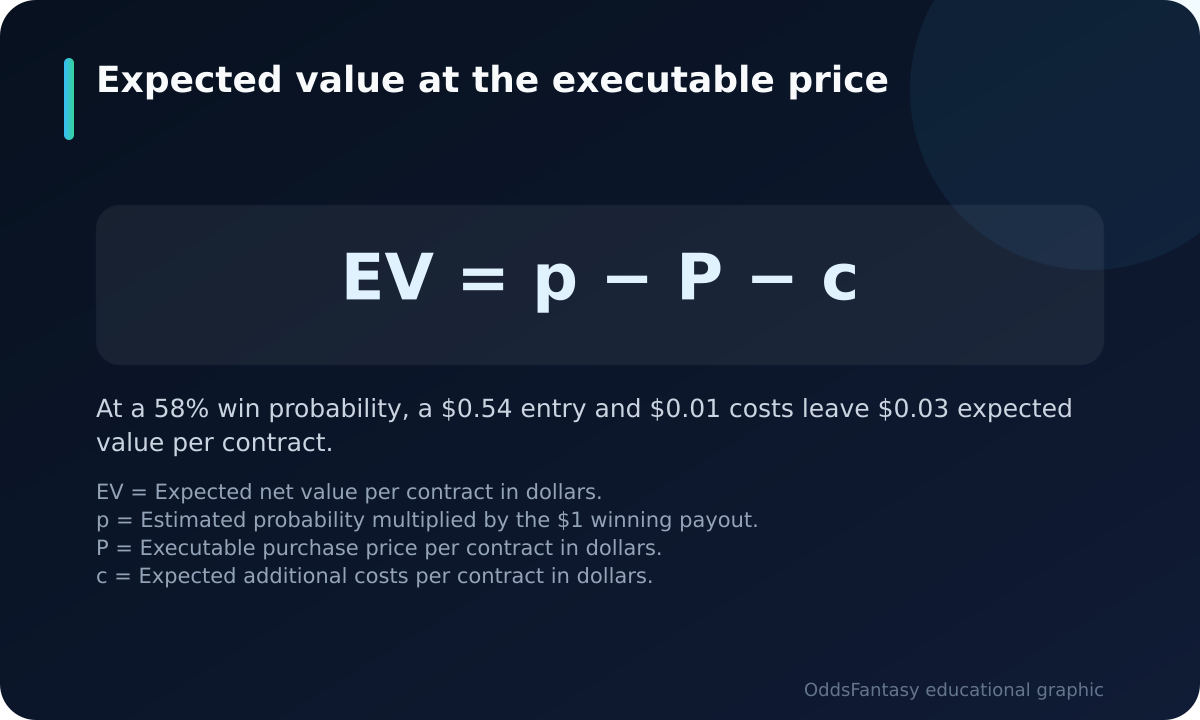
Calculate expected value using the executable entry price, not a historical midpoint or the last recorded transaction. For a contract paying $1 if the selected outcome wins and $0 otherwise, expected value per contract equals your estimated win probability minus the entry price and expected per-contract costs.
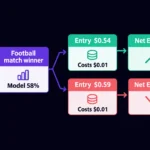
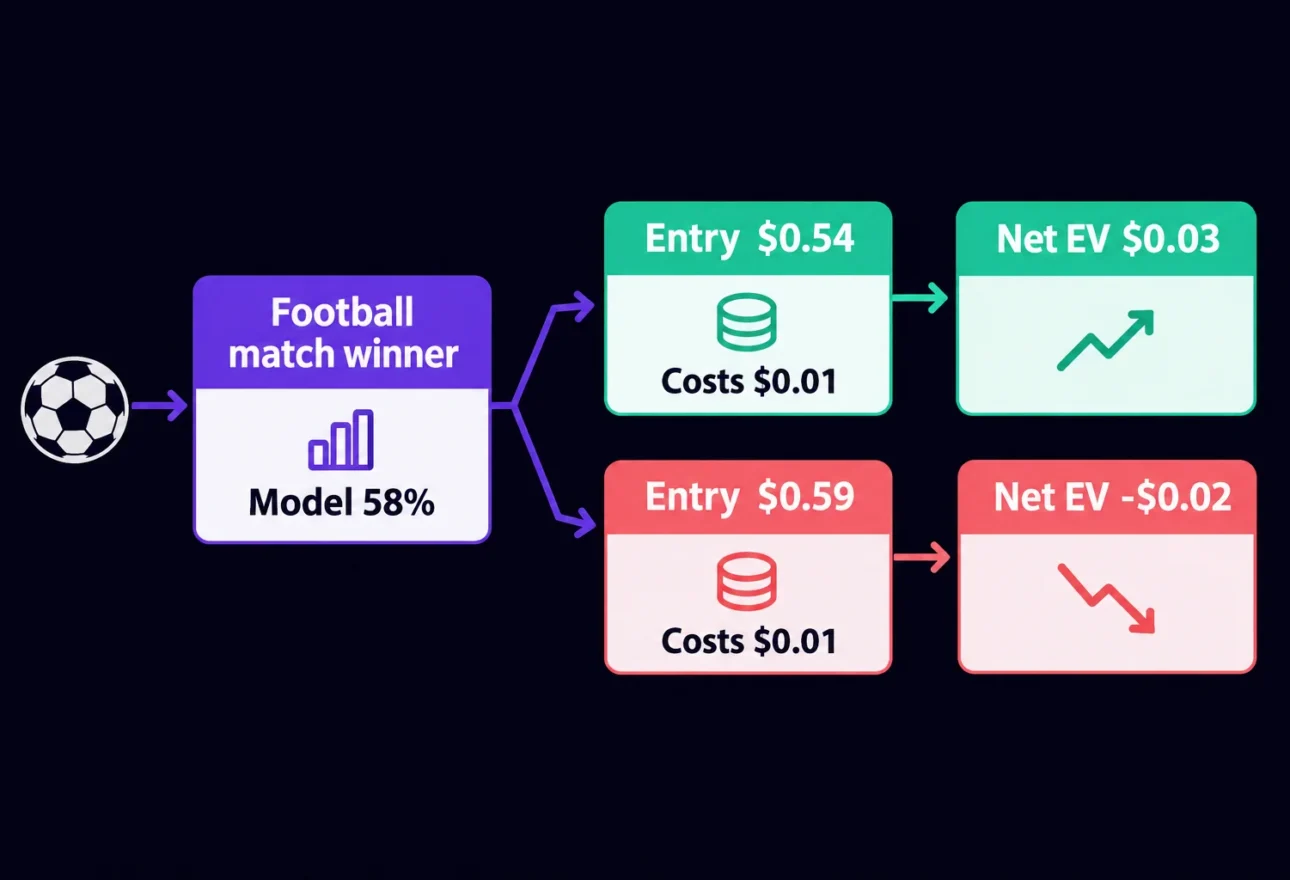
Example: a $1,000 account evaluates a football match-winner contract with a 58% model probability and a historical entry price of $0.54. Gross expected value is $0.58 − $0.54 = $0.04 per contract. With a $0.01 allowance for applicable trading costs, net expected value is $0.03. This is a worked calculation, not a live quote.
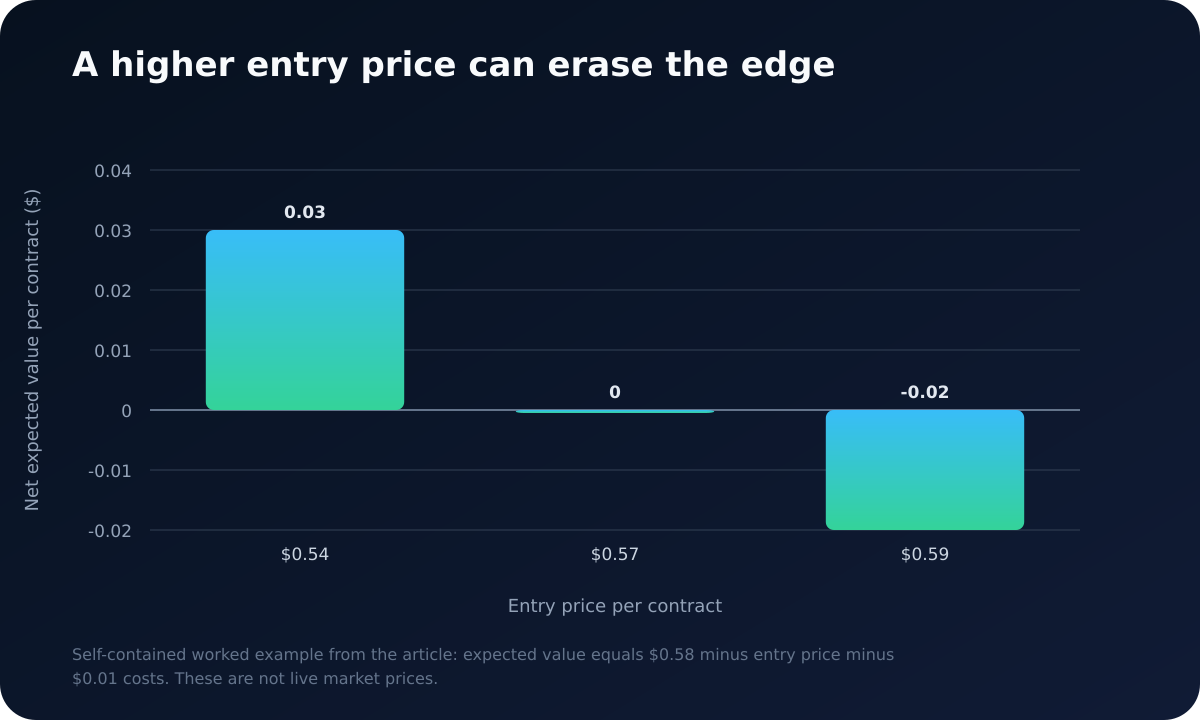
If the available entry price rises to $0.57, that same allowance reduces expected value to zero: $0.58 − $0.57 − $0.01 = $0.00. At $0.59, expected value becomes negative $0.02. The model has not changed, but the executable trade has. Use the expected value calculator to check the arithmetic, not to validate the probability estimate.
Avoid double-counting costs. If you use the actual purchase price, its distance from the midpoint is already reflected in that price. Add applicable fees and other execution costs separately. If the strategy exits before settlement, assess exit execution too rather than assuming an immediate sale at the displayed quote.
The Federal Reserve paper Measuring Transaction Costs in the Absence of Timestamps develops effective-spread measures when timestamps and trade-initiator information are unavailable. Its empirical illustration concerns small-cap stocks, not sports markets. The practical lesson here is to preserve execution data instead of assuming incomplete historical records reveal your trading costs.
How should you handle stale prices and limited liquidity?
Check freshness twice: when generating the signal and immediately before submitting the order. A price can become unsuitable because the market moved, the model inputs changed or the underlying event entered a different state. Set a signal-expiry rule appropriate to the strategy; do not choose a universal timeout without testing it.
Then check how much quantity is available at acceptable prices. A visible quote is not a promise that your full order can execute there. Estimate the total cost across the available prices needed for your intended quantity, and reject or reduce the order if that cost removes the edge.
A limit order executes only when the market trades at the specified price, but submitting one does not guarantee a fill. For the sports-market workflow described here, marketable orders also face a three-second placement delay. Include that delay in execution testing rather than treating a currently visible quote as immediately secured.
What happens when an order only partly fills?
A limit order may fill in portions rather than all at once. Your execution process must distinguish requested quantity, filled quantity and remaining open quantity. Otherwise, a retry can create more exposure than intended.
In the account example, an order for 30 contracts at $0.54 commits $16.20 before costs. If 12 contracts fill, the filled position costs $6.48 and the remaining 18 contracts represent another $9.72 if executed. Do not treat the unfilled portion as spare capacity while leaving that order active.
- Record the confirmed fill and remaining order quantity.
- Recalculate the remaining signal edge and account headroom.
- Keep, amend or cancel the remainder according to the original execution policy.
- Confirm the resulting order state before submitting a replacement.
Open orders can be monitored on the market page or from the Portfolio page. Outstanding sports-market limit orders are automatically canceled when the game begins, but start times can shift. Monitor them rather than relying on scheduled cancellation as your only control.
Why must settlement rules match the model target?
A model prediction and a market contract must describe the same outcome. Before trading a football match-winner signal, check whether the market definition matches the model’s treatment of regulation time, extra time and other possible match states. Do not infer settlement from a short market title.
Read the market’s resolution criteria for postponements, cancellations, abandoned events and the designated outcome source. These are questions to verify, not universal settlement rules. If the model target and contract definition differ, reject the mapping or build a separate model for that contract. A price advantage cannot fix trading the wrong outcome.
How should simulated testing differ from a backtest?
A useful simulation tests the complete decision chain: fresh inputs, signal generation, account checks, order submission, fills and settlement reconciliation. Start by recording intended orders alongside current market conditions, then test the order-management workflow in a simulated environment.
Interactive Brokers’ paper-trading definition describes simulation using real market conditions and explicitly notes that paper accounts do not execute or clear trades. Its simulator uses top-of-book fills without deeper-book access. Those are characteristics of that environment, not claims about OddsFantasy’s simulator, and they illustrate why simulated fills require scrutiny.
Challenge the simulation with less favorable execution assumptions. Delay submission, remove fills that depend on uncertain liquidity, increase estimated costs and test partial fills. Check whether the strategy still merits further testing, rather than selecting the assumptions that preserve its historical result.
- Reconcile each submitted order against its confirmed status and fills.
- Measure signal-to-submission delay and entry-price deterioration.
- Separate unfilled signals from completed trades when reviewing results.
- Compare estimated costs with costs recorded by the test environment.
- Record rule breaches, stale-signal rejections and settlement mismatches.
Define progression criteria before reviewing results. Require reliable reconciliation, functioning risk controls and an acceptable result under stressed execution assumptions. A short profitable run alone does not establish that an edge will survive live trading.
How do funded-account limits constrain execution?
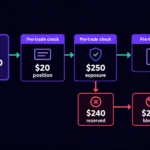
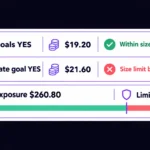
Every OddsFantasy funded account has a 2% maximum position size, a 25% maximum exposure and a 10% maximum drawdown. On the $1,000 account example, those percentages correspond to $20, $250 and $100 respectively. These are account limits, not recommended operating targets; use smaller internal budgets where execution uncertainty warrants them.
Place the risk check between signal generation and order submission, then repeat it after fills or order changes. As an internal safeguard, reserve capacity for open orders that could execute together. Also assess shared-event exposure: separate positions can still depend on the same match outcome.
Do not size solely from the model’s preferred allocation. If you use the Kelly criterion calculator, treat its result as an analytical input, not permission to exceed account limits. OddsFantasy accounts are governed by the Terms and Conditions published at trade.oddsfantasy.com; consult them for calculation definitions, including drawdown.
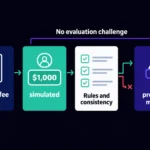
OddsFantasy funded accounts are instant, with no evaluation challenge, and begin on simulated capital from day one. Traders who stay within the rules and trade consistently move up to live capital on prediction markets, where they keep up to 90% of generated profits as performance rewards. This structure does not establish that a model has an executable edge.
How do you connect the model to a terminal responsibly?
Use a controlled handoff: model signal, market mapping, fresh-price check, risk approval, order submission and fill reconciliation. Keep a manual stop available in your operating process. If your records and the terminal disagree, stop new submissions until the discrepancy is resolved.
The OddsFantasy sports prediction-market terminal is free to use. Every funded account includes the terminal and full trading education library; the $1,000 funded account and larger also include AI-assisted trading, Positive EV signals and premium support.
For traders considering automation, the Sports Trading Tools Suite includes the AI Trading Agent, trading simulators, exposure calculators and a trading analytics dashboard. With the AI Trading Agent, you set your rules once and the agent trades them automatically. Specify and test those rules before automation; do not assume an arbitrary model integration or custom control is supported without checking.
The final readiness test is operational: can you explain why each order was permitted, what it could cost, how much remains open and which outcome it settles against? If not, improve the execution process before increasing exposure. Historical returns are a starting hypothesis; controlled execution determines whether that hypothesis remains worth testing.
Frequently asked questions
What is the first step to execute a sports model?
Define an executable signal with a specific market, outcome, probability estimate, maximum entry price, expiry condition and position limit. Then test the full order workflow in simulation rather than assuming the backtest price remains available.
Does a limit order guarantee the price and a full fill?
A limit order specifies the price at which it can execute, but it does not guarantee execution. It can remain unfilled or fill in portions, so track filled quantity and outstanding quantity separately.
How should trading costs change a model’s entry decision?
Use the executable entry price and applicable costs to recalculate expected value before submitting an order. Reject or reduce the trade if price movement or costs remove the required edge. Include exit costs when the strategy closes positions before settlement.
Does successful paper trading prove a sports model will work live?
No. Simulated execution can differ from live execution, including how fills and liquidity are represented. Use paper trading to test workflow and risk controls, then challenge results with delayed orders, higher costs and less favorable fill assumptions.
What limits apply to an OddsFantasy funded account?
Every OddsFantasy funded account has a 2% maximum position size, a 25% maximum exposure and a 10% maximum drawdown. Accounts start on simulated capital without an evaluation challenge. The Terms and Conditions govern the account and calculation definitions.
Sources
- Polymarket Help Center: Limit Orders | Polymarket Help Center
- Interactive Brokers: Paper Trading Account definition
- Board of Governors of the Federal Reserve System: Measuring Transaction Costs in the Absence of Timestamps
Trade responsibly: only trade what you can afford to lose. 18+.