

A prediction market trading strategy compares your estimated probability with an executable market price, subtracts costs, and limits exposure before entering a position. A repeatable process also checks liquidity and tests decisions in simulation rather than relying on event picks or promised returns.
The goal is not simply to identify the most likely winner. It is to decide whether a particular contract is worth its price, whether enough contracts are available at that price, and whether the position fits your risk budget.
How do you turn an event forecast into a trading decision?
Start with the contract’s exact resolution conditions. Identify what must happen for it to pay, when it resolves, and which information could change your estimate. A forecast about a team winning is not interchangeable with a contract that includes different treatment of overtime, postponement or cancellation.
Write down your probability estimate before using the quoted price as a reference point. Record the reasoning, relevant assumptions and a conservative alternative estimate. For sports markets, the estimate might depend on lineup information or playing conditions; the important discipline is documenting which inputs matter rather than changing your explanation after the result.
- Contract: state the precise outcome and settlement conditions.
- Estimate: record a central probability and a conservative alternative.
- Invalidation: identify information that would make the forecast obsolete.
- Entry condition: specify the minimum edge required after costs.
- Risk condition: set position and combined exposure limits before trading.
Can you treat a market price as the true probability?
Treat market price as a useful benchmark, not unquestionable truth. A 52¢ contract paying $1 if an event occurs resembles a 52% probability quote, but that interpretation alone does not establish fair value or an executable opportunity.
The Princeton thesis The Price is (Almost) Right reports forecasting skill in Polymarket prices overall, with substantial differences across domains. Its calibration analysis also finds prices compressed toward the midpoint, with longshots overpriced and favourites underpriced, and stronger bias over longer horizons.
The Duke publication Do Prediction Markets Produce Well-Calibrated Probability Forecasts? also connects time until expiration with favourite/longshot bias. These findings support checking calibration by market type and time horizon; they do not establish that every favourite is worth buying or every longshot is worth selling.
To assess your own forecasts, group resolved predictions into probability bands and compare estimated probabilities with observed outcomes. Keep sports categories and time horizons separate where practical. Also flag related contracts: several positions on the same event are not independent evidence that your forecasting process works.
How do you calculate an edge after execution costs?
For a binary contract paying $1 on success and $0 otherwise, expected net profit per contract equals estimated probability minus purchase price minus applicable costs. This calculation assumes holding to settlement; a planned earlier exit needs a separate estimate of the achievable exit price and associated costs.
Example: a $1,000 account considering a sports outcome contract. Your estimated probability is 58%, the executable ask is 52¢, and your cost allowance is 1¢ per contract. The contract pays $1 on success and $0 otherwise. These are practice inputs, not live quotes or a venue fee schedule.
Expected net profit per contract is $0.58 − $0.52 − $0.01 = $0.05. The break-even probability is 53%, because the purchase and cost allowance total 53¢. Positive expected value describes the probability-weighted average under your assumptions, not the outcome of this individual position.
Now stress the estimate. At a conservative probability of 54%, the edge falls to 1¢ per contract. If your strategy requires at least a 2¢ edge after costs under that conservative estimate, this trade fails the entry test. You can check the arithmetic with the expected value calculator, but the calculator cannot validate your probability estimate.
How do liquidity and the order book change the trade?
The Kalshi order book guide explains that an order book displays resting orders, quantities and prices. Bids represent the maximum price buyers will pay; asks represent the minimum price sellers will accept. A displayed price therefore needs to be read alongside the quantity available.
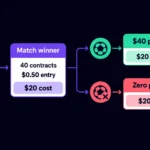
Continue the example with 20 contracts available at 52¢ and another 30 at 56¢. Buying the first 20 costs $10.40 before the $0.20 cost allowance, for $10.60 total. At the central 58% estimate, expected net profit is $1.00: 20 × $0.05. Settlement produces either a $20 payout or no payout, not a guaranteed $1 gain.
The next price level changes the decision. At 56¢ plus the 1¢ cost allowance, the central-estimate edge is only 1¢ per contract. Do not apply the first level’s 5¢ edge to the entire order. Calculate the cost across the quantities you would actually purchase.
A resting order offers to buy at a specified price without matching immediately, according to Kalshi’s guide. Setting a price limit controls what you are willing to pay, but does not assure a fill. Your plan should address partial fills, unfilled orders and what to do if new information invalidates the estimate while an order is resting.
How much exposure should you allow?
Set account limits before calculating a preferred position size. OddsFantasy funded accounts have a 2% maximum position size, a 10% maximum drawdown and a 25% maximum exposure. On a $1,000 starting account, 2% is $20 and 25% is $250. Those percentages are ceilings, not targets to fill.
The example’s $10.60 purchase and cost allowance sit below the $20 starting-account position ceiling. That does not make the position acceptable automatically: the probability stress test still fails the chosen entry rule. For governing definitions, including how drawdown and exposure are calculated, consult the OddsFantasy Terms and Conditions.
Keep a separate record of related positions. Contracts involving the same team, game or underlying event can concentrate risk even when each position is small. A useful internal rule is to cap each event group below your overall exposure ceiling, leaving room for uncertainty and existing commitments.
Should you use Kelly sizing?
Kelly sizing is a reference, not permission to override account rules. Ben Lynn’s explanation of the Kelly criterion describes maximizing expected log wealth and explains why committing an entire bankroll can lead to ruin even with positive expected value. Because your probability estimate can be wrong, compare the Kelly calculator output with a deliberately smaller size and the account’s hard limits.
How should you practise before increasing capital?
Use the free OddsFantasy prediction-market trading terminal to inspect sports markets and build familiarity with prices. Practise the decision process in simulation, recording rejected opportunities as well as entries. A useful log separates forecast quality, execution quality and rule compliance.
- Record the contract, timestamp, probability estimates and expiry horizon.
- Capture executable prices and quantities, not just a headline quote.
- Calculate expected value after costs and repeat it with conservative assumptions.
- Check position size, combined exposure and related-event concentration.
- Record the entry, rejection or resting-order decision before the outcome.
- Review settlement results and execution separately; one profitable outcome does not validate the process.
The Sports Trading Tools Suite includes trading simulators, ROI and exposure calculators, price comparison, market analysis, risk utilities and an analytics dashboard. It also includes a Positive EV Finder and an AI Trading Agent that automatically trades rules you set. Automation should follow tested rules, not substitute for establishing them.
Where do funded accounts fit into this process?
OddsFantasy funded accounts are instant, with no evaluation challenge, and start on simulated capital from day one. Available sizes are $150, $1,000, $2,000, $5,000 and $10,000, with respective one-time platform fees of $19.99, $99.99, $199.99, $499.99 and $999.99.
Every account includes the trading terminal and full trading education library. The $1,000 account and larger also include AI-assisted trading, Positive EV signals and premium support. OddsFantasy moves traders who stay within account rules and trade consistently to live prediction-market capital, where traders keep up to 90% of generated profits as performance rewards.
Choose capital around a process you can follow. The repeatable strategy is to estimate, price, stress-test, check liquidity and enforce limits. When an opportunity fails any of those checks, declining the position is a valid trading decision.
Frequently asked questions
What is a prediction market trading strategy?
It is a repeatable set of rules for estimating an outcome’s probability, comparing it with executable contract prices, accounting for costs and controlling exposure. It should specify when to enter, when to reject a trade and how to review results.
Does a 60¢ prediction-market price mean a 60% probability?
For a contract paying $1 on success, 60¢ can be read as a probability-like market quote. It is not proof that the true probability is 60%, and it does not account for execution costs or guarantee that your desired quantity is available.
Is positive expected value enough to enter a position?
No. Positive expected value depends on your probability estimate and cost assumptions. You also need sufficient liquidity, an acceptable conservative-case edge and enough room within position and total exposure limits.
Can I use OddsFantasy’s terminal without buying a funded account?
Yes. The OddsFantasy trading terminal for sports prediction markets such as Polymarket is free to use. Funded accounts and the Sports Trading Tools Suite are separate product offerings.
Do OddsFantasy funded accounts start with live capital?
No. They start on simulated capital from day one, without an evaluation challenge. OddsFantasy moves traders who remain within account rules and trade consistently to live prediction-market capital.
Sources
- Kalshi Help Center: The Orderbook | Kalshi Help Center
- Princeton University: The Price is (Almost) Right: A Calibration Analysis of Polymarket Pricing Data
- Duke University: Scholars@Duke publication: Do Prediction Markets Produce Well-Calibrated Probability Forecasts?
- Ben Lynn: Probability – The Kelly Criterion
- arXiv: Prices, Probabilities, and Parlays: Systematic Bias in Sports Prediction Markets
Trade responsibly: only trade what you can afford to lose. 18+.