

Funded account position sizing means checking a proposed trade against three separate constraints: the per-position limit, total exposure and the loss allowance remaining before the drawdown limit. OddsFantasy’s limits are 2% maximum position size, 25% maximum exposure and 10% maximum drawdown; a trade that passes the first check can still be too large for the other two.
The practical rule is to size from the tightest constraint, not automatically trade at the maximum. Start with the position’s cost, estimate how much it could lose alongside your existing positions, and leave room for adverse execution and fees.
What is the difference between position size and potential loss?
Position size describes how much you commit to a trade under the account’s sizing rules. Potential loss describes how much account value could disappear if that trade moves against you. Potential payout is different again: it is the settlement amount before subtracting purchase cost and applicable fees.
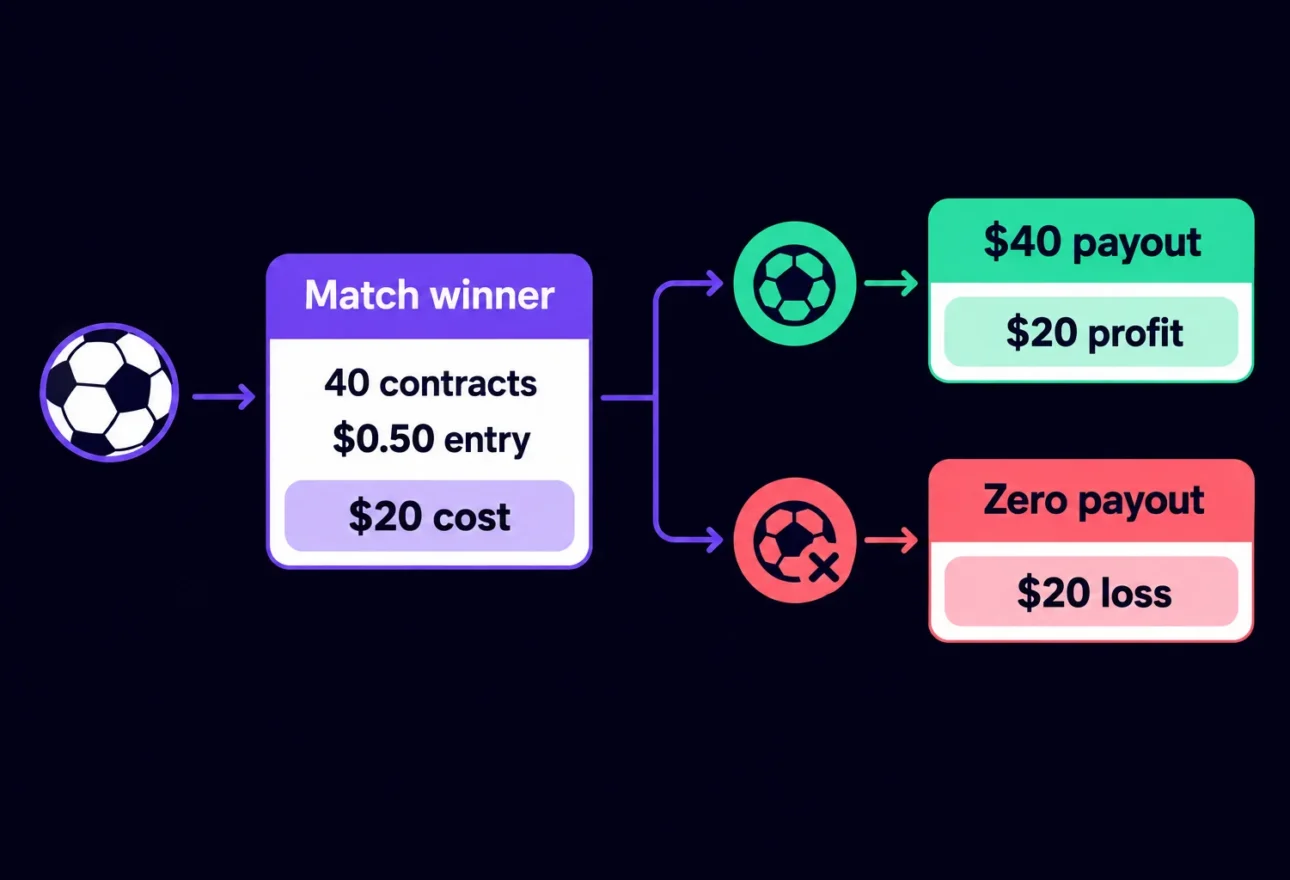
Example: a $1,000 account trading a football match-winner contract. For this worked calculation, each purchased contract pays $1 if the selected outcome occurs and $0 otherwise. The entry price is $0.50, and 40 contracts cost $20. Fees are excluded from the arithmetic and must be allowed for separately.
- Purchase cost: 40 contracts × $0.50 = $20.
- Potential winning payout: 40 contracts × $1 = $40.
- Profit on winning settlement: $40 payout − $20 cost = $20 before fees.
- Loss on zero settlement: $20 cost − $0 payout = $20 before fees.
The $40 payout is neither the amount committed nor the profit. As the Kalshi Help Center explains, position details can show quantities, purchase prices and potential payouts, but profit or loss also depends on purchase cost and fees. In this purchased-contract example, the full purchase cost is at risk if the contract settles at zero.
How do OddsFantasy’s three risk limits work together?
Every OddsFantasy funded account has the same three risk rules. They answer different questions, so passing one does not replace checking the others.
- 2% maximum position size: does this individual position fit the account’s limit?
- 25% maximum exposure: does the combined exposure fit after adding the position?
- 10% maximum drawdown: could losses push the account beyond its permitted decline?
For the calculations below, use $1,000 as a fixed reference balance and purchase cost as the position-size and exposure measure. That produces a $20 individual-position ceiling, a $250 exposure ceiling and a $100 drawdown amount. These are teaching assumptions, not a specification of how the platform measures those limits. OddsFantasy funded accounts are governed by the Terms and Conditions published at trade.oddsfantasy.com; consult them for the applicable sizing basis, exposure treatment and drawdown calculation.
At that reference balance, twelve separate $20 positions total $240. A thirteenth would bring exposure to $260, above the $250 ceiling. But even the twelve-position portfolio could lose more than the $100 drawdown allowance if those purchased contracts all settled at zero. Exposure capacity is not permission to risk that entire amount.
How do you calculate the remaining drawdown allowance?
Drawdown is the decline from a previous peak to a later trough. The CFA Institute’s explanation of maximum drawdown also notes that measurement frequency affects measured drawdowns. That makes a closing-balance check an incomplete substitute for understanding the account’s monitoring rules.
Within our fixed-reference example, suppose the relevant peak is $1,000 and the drawdown floor is $900. If current account value is $930, the remaining allowance is $30: current value minus the floor. The original $100 allowance is no longer available because $70 has already been used.
Do not confuse cash with portfolio value. Kalshi defines portfolio value as cash plus the displayed value of positions and warns that displayed position value is not a guaranteed selling amount. Open positions can change the displayed total without changing the cash balance. When assessing risk, review both the account’s official measurement and the prices at which positions could actually be reduced.
How much can you trade when only $30 of drawdown room remains?
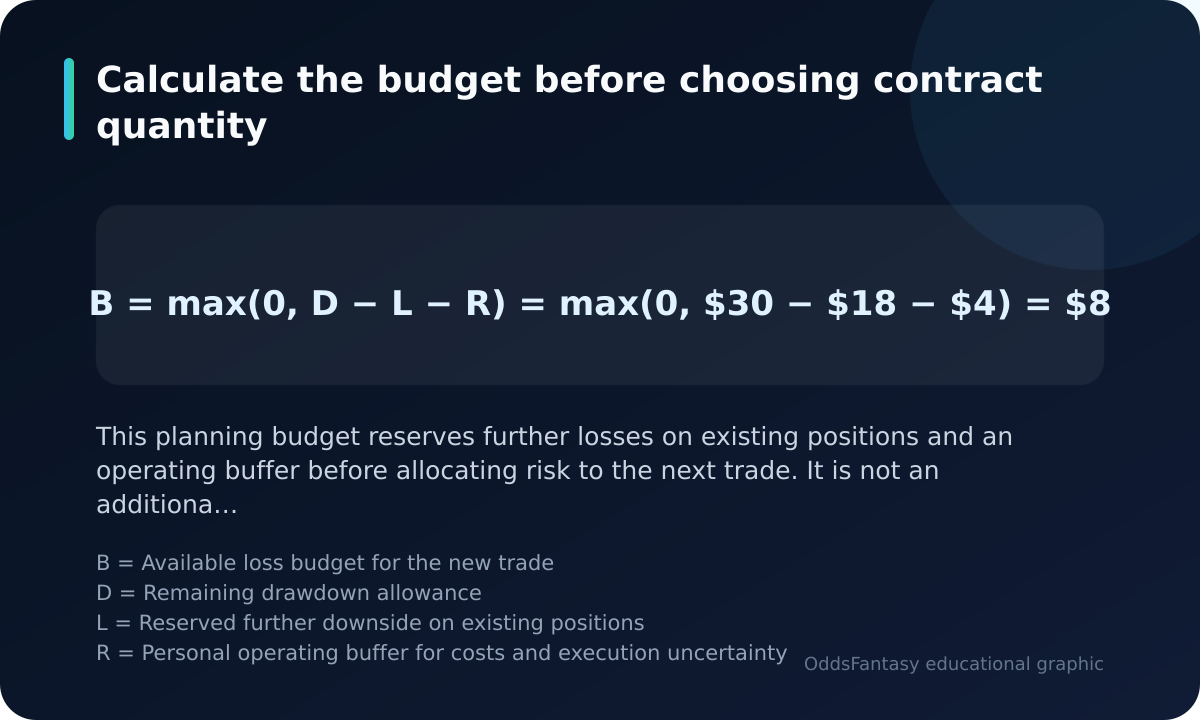
Continue the $1,000 account example at a current value of $930. Existing purchased contracts have $18 of displayed value and could lose that entire remaining value. Reserve $4 as a personal operating buffer for costs and execution uncertainty. This buffer is a sizing choice, not an additional OddsFantasy rule.
- Start with $30 of remaining drawdown allowance.
- Reserve $18 for further losses on existing positions.
- Reserve the $4 operating buffer.
- The new trade’s loss budget is $30 − $18 − $4 = $8.
At $0.50 per contract, buy no more than 16 contracts under this budget: 16 × $0.50 = $8. A zero settlement loses $8 before fees. If the existing positions also lose $18, account value falls from $930 to $904, leaving the planned $4 buffer above the $900 floor.
The individual-position ceiling still permits $20 under our reference assumptions. Exposure also has ample room: $250 − $18 = $232. Neither is the binding constraint. Remaining drawdown capacity makes $8 the tighter ceiling, and known costs may require sizing below it.
Buying the full $20 would instead create $38 of combined further downside: $18 already open plus $20 new. A joint zero settlement would take account value to $892 before fees, below the example’s floor. The new position passes the 2% size check but fails the portfolio loss check.
What formula helps you choose the smaller position?
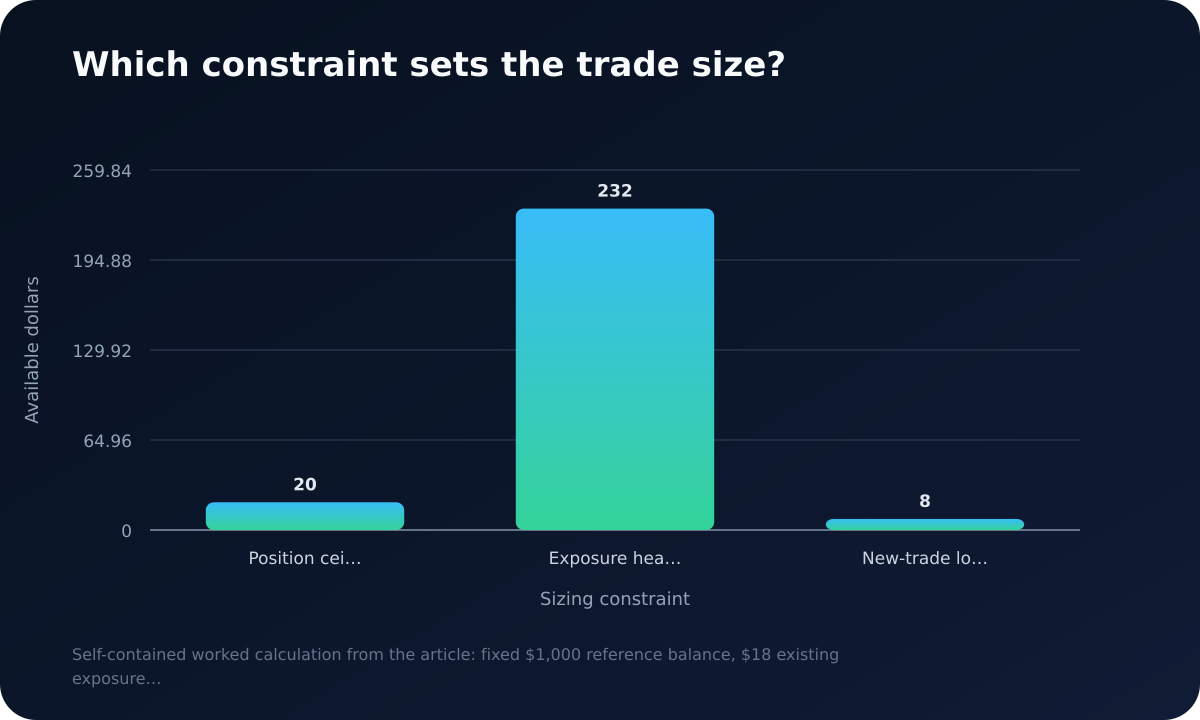
For purchased contracts that can lose their entire cost, a conservative planning ceiling is the smallest of three amounts: the individual-position ceiling, remaining exposure capacity, and remaining drawdown allowance after reserving existing downside and a buffer. If the last amount is zero or negative, this method leaves no budget for a new position.
For a contract price p, divide the allowed purchase cost by p and round down to a whole contract. In the example, $8 ÷ $0.50 = 16 contracts. Rounding down matters whenever the division produces a fraction; rounding up would exceed the budget.
Can a planned early exit justify a larger position?
Not by itself. Suppose the original 40-contract position is bought at $0.50 and you intend to exit at $0.40. The planned price loss is 40 × $0.10 = $4 before fees. That is an exit estimate, not a guaranteed maximum loss: the displayed price may not be obtainable, and the contract can ultimately settle at zero.
Keep intended exit loss and adverse-case loss separate. A sizing plan that only works if every exit fills at the expected price is fragile. Use a loss assumption that reflects the contract, available liquidity and ability to execute, without treating a planned exit as guaranteed protection.
Why do related sports positions need a joint loss check?
Different market names do not guarantee independent risk. A football match-winner position and a related team-performance position can both suffer when that team underperforms. Check a plausible adverse match scenario across the portfolio, rather than assessing each ticket in isolation.
For purchased contracts, reserve their full remaining value when a joint zero settlement is plausible. Do not assume one position will offset another unless the actual settlement conditions support it. If existing downside already consumes the remaining allowance, consider reducing exposure rather than adding another small trade.
What should you check before submitting an order?
- Read the current account value, applicable drawdown boundary and remaining allowance.
- Check the proposed position against the 2% maximum.
- Add it to existing exposure and check the 25% maximum.
- Estimate further losses across existing and proposed positions together.
- Allow for fees and execution uncertainty, then round quantity down.
- Recheck after material price changes or another filled order.
How does this fit an OddsFantasy funded account?
OddsFantasy funded accounts start instantly on simulated capital, with no evaluation challenge. Account sizes range from $150 to $10,000, and every size uses the same risk limits. Traders who stay within the rules and trade consistently move up to live capital on prediction markets, where they keep up to 90% of generated profits as performance rewards.
Every account includes the trading terminal and full education library. The $1,000 funded account and larger accounts also include AI-assisted trading, Positive EV signals and premium support. Those tools do not change the sizing task: a promising trade still needs to fit the account’s remaining loss capacity.
Frequently asked questions
Does a 2% maximum position size mean every trade should use 2%?
No. The 2% rule is a maximum, not a target. Remaining exposure capacity, existing downside and remaining drawdown allowance may require a smaller position or no new trade.
Is potential payout the same as position size?
No. In the article’s example, 40 contracts bought at $0.50 cost $20 and can pay $40 at winning settlement. The profit is $20 before fees, not $40. Use the account’s applicable sizing rules rather than the payout figure.
Can I use the full 25% exposure allowance?
The exposure ceiling does not override the 10% maximum drawdown rule. Before increasing exposure, estimate how much existing and proposed positions could lose together and compare that loss with the remaining drawdown allowance.
What should I do when my drawdown allowance is nearly used?
Recalculate the loss budget after reserving downside on existing positions and allowing for costs. If no positive budget remains, do not add risk under this method. Consider reducing existing exposure rather than relying on a new trade to recover losses.
Do OddsFantasy funded accounts start with live capital?
No. OddsFantasy funded accounts are instant, have no evaluation challenge and start on simulated capital from day one. Traders who stay within the rules and trade consistently move up to live capital on prediction markets, with up to 90% performance rewards on profits generated.
Sources
- Kalshi Help Center: Portfolio: Balances and Positions | Kalshi Help Center
- CFA Institute: Sculpting Investment Portfolios: Maximum Drawdown and Optimal Portfolio Strategy – CFA Institute Daily Browse
- NFA: Rules | NFA
Trade responsibly: only trade what you can afford to lose. 18+.