


An algo trading prop firm is suitable only if it explicitly permits your automation method, supports your intended markets and execution access, and has risk rules your system can enforce before submitting orders. A bot-compatible tool does not, by itself, establish permission to automate a funded account.
For sports and prediction-market traders, the decision has three layers: permission, execution and risk. Check them in that order before paying a fee or connecting software. A strategy that passes a backtest can still be unusable if its order route is prohibited or its exposure cannot be controlled.
Does the funded program permit your exact automation method?
Start with the funded program’s rules, not the software’s feature list. Automated analysis, suggested orders and unattended execution are different activities. Permission to receive a signal does not necessarily include permission for software to place, amend or cancel a position.
- Describe the workflow: what generates the signal, who approves it and what submits the order.
- Ask whether bots, custom scripts, browser automation and third-party execution tools are permitted.
- Check strategy restrictions separately, including copying third-party positions, latency-based execution and arbitrage.
- Confirm whether permission covers simulated accounts, live-capital accounts and every market you intend to trade.
- Keep the applicable rule text and written clarification with your deployment records.
A useful support question is specific: “May my software submit and cancel orders automatically using this connection, for my own strategy, in these markets?” If the answer only confirms that an analysis tool is available, the execution-permission question remains unanswered.
Are the markets your strategy needs actually supported?
“Sports trading” is not a complete market specification. Identify the event type, contract, trading window and settlement conditions your model expects. A football totals strategy and an event-outcome prediction strategy need different inputs; neither should be deployed against a superficially similar contract without checking its terms.
- Market coverage: confirm the specific sports, competitions or prediction-event categories you need.
- Trading window: establish whether your workflow requires pre-event trading, in-play trading or both.
- Contract interpretation: verify outcome wording, settlement conditions and treatment of disrupted events.
- Usable capacity: test whether available prices and executable size support the intended position size after costs.
Does execution access fit the strategy?
An automation permission is not an execution specification. Establish how orders reach the market and how your system learns what happened afterward. Do not assume that a trading terminal provides a public API, or that access available in one product also exists in a funded account.
- Connection: identify the approved interface and whether a third-party integration is allowed.
- Orders: check supported order types, cancellation behavior and any documented submission limits.
- State: determine how the system receives acknowledgments, rejections, partial fills and completed fills.
- Recovery: establish how it reconciles open positions after a disconnect or restart.
- Costs: include applicable fees and price slippage in the decision to submit an order.
Test ambiguous responses carefully. If an order request times out, sending it again without checking its status can create duplicate exposure. Your deployment plan should explain how the system distinguishes an unfilled request from a filled order whose acknowledgment was lost.
Can the system enforce risk limits before sending orders?
Risk checks should block an unacceptable order, not merely report it afterward. The SEC’s market-access guidance describes automated pre-trade controls for excessive exposure and erroneous orders, including duplicate orders. That guidance concerns broker-dealers with securities market access; it does not determine a sports funded program’s automation permissions. Its preventive-control principle is nevertheless useful when designing your checklist.
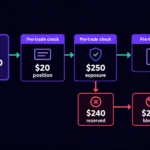
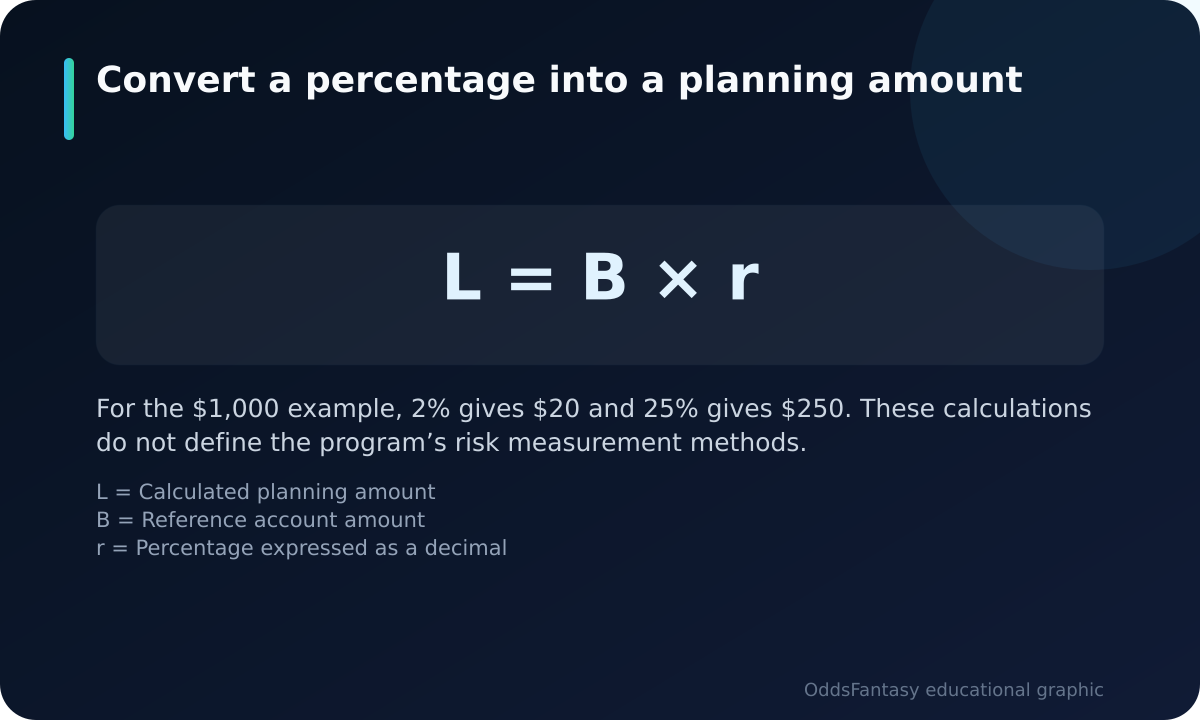
Example: a $1,000 OddsFantasy funded account. Every OddsFantasy funded account has a 2% maximum position size, a 25% maximum exposure and a 10% maximum drawdown. Applying those percentages to the starting account size gives these planning reference amounts:
- 2% of $1,000 is $20.
- 25% of $1,000 is $250.
- 10% of $1,000 is $100.
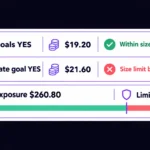
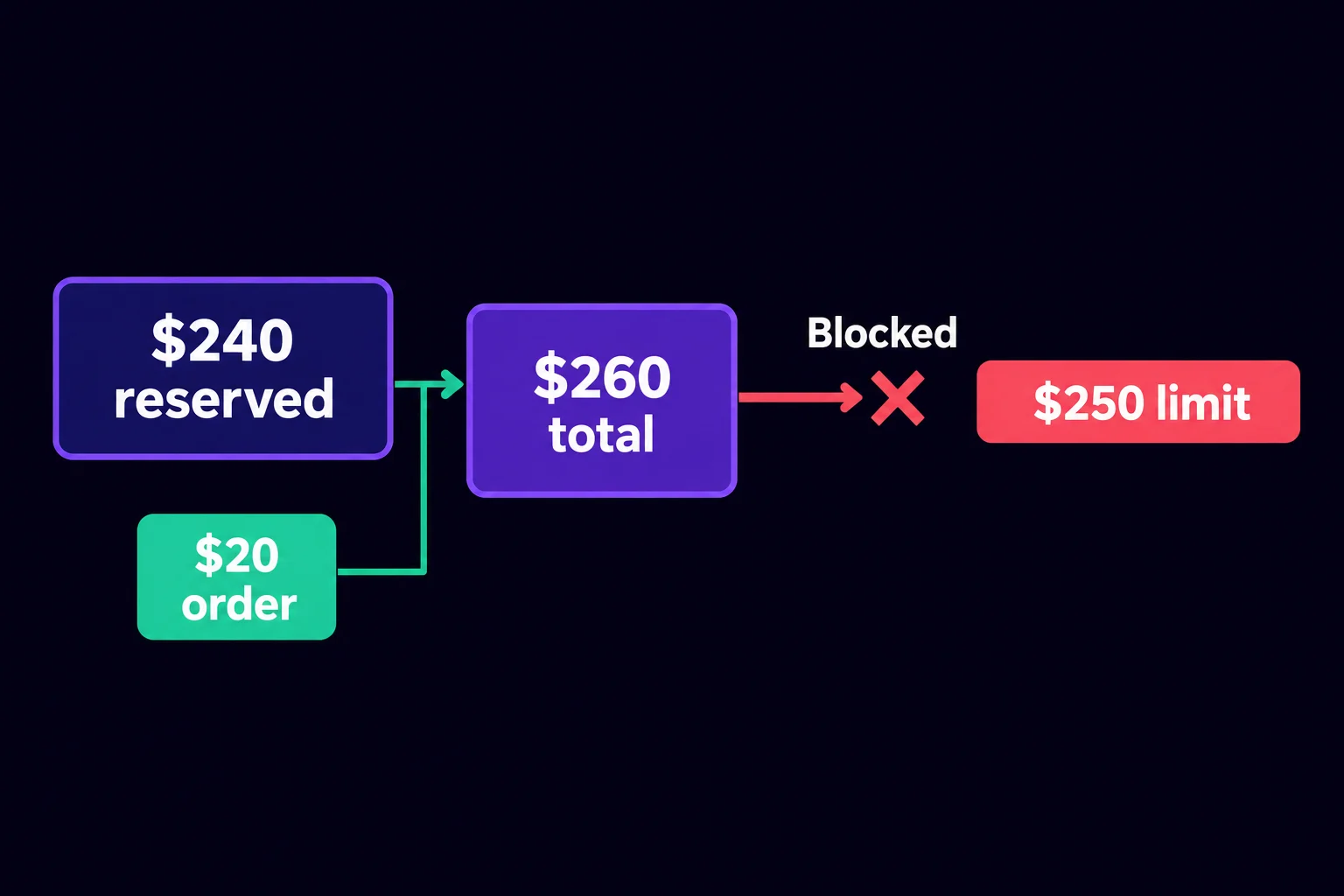
For a conservative internal reservation check, twelve $20 positions total $240; another $20 would raise that total to $260, above $250. Reserve capacity for orders awaiting confirmation so separate processes cannot each spend the same remaining allowance. This reservation method is a proposed software safeguard, not a statement of the program’s exposure calculation.
The $100 drawdown reference is not a daily loss budget or permission to risk that amount on one trade. Use the Terms and Conditions published at trade.oddsfantasy.com for governing definitions, including how drawdown is calculated. Build your controls around those definitions rather than an assumed balance formula.
What should a pre-trade check do?
- Refresh account and order state; stop new submissions if either is stale or unresolved.
- Check the proposed position size against the applicable limit.
- Check total exposure while reserving capacity for pending orders.
- Check remaining drawdown capacity using the program’s governing definition and an internal buffer.
- Reject duplicate or invalid requests, record the reason and provide a manual stop for new orders.
How should you test automation before deployment?
Test operational failures as deliberately as strategy logic. ESMA’s supervisory briefing on algorithmic trading addresses pre-trade controls, governance, testing and outsourcing, with considerations for AI. It is a nonbinding supervisory tool concerning MiFID II, not a permission framework for every funded program.
Your test set should include stale prices, rejected orders, partial fills, delayed cancellations, duplicate signals and connection loss. Also test a restart while positions remain open. Use a simulator or other permitted testing environment; do not assume that a simulated funded account authorizes experimental automation.
Define pass conditions before testing: no duplicate submissions, no orders above internal limits and no resumed trading until uncertain positions are reconciled. Keep logs of signals, risk decisions, submissions and fills. These records help distinguish a strategy problem from an execution failure; a profitable test alone does not establish operational safety.
How do OddsFantasy funded accounts and automation tools differ?
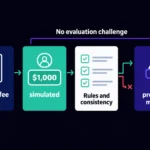
OddsFantasy funded accounts are instant, with no evaluation challenge: traders start on simulated capital from day one. Account sizes range from $150 to $10,000. OddsFantasy moves traders who stay within the account rules and trade consistently up to live capital on prediction markets, where they keep up to 90% of generated profits as performance rewards.
Every funded account includes the trading terminal and full trading education library. The $1,000 funded account has a one-time platform fee of $99.99; that size and larger also include AI-assisted trading, Positive EV signals and premium support. AI-assisted trading should not be read as blanket permission for unattended execution.
The Sports Trading Tools Suite is a separate subscription costing $79.99 monthly or $499.99 annually. It includes the AI Trading Agent: a trader sets their rules once, and the agent trades them automatically. The suite also includes Positive EV and arbitrage tools, calculators, simulators, market analysis, risk utilities and an analytics dashboard.
That automation capability describes the Tools Suite, not permission to connect it to any funded program. Before combining products, establish whether the intended account permits the agent, supports its execution route and allows the strategy. A scanner finding an opportunity does not establish that the funded account permits the corresponding trade.
What should you confirm before paying?
Require a clear answer on five points: your automation method is permitted; your markets are supported; the execution connection is approved; your system can enforce the risk definitions; and your failure tests pass. If permission or access remains unclear, resolve it before purchase. If risk enforcement fails, revise the system before deployment rather than relying on manual intervention after a breach.
Frequently asked questions
What should I look for in an algo trading prop firm?
Look for explicit permission for your execution method, supported markets, an approved order connection and risk rules your software can enforce before submitting orders. Check strategy restrictions separately from general bot permission.
Does access to an AI trading tool mean a funded account allows automation?
No. A tool’s capabilities and a funded program’s permissions are separate. The OddsFantasy Tools Suite includes an AI Trading Agent for automatic execution, but that capability does not establish permission to use it with any funded account.
Can I assume an API is available if automated trading is allowed?
No. Confirm the approved interface, supported order actions, status reporting and recovery behavior. Do not assume that a terminal or automation feature includes public API access.
What are OddsFantasy’s funded-account risk limits?
Every OddsFantasy funded account has a 2% maximum position size, a 10% maximum drawdown and a 25% maximum exposure. Automated safeguards must use the governing account definitions rather than assumed calculation methods.
Is the OddsFantasy Sports Trading Tools Suite refundable?
The Sports Trading Tools Suite can be refunded in full within 7 days of the first payment. Renewals can be cancelled at any time from My Account. These are Tools Suite terms, not funded-account refund terms.
Sources
- Omen Help Center: Algorithmic Trading and API Access | Omen Help Center
- P1 Prop Markets: Can I use Expert Advisors (EAs), bots, or automated trading? | P1 Help Center
- U.S. Securities and Exchange Commission: SEC.gov | Responses to Frequently Asked Questions Concerning Risk Management Controls for Brokers or Dealers with Market Access
- European Securities and Markets Authority (ESMA): ESMA issues a supervisory briefing on algorithmic trading
Trade responsibly: only trade what you can afford to lose. 18+.