

EOD maximum drawdown in a prop firm usually means the trailing loss threshold updates from the account’s end-of-day balance rather than every intraday equity high. It does not, by itself, tell you whether an intraday loss can breach that threshold: updating the floor and checking for breaches are separate rules.
For sports and prediction-market traders, that distinction matters while positions remain open. Start with our broader guide to prop firm drawdown rules if you need the basics; here, the focus is the timing of calculation and enforcement.
What is maximum drawdown, and what is a drawdown floor?
Maximum drawdown measures the greatest cumulative loss from a peak to a subsequent trough over a specified period, as defined by CFA Institute. A funded-account drawdown rule turns a permitted loss into an operating boundary. Understanding that boundary requires three separate definitions:
- Balance is the account value after realized gains and losses; equity also reflects unrealized gains and losses on open positions.
- The high-water mark is the highest qualifying account value recorded under the program’s measurement rules.
- The drawdown floor is the minimum account value permitted by the rule. Whether touching it or falling below it causes a breach depends on the terms.
How does an EOD trailing drawdown calculation work?
Example: a $1,000 account has a fixed $100 trailing drawdown allowance, with no stop-trailing cap. This is a generic rule comparison, not an explanation of OddsFantasy’s drawdown calculation. The initial high-water mark is $1,000, so the initial floor is $900.
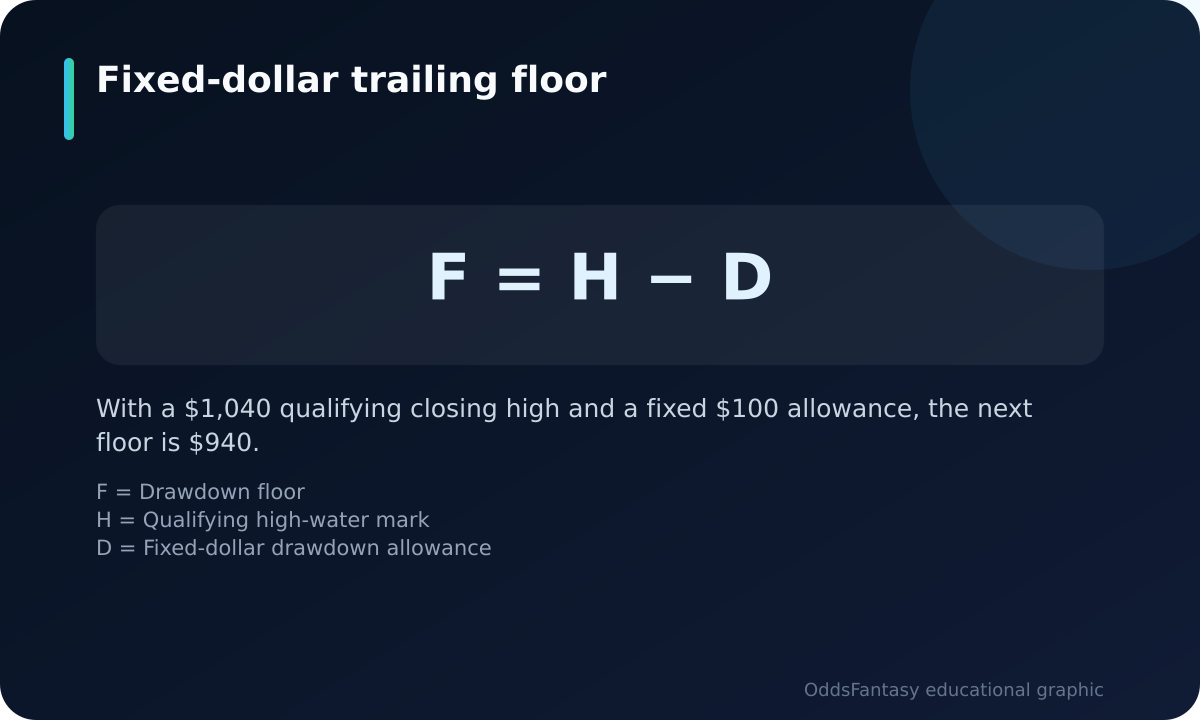
For this fixed-dollar trailing model, the drawdown floor equals the qualifying high-water mark minus the drawdown allowance. The EOD high-water mark is the highest eligible closing balance recorded so far, including the starting balance.
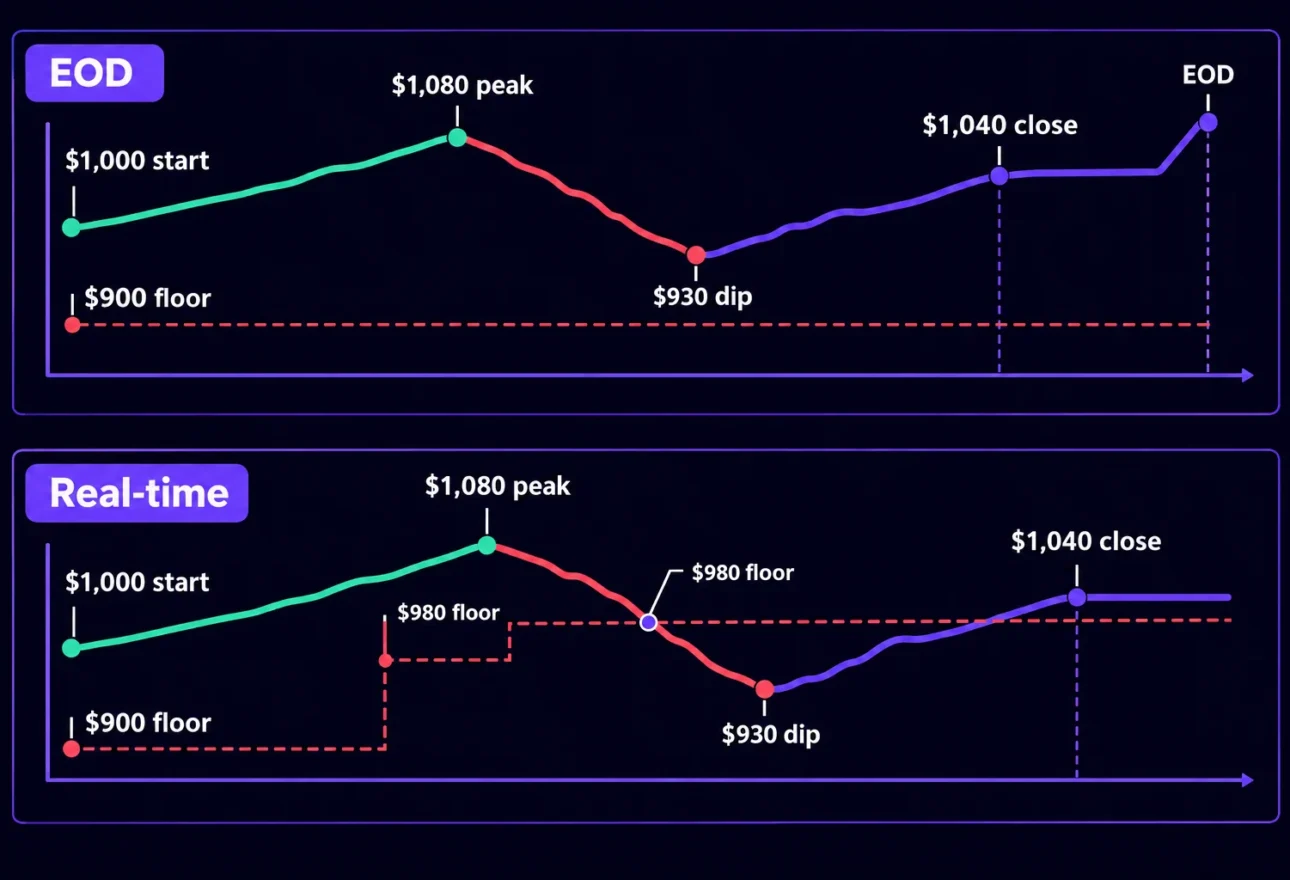
- The account starts at $1,000, with a $900 floor.
- Open positions lift equity to $1,080 during the session. Under the EOD update rule, the floor remains $900.
- Equity then falls to $930. That is still above the existing $900 floor.
- The account closes at $1,040. The qualifying high-water mark becomes $1,040, and the recalculated floor becomes $940.
The closing gain of $40 raises the floor by $40. In this trailing model, a later lower close does not lower the floor again. A rule based on a percentage of the changing high-water mark, or one with a stop-trailing cap, would require a different calculation.
How would intraday drawdown treat the same account?
With real-time trailing drawdown, the $1,080 intraday equity peak immediately raises the floor to $980. The subsequent fall to $930 crosses that floor. Under continuous enforcement, the account breaches before it can reach the planned $1,040 close.
NinjaTrader’s drawdown-mode documentation explains that real-time mode raises the high-water mark continuously, including unrealized profit, while EOD mode refreshes it once per session. An open-position gain can therefore tighten a real-time floor even when the trader never realizes that gain.
Does an EOD floor mean breaches are checked only at the close?
No. “EOD” can identify the floor’s update schedule without identifying the breach-monitoring schedule. Keep these two mechanisms separate when reading a rule:
- Threshold updating determines when a qualifying gain raises the minimum permitted account value.
- Breach monitoring determines when account balance or equity is tested against the active floor.
Continue the EOD example into the next session, with the $940 floor now active. Equity briefly falls to $930 and later closes at $1,010. If the rule continuously monitors equity against the active floor, the $930 dip breaches it. If the rule instead tests only the closing balance, the $1,010 close passes that test.
These are alternative enforcement policies, not two outcomes available to the same account. Under continuous enforcement, a later recovery does not undo the earlier breach. NinjaTrader’s documentation describes EOD mode as a single-floor model with terminal liquidation on breach, illustrating why an EOD update schedule should not be read as permission to cross the floor intraday.
Which closing time and account value count?
A session close is a defined account-rule event, not necessarily midnight or the final whistle. NinjaTrader’s documented EOD mode refreshes its high-water mark at the 4 PM CT close. That is a documented implementation, not a universal cutoff for funded sports or prediction-market accounts.
Identify the time zone, qualifying closing value and effective time of any revised floor. Also establish how open positions are valued at that boundary. A balance-based update and an equity-based breach check can coexist; knowing one does not establish the other.
How should traders plan around the active floor?
The useful number during a session is remaining headroom, not simply the original account size. In the example’s second session, equity of $1,000 against a $940 floor leaves $60 of headroom. That is not permission to risk $60: other limits and enforcement details still apply.
- Record the active floor before opening positions, rather than estimating it from yesterday’s profit.
- Calculate current headroom as the monitored account value minus the active floor.
- Assess combined losses across open positions, including positions tied to the same match or outcome.
- Leave room below your internal risk budget rather than planning to trade exactly at the account’s failure boundary.
Does OddsFantasy use an EOD drawdown model?
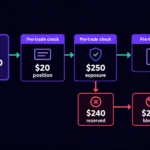
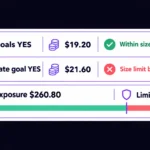
Do not assume OddsFantasy uses the generic EOD calculation above. Every OddsFantasy funded account has a 2% maximum position size, a 10% maximum drawdown and a 25% maximum exposure. For the drawdown calculation method, monitoring schedule and breach conditions, check the Terms and Conditions published at trade.oddsfantasy.com.
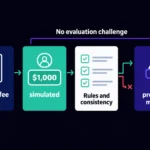
OddsFantasy accounts are instant, with no evaluation challenge: traders start on simulated capital from day one. Traders who stay within the account rules and trade consistently move up to live capital on prediction markets, where they keep up to 90% of generated profits as performance rewards.
The practical test is whether your trading plan fits the actual account rules—not whether the label “EOD” sounds more forgiving. Establish what raises the floor, what value is monitored and exactly when a breach occurs before putting on a position.
Frequently asked questions
Is EOD drawdown the same as a daily loss limit?
No. EOD describes a measurement or update schedule. A daily loss limit restricts losses over a defined day, while a trailing drawdown floor follows a qualifying high-water mark across sessions. Check whether an account applies either or both.
Can unrealized profits raise a drawdown floor?
Yes, under a real-time equity-based trailing rule. NinjaTrader’s documented real-time mode includes unrealized profit when updating the high-water mark. An EOD closing-balance model does not raise its floor merely because equity reaches a higher level during the session.
Can I breach an EOD drawdown rule before the day ends?
Yes, if the program continuously monitors equity against the active floor. An end-of-day threshold update does not necessarily mean end-of-day-only enforcement.
Does a losing day lower a trailing drawdown floor?
Not in the fixed-dollar high-water-mark model used in this article. A lower closing balance does not erase the previously recorded high-water mark, so it does not move the floor downward.
Is OddsFantasy’s 10% maximum drawdown necessarily EOD trailing?
No. The 10% maximum drawdown limit alone does not establish the reference value, update schedule or enforcement method. Read OddsFantasy’s Terms and Conditions for the applicable calculation and breach rules.
Sources
- Earn2Trade: How Does "End of Day Drawdown" Work? | Earn2Trade Help Center
- CFA Institute: An Upper Bound for an Ex Post Sharpe Ratio with Application in Performance Measurement (Digest Summary)
- NinjaTrader: Drawdown Modes | NinjaTrader Partner API
- Goat Funded Futures: What is a trailing drawdown? | Goat Funded Futures FAQ
- CFA Institute: Sculpting Investment Portfolios: Maximum Drawdown and Optimal Portfolio Strategy – CFA Institute Daily Browse
Trade responsibly: only trade what you can afford to lose. 18+.