

A sports betting prop firm should not be treated as legitimate simply because it advertises funded accounts or displays results. Before paying, verify who operates it, whether capital is simulated or live, exactly what the fee buys, and which rules govern access to performance rewards.
The practical question is whether the written agreement supports the marketing—and whether you can trade within it. OddsFantasy’s disclosed structure provides a concrete example to examine, not independent proof of legitimacy or a promise that an account will suit you.
What would establish that a funded trading offer is credible?
Look for agreement between the sales page, checkout, account rules and contractual terms. A credible-looking website is not enough. You should be able to identify the business taking payment, understand its service, find contact details and retain the terms you accepted.
Separate three questions: does the business exist, does it accurately describe the offer, and is the agreement suitable for your trading? A business can be identifiable while offering terms that do not fit your position sizes, available time or tolerance for losing the platform fee.
Does a sports betting licence verify a prop firm?
A licence claim must match the legal entity, activity and jurisdiction involved. The North Carolina Gaming Commission’s approved-licensees register lists licensed interactive sports betting operators and their licence numbers. That verifies the listed licensing information; it is not a general register approving every sports trading funded-account service.
If a firm claims regulatory approval, ask which authority issued it, which entity holds it and what activity it covers. Check the authority’s own record rather than relying on a badge. Neither a sportsbook licence nor the label “prop firm” should replace examining the actual service and contract.
Are you receiving simulated or live trading capital?
Ask what the displayed account balance represents from the first day. An account size alone does not establish that real money is being deployed, that you own that balance or that it is available to withdraw.
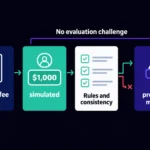
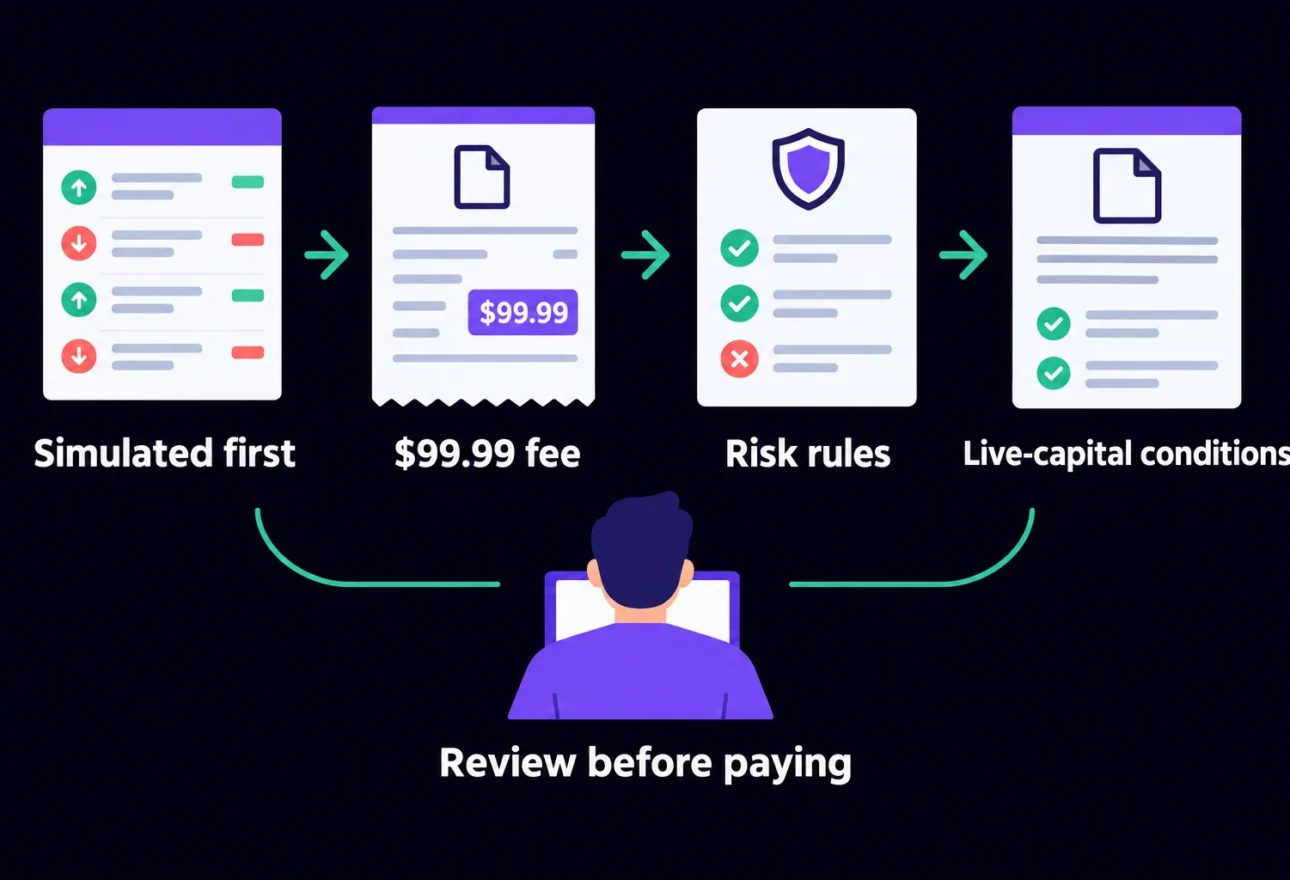
OddsFantasy funded accounts are instant, with no evaluation challenge, and traders start on simulated capital from day one. OddsFantasy moves funded traders who stay within the account rules and trade consistently up to live capital on prediction markets. On live capital, traders keep up to 90% of the profits they generate as performance rewards.
These are distinct stages. “Instant” describes the account start, not immediate live capital or immediate rewards. For any provider, establish what changes between stages, what conditions apply and where those conditions are recorded. Do not substitute an assumed timeline for a written commitment.
What does the platform fee actually buy?
Identify whether the advertised charge is one-time or recurring, what access it purchases, and whether any other charges apply. Read refund, cancellation and account-termination provisions before entering payment details. Do not assume that an unused account or a rule breach entitles you to a refund.
OddsFantasy’s funded accounts have the following account sizes and one-time platform fees:
- $150 account: $19.99.
- $1,000 account: $99.99.
- $2,000 account: $199.99.
- $5,000 account: $499.99.
- $10,000 account: $999.99.
Every account includes the OddsFantasy trading terminal and full trading education library. Accounts of $1,000 and larger also include AI-assisted trading, Positive EV signals and premium support. Those inclusions describe access, not evidence of future trading results.
How should you compare the fee with the account size?
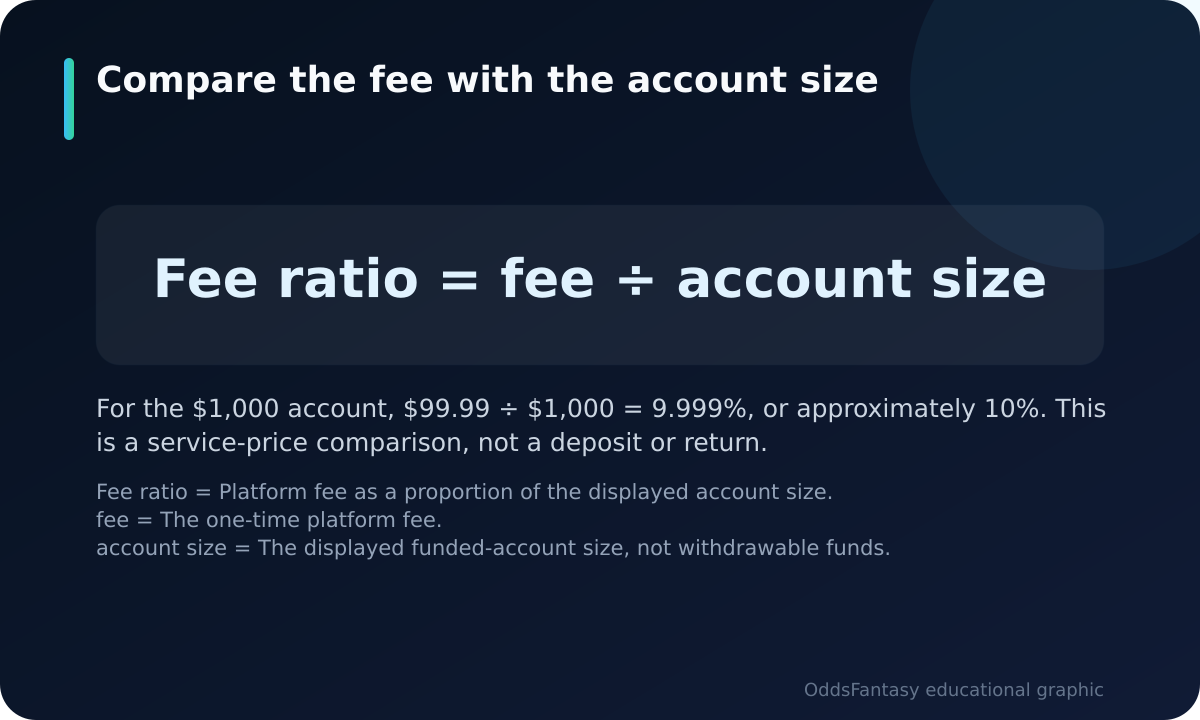
Example: a $1,000 account at OddsFantasy costs a $99.99 one-time platform fee. Dividing $99.99 by $1,000 gives 9.999%, approximately 10%. This ratio describes the access price relative to the displayed account size; it is not a deposit percentage, an expected return or a break-even trading target.
The $1,000 funded account therefore needs to be assessed as a paid service beginning with simulated capital, not as a purchase of $1,000 you can withdraw. Judge the fee against the service and restrictions you are actually accepting.
Which consumer guidance is relevant to fee disclosures?
The FTC’s subscription and free-trial guidance advises consumers to understand the agreement, trial length and cancellation process before signing up. It also says not to sign up when the offer information is missing or unclear. If an offer includes recurring charges, establish the amount, timing and cancellation method before supplying card details.
Keep legal scope clear. The FTC’s unfair or deceptive fees rule FAQ covers live-event tickets and short-term lodging—not sports trading prop firms as a category. Its requirements for upfront total prices and meaningful fee descriptions should not be presented as sector-specific legal protection here. Nevertheless, asking for the full price and purpose of each charge is sensible due diligence.
Can your trading stay inside the account restrictions?
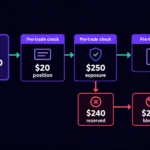
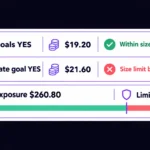
OddsFantasy applies the same risk rules to every funded account: a 2% maximum position size, a 10% maximum drawdown and a 25% maximum exposure. For the $1,000 example, those percentages correspond to $20, $100 and $250 respectively. They are separate limits, not interchangeable allowances.
Before paying any provider, establish how it measures position size, concurrent exposure and drawdown, and what happens after a breach. OddsFantasy accounts are governed by the Terms and Conditions published at trade.oddsfantasy.com; consult them for calculation details and contractual conditions rather than inferring them from percentage arithmetic.

Test your intended trading routine against the limits. List the positions you might hold simultaneously, including positions linked to the same event. If your routine only fits by assuming that exposure will be ignored or losses will receive an exception, the account does not fit your plan.
What must happen before performance rewards are earned?
A headline reward share is incomplete without its eligibility conditions. Separate the percentage from the basis used to calculate it, the stage at which it applies, and the conduct required to remain eligible. “Up to” expresses a ceiling, not an unconditional entitlement.
For OddsFantasy, the stated reward share is up to 90% of profits generated on live capital. Do not apply that percentage to a simulated balance or treat simulated gains as money owed. If a reward condition is unclear, obtain clarification before paying rather than building an income plan around an assumption.
How should you assess reviews and performance screenshots?
The FTC recommends researching reviews across multiple sources and searching a company’s name alongside terms such as “scam” or “complaint.” Read for specific, checkable issues: unexpected charges, conflicting rules or unresolved questions. Neither a complaint nor a favourable testimonial alone settles legitimacy.
For performance claims, ask whether results are actual or hypothetical, which costs and execution assumptions are included, and what period is shown. A screenshot without those details cannot establish repeatability or your likely outcome.
The NFA’s guidance on hypothetical performance explains that hypothetical results are not actual trading and can be affected by hindsight, liquidity and slippage assumptions. Its requirements concern specified NFA Members and Associates, not every sports trading firm. As an assessment standard, look for material assumptions and nearby, prominent explanations—not a distant disclaimer.
What should you save before paying?
- Save the offer, account description, fee breakdown and checkout total.
- Retain the applicable terms, including capital stages, risk restrictions and reward conditions.
- Get written answers to material questions about charges, cancellation or account consequences.
- Check the business identity and any claimed licence against the relevant official record.
- Walk away if important terms remain missing, contradictory or incomprehensible.
Pay only when you understand both the service and the reasons you could lose access to it. Clear disclosures make a decision possible; they do not guarantee trading success or remove the risk of paying for an unsuitable account.
Frequently asked questions
Are sports betting prop firms the same as licensed sportsbooks?
Do not assume they are. A sportsbook licence covers the entity and activity identified by the relevant authority. A funded trading offer must be assessed separately, including its capital structure, fees, restrictions and contract.
Does an instant funded account mean immediate live capital?
Not necessarily. OddsFantasy instant funded accounts have no evaluation challenge and start on simulated capital from day one. Traders who stay within the account rules and trade consistently move up to live capital on prediction markets.
Is the OddsFantasy platform fee a trading deposit?
The stated charge is a one-time platform fee for the funded account service. The displayed account size should not be treated as money you own or can withdraw. Accounts begin with simulated capital.
Do performance screenshots prove a firm is legitimate?
No. Establish whether results are actual or hypothetical, which assumptions and costs they include, and whether they relate to the service being offered. Screenshots do not replace checking the business and its written terms.
What should I do if the account terms are unclear?
Ask for written clarification before paying. If material terms about fees, cancellation, capital, risk restrictions or reward eligibility remain missing or contradictory, do not sign up.
Sources
- Federal Trade Commission: Getting In and Out of Free Trials, Auto-Renewals, and Negative Option Subscriptions
- Federal Trade Commission: The Rule on Unfair or Deceptive Fees: Frequently Asked Questions
- North Carolina Gaming Commission: Approved Licensees – ncgaming.gov
- NFA: Rules | NFA
Trade responsibly: only trade what you can afford to lose. 18+.