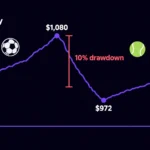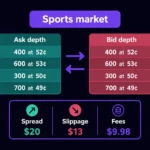


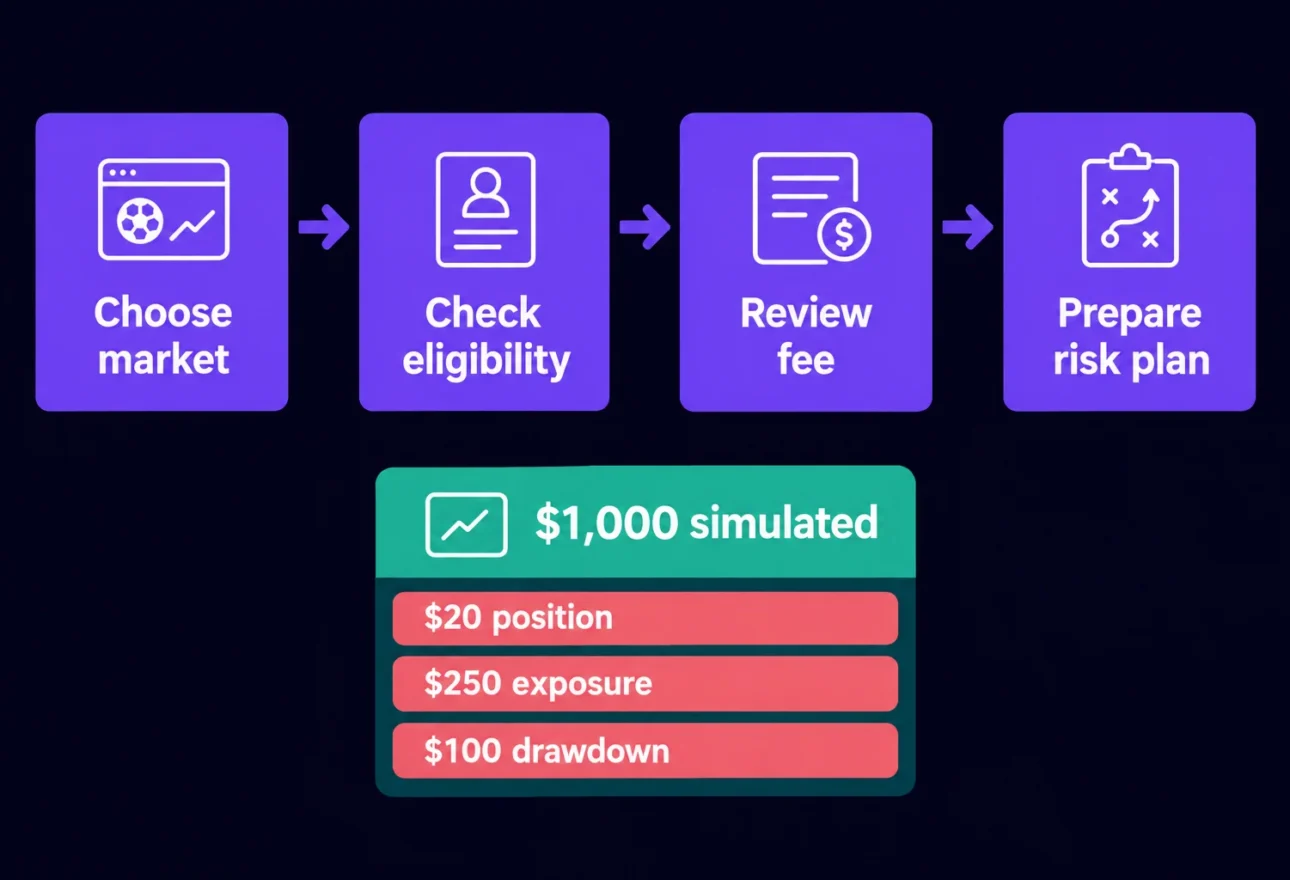
To get a funded trading account, choose a program that supports your markets, check eligibility and fees, and prepare a risk plan before applying. At OddsFantasy, instant accounts start with simulated capital—not immediate live funding—with a 2% maximum position size, 10% maximum drawdown and 25% maximum exposure.
The practical goal is not simply to obtain access. It is to choose an account whose rules you can follow through ordinary losses, uncertain markets and tempting opportunities. Work through the following steps before paying a fee or opening your first position.
1. Which markets do you actually want to trade?
Start with the market, not the advertised account size. A sports trader needs to understand the event, the traded outcome and the settlement conditions. A prediction-market trader also needs to identify exactly what resolves the contract, rather than relying on its headline.
The CFTC’s guide to prediction markets explains that event contracts can hedge risks or speculate on outcomes, and that contract prices reflect traders’ perceived probabilities. A market price is therefore an expression of expectations, not confirmation that an outcome will happen.
- Choose a narrow starting market, such as one sport and one clearly defined contract type.
- Read the settlement conditions, including how postponements, cancellations or disputed outcomes are handled.
- Decide when you can monitor positions and what would make you close or avoid a trade.
- Check that the program supports the markets and trading approach you intend to use.
Do not confuse a funded program with a brokerage margin account. FINRA’s explanation of margin requirements says margin trading requires a margin account and the broker’s minimum deposit. Those are brokerage requirements, not an explanation of how an OddsFantasy funded account works.
2. Do you need to pass an evaluation?
Separate an evaluation route from instant access before comparing fees. With an evaluation, read every passing condition: a profit target may be only one requirement. With instant access, find out whether the starting capital is simulated or live and what conditions govern any later transition.
What should you check in an evaluation?
Consider an evaluation rule set requiring five separate qualifying trading days, with the largest profitable day no more than 40% of net evaluation profit and no calendar-day deadline. Under those conditions, reaching the profit target alone does not pass the evaluation. The qualifying-day and consistency requirements must also be satisfied.
Translate each condition into a practical question: What makes a day qualify? How is net evaluation profit calculated? Could one unusually profitable day leave the consistency requirement unmet? A lack of a calendar deadline removes a time limit; it does not remove the other conditions.
How is OddsFantasy’s instant route different?
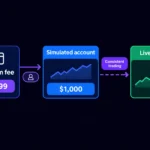
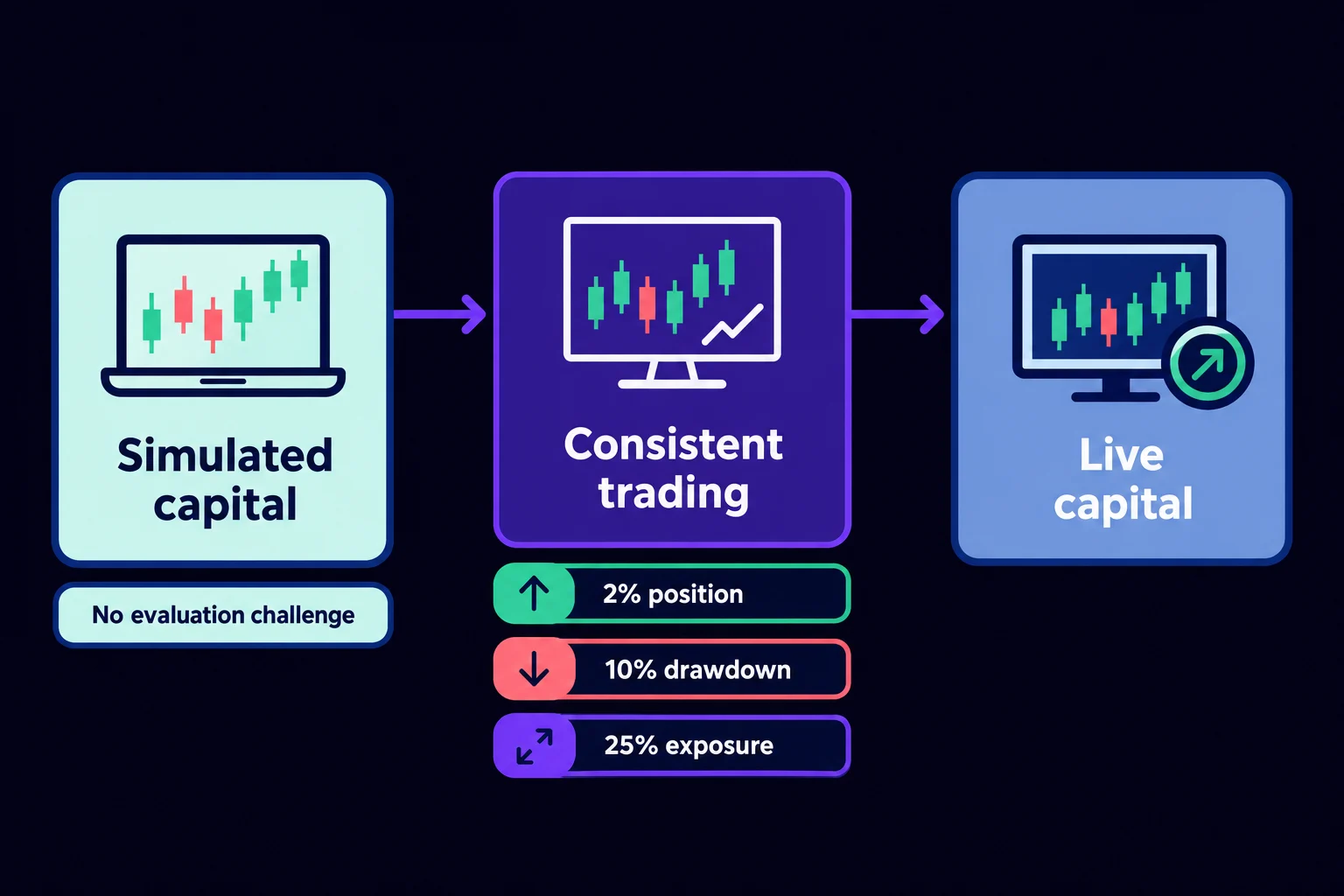
OddsFantasy funded accounts have no evaluation challenge. Traders start on simulated capital from day one. OddsFantasy moves funded traders who stay within the account rules and trade consistently up to live capital on prediction markets. On live capital, traders keep up to 90% of the profits they generate as performance rewards.
Instant describes access to the simulated funded account. It does not mean immediate live capital, guaranteed progression or guaranteed rewards. This distinction matters when deciding whether the program matches your expectations.
3. What eligibility checks should you complete?
Before paying, confirm the stated minimum age, whether access is permitted where you live, and which personal information the application requires. Check whether identity documents may be requested. These are separate questions from whether you understand the market or can afford the fee.
Use accurate personal information and be ready to complete document verification if requested. Do not assume that access to a website proves eligibility, or that approval for one service establishes eligibility for another. If an eligibility point is unclear, resolve it before proceeding rather than testing it after payment.
4. What does the account cost?
OddsFantasy offers five funded account sizes, each with a one-time platform fee. Compare the fee with the amount you can comfortably spend on access—not with profits you hope to generate.
- $150 account: $19.99 one-time platform fee.
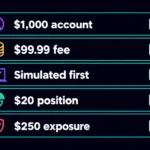
- $1,000 account: $99.99 one-time platform fee.
- $2,000 account: $199.99 one-time platform fee.
- $5,000 account: $499.99 one-time platform fee.
- $10,000 account: $999.99 one-time platform fee.
Every account includes the OddsFantasy trading terminal and full trading education library. Accounts of $1,000 and above also include AI-assisted trading, Positive EV signals and premium support. Compare the options on the OddsFantasy funded accounts page. These tools support your process; they do not remove trading risk.
The account size is not cash available to withdraw, and the platform fee is not a personal trading balance. Keep those amounts separate in your budget. The CFTC also advises traders to understand how fees and other costs affect returns and to use only risk capital left after living expenses and savings needs.
5. Can your risk plan fit the account rules?
Every OddsFantasy funded account has a 2% maximum position size, a 10% maximum drawdown and a 25% maximum exposure. These are ceilings, not targets. Before opening positions, write down a smaller operating size and an exposure buffer that leave room for mistakes and adverse outcomes.
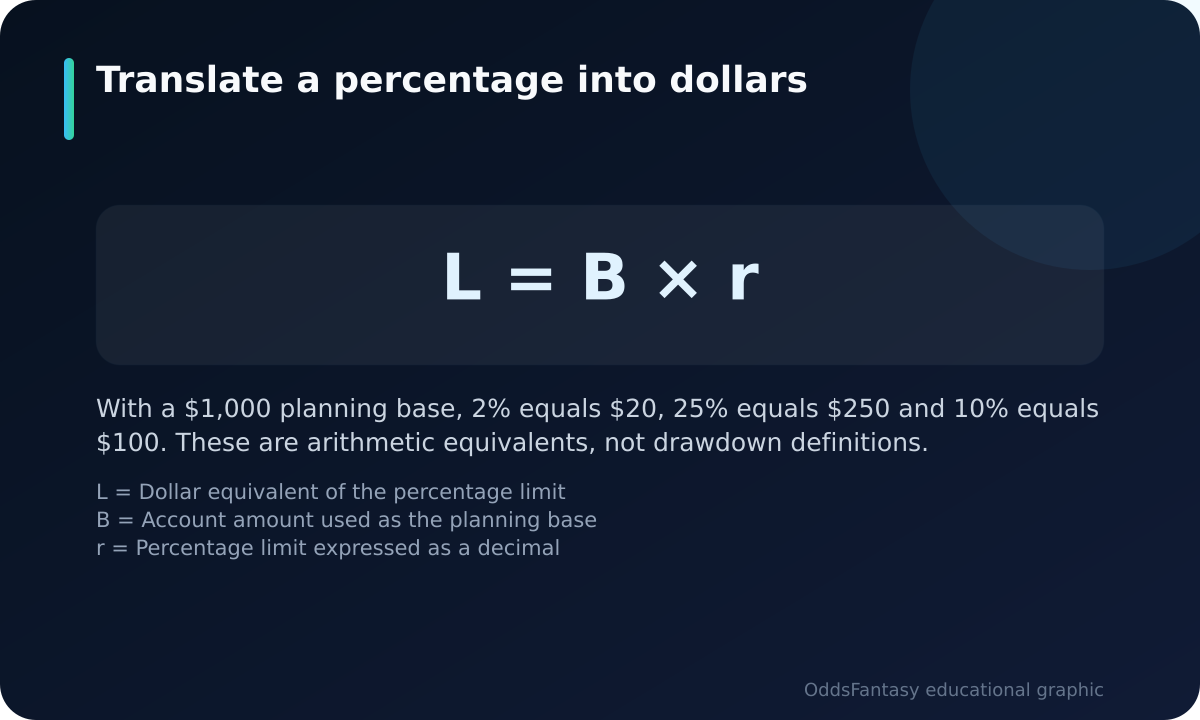
Example: a $1,000 account. Using $1,000 as a planning base, 2% equals $20, 25% equals $250 and 10% equals $100. These calculations translate percentages into dollars; they do not establish how the platform measures position size, exposure or drawdown. Read the Terms and Conditions published at trade.oddsfantasy.com for those definitions and the governing rules.
Suppose your chosen operating position size is $10. Eight open positions total $80 in planned position amounts, or 8% of the planning base. That leaves more room than treating the $250 exposure ceiling as an amount you should use. Still, eight positions linked to the same event can be concentrated around one outcome.
- Set a normal position size below the maximum.
- Check total open exposure before adding another position.
- Review whether several positions depend on the same event or information.
- Choose a personal stopping point before the account’s drawdown limit.
- Write down what invalidates a trade and when you will review open positions.
6. What should you practise before your first position?
Paper trading lets you practise in a simulated environment based on real market conditions. Use it to learn order types, understand market dynamics and test your routine without risking trading capital on those practice positions. Simulation is useful preparation, but its behaviour can differ from live execution.
Practise the complete sequence: read the contract, record your reasoning, choose a size, check existing exposure, enter the order and review the result. Include a losing trade and a decision not to trade. The test is whether you can follow the process, not whether a short run produces a profit.
If you need the fundamentals first, the Beginner’s Guide to Data-Driven Sports Trading is a $14.99 PDF downloadable after checkout. It covers implied probability, positive EV strategies, risk management, position sizing, exposure, market psychology, market movement and common mistakes.
7. When are you ready to apply?
Apply when you can explain the market’s settlement rules, confirm your eligibility, afford the fee without relying on future rewards, and show a written plan that fits the account limits. For the OddsFantasy $1,000 funded account, that means understanding the $99.99 platform fee and simulated starting capital before purchasing.
Once you have access, begin with the routine you practised rather than increasing size to justify the purchase. Record positions, review rule compliance and keep exposure controlled. Obtaining the account is the administrative step; maintaining disciplined trading is the continuing task.
Frequently asked questions
Do I need to pass a challenge to get an OddsFantasy funded account?
No. OddsFantasy funded accounts have no evaluation challenge and start with simulated capital from day one. Traders who stay within the rules and trade consistently can move up to live capital on prediction markets.
How long does it take to get a funded trading account?
The route matters. An evaluation can require qualifying trading days as well as a profit target and consistency conditions. OddsFantasy provides instant access to simulated capital without an evaluation challenge; instant access does not mean immediate live funding.
Can I make $500 a day trading?
There is no guaranteed daily trading income. Results depend on positions, prices, costs and outcomes, and losses are possible. A fixed income target should not override position-size, exposure or drawdown limits.
Is there a 9-dollar funded account available?
OddsFantasy’s lowest-priced funded option is the $150 account with a $19.99 one-time platform fee. It starts with simulated capital and has the same percentage risk limits as the larger accounts.
Does a larger funded account have looser risk rules?
No. Every OddsFantasy funded account has a 2% maximum position size, 10% maximum drawdown and 25% maximum exposure. A larger account changes the account size and fee, not those percentage limits.
Sources
- U.S. Commodity Futures Trading Commission (CFTC): Understanding Prediction Markets and Event Contracts | CFTC
- Interactive Brokers: Paper Trading Account definition
- Kalshi Help Center: Signing Up as an Individual | Kalshi Help Center
- FINRA: Understanding the New Intraday Margin Requirements | Syndication
Trade responsibly: only trade what you can afford to lose. 18+.