

Maximum drawdown in trading is the largest percentage decline in account equity from a peak to a subsequent trough over a measured period. It describes losses already experienced; an account’s enforced maximum drawdown limit is a separate rule defining how much decline the program permits.
That distinction matters when choosing trading capital. A strategy’s historical 10% maximum drawdown does not establish how a funded account’s 10% limit works. For the broader rule-checking framework, start with Prop Firm Drawdown Rules: Does Your Risk Plan Fit?. Here, the focus is the measurement itself and why an identical percentage can describe different things.
How do you calculate maximum drawdown?
IBKR Campus defines maximum drawdown as the largest cumulative percentage decline in a portfolio’s net asset value from its peak to the lowest value that follows. The order matters: the peak must occur before the trough. Comparing the period’s highest and lowest values without checking their order can produce the wrong answer.
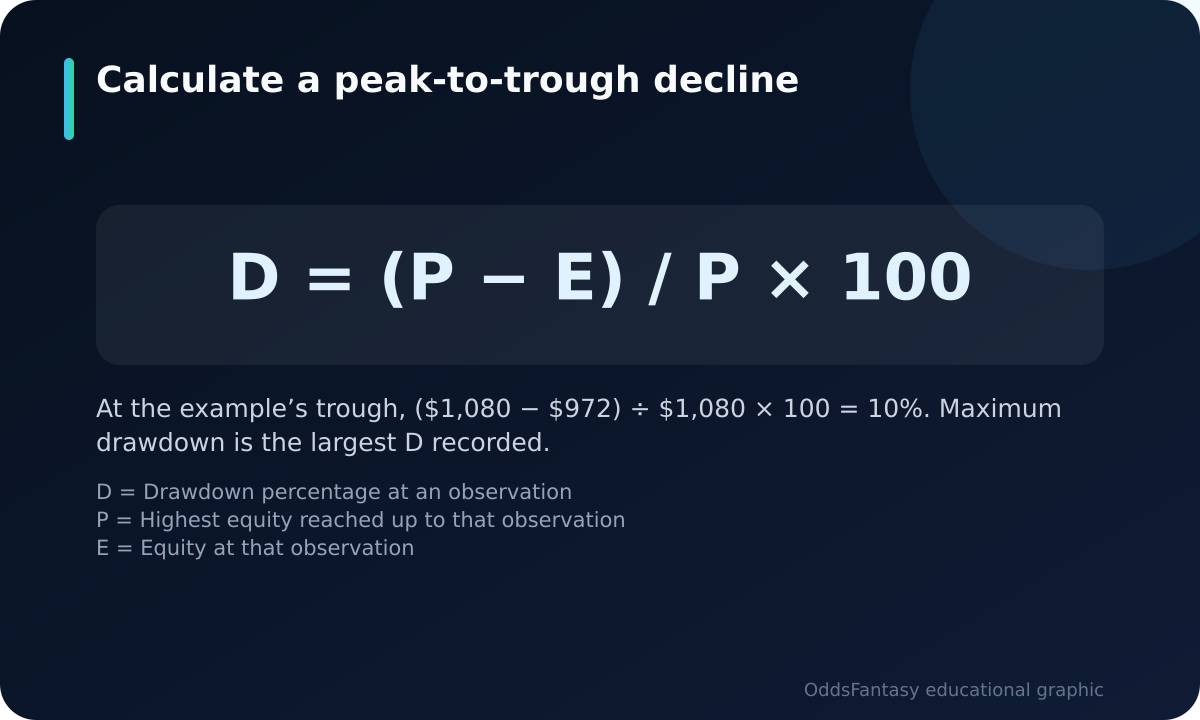
For each equity reading, identify the highest equity reached up to that point. Subtract the current equity from that running peak, divide by the peak, and multiply by 100. Maximum drawdown is the largest resulting percentage during the period. This article expresses drawdowns as positive loss percentages: a 10% drawdown means equity fell 10%, not that it gained 10%.
The percentage denominator is the relevant peak, not necessarily the starting account size. A $100 fall from $1,000 is 10%; a $100 fall from $1,080 is about 9.26%. Measuring every loss against the starting balance would miss that distinction.
What does a sports-trading drawdown look like?
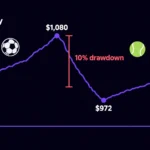
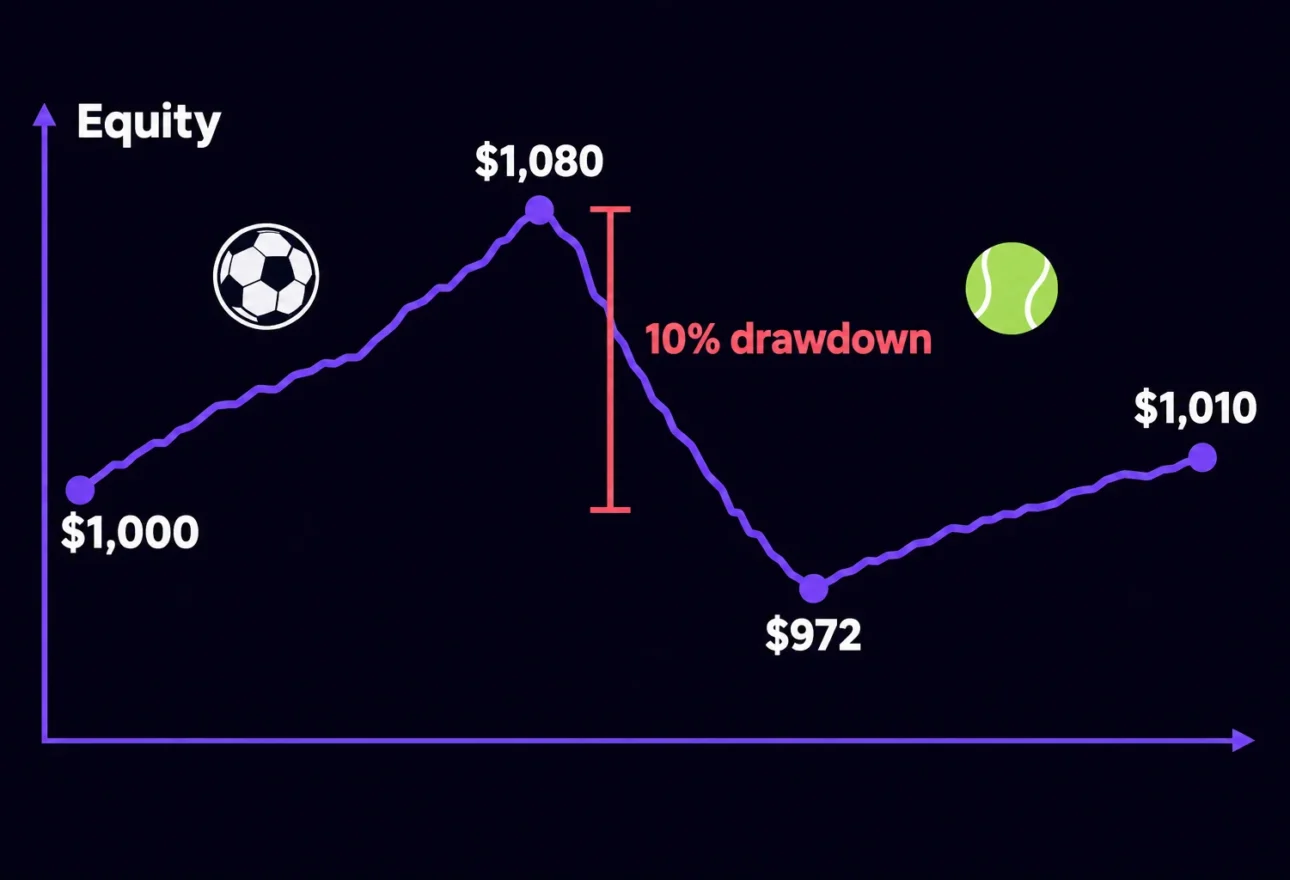
Example: a $1,000 account trading football and tennis prediction markets records the following equity readings. These are constructed numbers, not live market data or an OddsFantasy performance record. Equity here means account value including the marked value of open positions, rather than only results from closed trades.
- Start: equity is $1,000.
- After a profitable football position: equity reaches $1,040, a new peak.
- During a losing tennis position: equity falls to $990. The decline from $1,040 is $50, or about 4.81%.
- After subsequent trading: equity reaches $1,080, establishing a new peak.
- At the next trough: equity is $972. The decline from $1,080 is $108, or 10%.
- At the final reading: equity recovers to $1,010.
Maximum drawdown across these readings is 10%, even though final equity is $10 above the starting value. The final reading is still about 6.48% below the $1,080 peak. Ending profit, current drawdown and maximum drawdown answer different questions: where the account finished, how far it currently sits below its peak, and how deep its worst recorded decline was.
Can an account have more than one drawdown?
Yes. The example contains a decline from $1,040 to $990 and another from $1,080 to $972. As the CFA Institute explains, an investment can experience multiple drawdowns over a period but has one maximum drawdown measurement: the largest decline. Several episodes can tie for that maximum.
Recovery does not erase the earlier maximum from that period’s record. Returning from $972 to $1,080 would require an $108 gain, approximately 11.11% of $972. This is why the percentage needed to recover is larger than the percentage lost: the recovery starts from a smaller base.
Why does measurement frequency matter?
The CFA Institute also notes that drawdown magnitude depends on measurement frequency. In the example, a record containing the $1,080 peak, $972 trough and $1,010 finish captures the 10% decline. A less frequent record that captures the peak and finish but misses the trough shows only about 6.48% for that move.
For sports and prediction-market traders, this distinction matters when open positions move before settlement. A closed-trade record can omit adverse movements visible in equity. When reviewing a strategy, record the observation period, sampling frequency and whether values include open positions. A historical maximum is an observation, not a ceiling on future losses.
How is an enforced drawdown limit different?
A historical maximum drawdown describes an equity path. An enforced limit determines whether that path remains within an account’s rules. The percentage alone does not identify the reference value, when the threshold changes, what account values are monitored, or what constitutes a breach.
Using the same account example, compare two possible rule designs—not descriptions of OddsFantasy’s calculation. A floor fixed 10% below the $1,000 starting value would be $900. A floor set 10% below the $1,080 equity peak would be $972. Both involve “10%,” but the second leaves substantially less room after the account reaches that peak.
- Reference value: Is the threshold based on starting capital, a balance high, an equity high or another defined amount?
- Movement: Does the permitted floor stay fixed, move with new highs or stop moving under specified conditions?
- Observation: Are values checked continuously, at defined snapshots or at the end of a trading day?
- Included losses: Do open-position losses and applicable charges count?
- Enforcement: Does touching the threshold breach the rule, or must equity fall below it?
A daily loss limit, where present, is a separate constraint on losses within a day. Do not treat a maximum drawdown allowance as permission to lose that entire amount in one session, or assume that a daily reset also resets the overall drawdown threshold.
What does this mean for OddsFantasy traders?
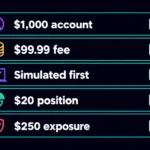
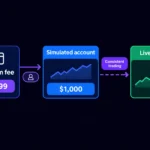
OddsFantasy funded accounts have a 2% maximum position size, a 10% maximum drawdown and a 25% maximum exposure. Accounts are instant, with no evaluation challenge, and trading starts on simulated capital from day one. The Terms and Conditions published at trade.oddsfantasy.com govern the accounts; consult them for the drawdown calculation, monitoring and enforcement details rather than assuming either example above applies.
Traders who stay within the account rules and trade consistently move up to live capital on prediction markets, where they keep up to 90% of the profits they generate as performance rewards. Keeping access to that progression requires planning around the actual rules, not just recognising the headline percentage.
Before opening another position, check current equity, the applicable loss threshold and existing exposure together. Several positions on the same sporting outcome may deteriorate together. A permitted position size does not mean the remaining drawdown room can absorb it comfortably. Use maximum drawdown to understand past losses, and the account’s enforced rules to decide what risk remains available now.
Frequently asked questions
Is maximum drawdown the same as the largest losing trade?
No. Maximum drawdown measures the largest cumulative peak-to-trough decline in account value. It can include several losing trades and adverse movements in open positions, rather than one isolated loss.
Does maximum drawdown reset after a profitable trade?
A profitable trade does not erase historical maximum drawdown from the measured period. It may reduce current drawdown or establish a new peak. Whether an enforced account threshold changes depends on the account’s rules.
Can a profitable strategy have a large maximum drawdown?
Yes. In the article’s example, equity finishes at $1,010 after starting at $1,000, but experiences a 10% maximum drawdown along the way. Ending profit does not describe the depth of losses experienced before the finish.
Does a 10% maximum drawdown limit always mean a $900 floor on a $1,000 account?
No. That floor follows only from a rule fixed 10% below the initial $1,000 value. A rule using a changing reference value can produce a different threshold. The program’s calculation and enforcement terms determine the applicable floor.
Sources
- IBKR Campus: Max Drawdown definition
- CFA Institute: Sculpting Investment Portfolios: Maximum Drawdown and Optimal Portfolio Strategy – CFA Institute Daily Browse
- Orion: What is the daily loss limit? · Help Center
Trade responsibly: only trade what you can afford to lose. 18+.