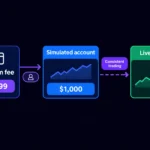


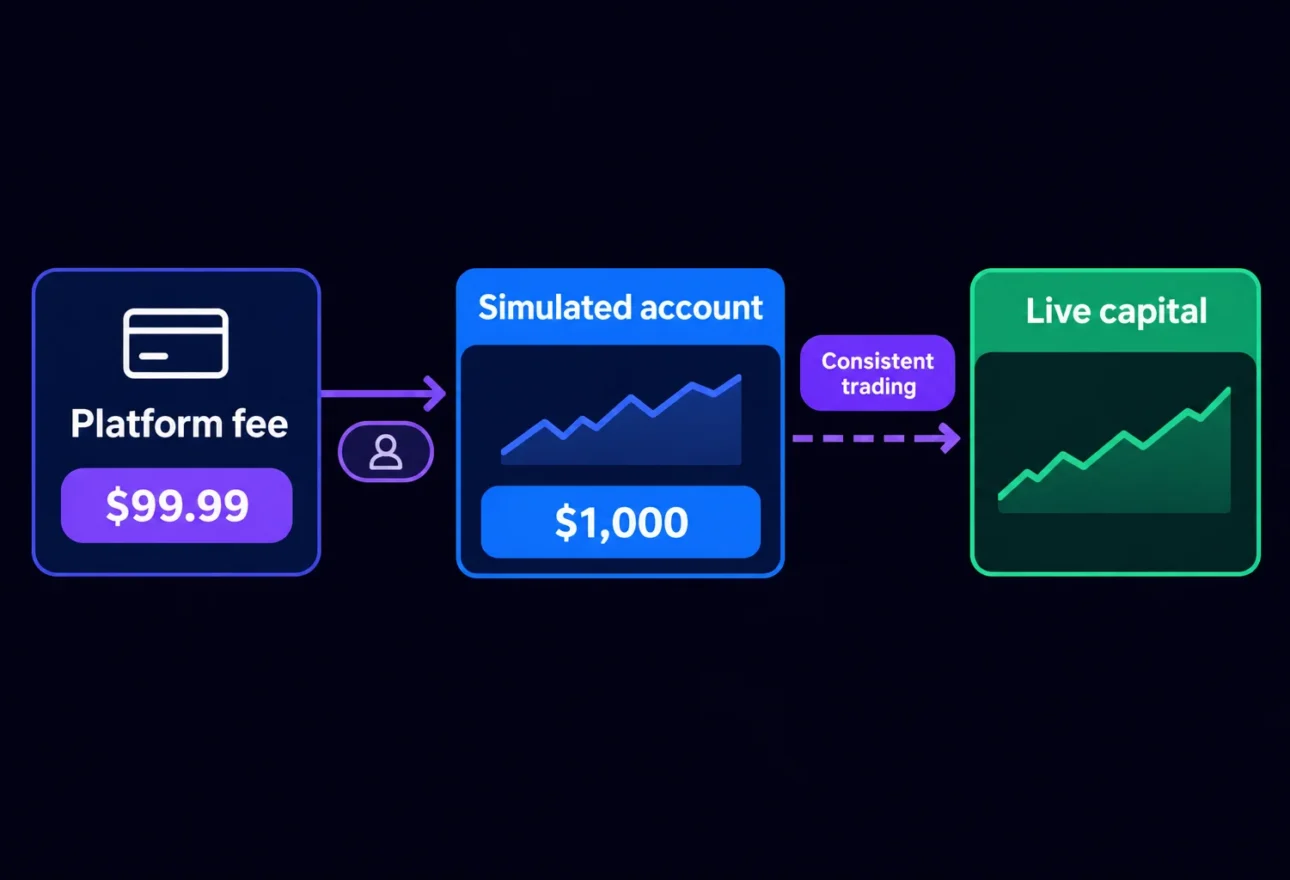
Prop firms can make money from account or evaluation fees and from live trading profits retained after trader rewards; some evaluation models also charge for resets. These are different revenue streams: OddsFantasy, for example, charges a $99.99 one-time platform fee for a $1,000 account that starts on simulated capital.
Where does a prop firm’s revenue come from?
For a trader considering a retail funded-account program, the useful distinction is between selling access to a trading program and earning money through actual market positions. A firm can receive a fee before any live trade occurs. Whether it later earns trading revenue is a separate question.
- Evaluation or platform fees: payment for access to the program, its account structure and any included tools.
- Reset fees: in models that offer paid resets, another payment to restart after a rule breach.
- Live trading results: actual market profits or losses, with performance rewards reducing the amount retained by the firm.
Revenue is not profit. Platform operation, support, education, trading costs and performance rewards affect the economics. Without a firm’s financial disclosures, a fee schedule alone cannot establish which revenue stream dominates or whether the business is profitable. Claims that a fixed percentage of all prop-firm income comes from failed traders need evidence, not repetition.
Why are simulated profits different from trading revenue?
A simulated account records trading outcomes without those positions necessarily being executed in the underlying market. Its displayed profit is therefore not, by itself, money the firm earned from a market counterparty. Likewise, a simulated loss is not automatically an equivalent cash loss for the firm.
The CFTC’s discussion of hypothetical performance states that simulated results do not represent actual trading and may understate or overstate market effects such as insufficient liquidity. The disclosure requirement discussed there applies to specified regulated entities; it should not be treated as proof that every funded-account program has the same regulatory status.
The NFA’s guidance on hypothetical results also explains that simulation cannot fully reflect the ability to withstand losses or follow a trading program during losses. Its guidance calls for material assumptions, including commissions and incentive fees, to be disclosed. For sports and prediction-market traders, the practical lesson is to distinguish a simulated record from executable, cost-adjusted live performance.
What are you buying when you pay a fee?
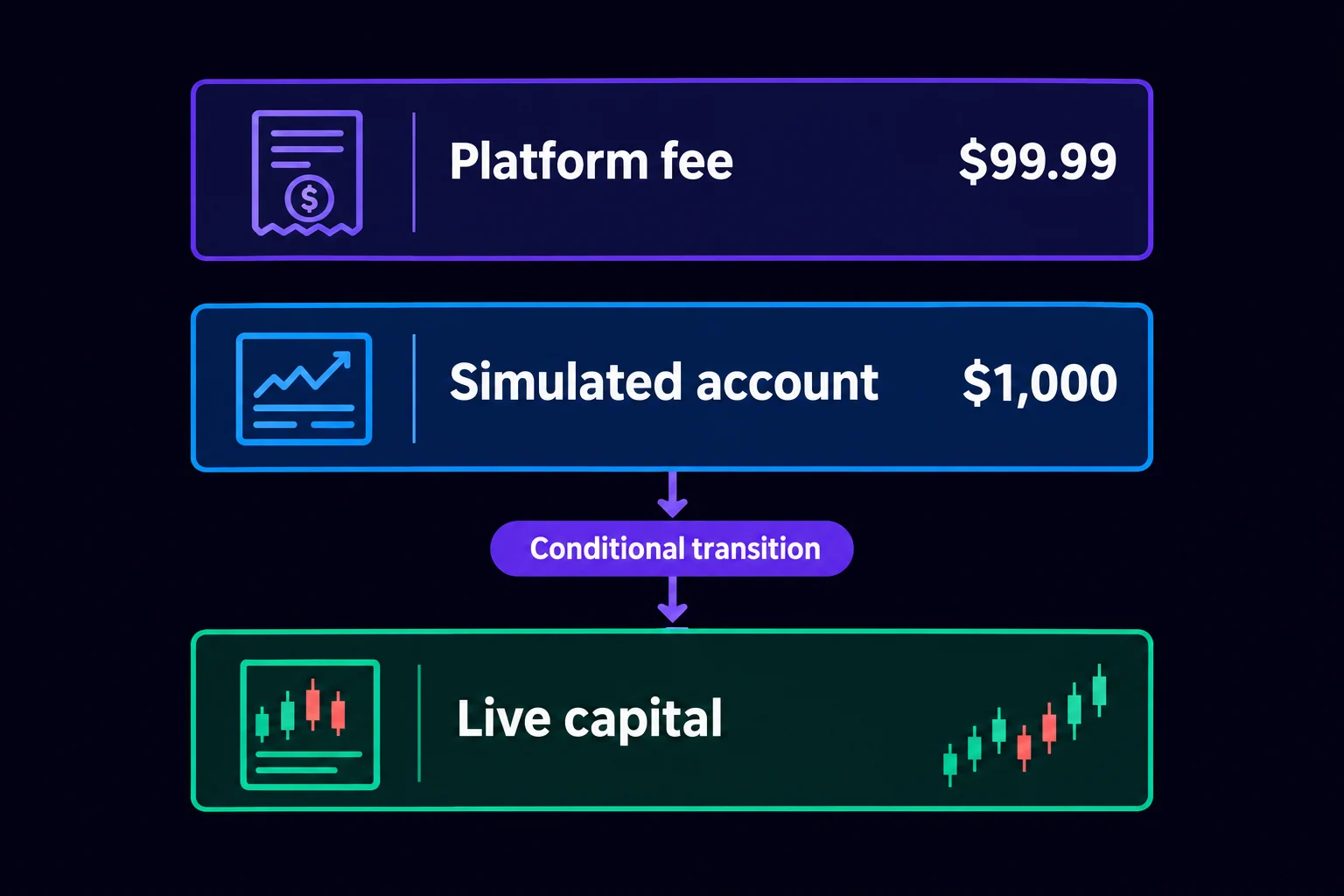
You are buying the access and services specified by the program, subject to its rules. The headline account size is not necessarily cash deposited into an account you own, and it is not the amount you can withdraw. A platform fee, a simulated account balance and a performance reward are three different things.
Assess the purchase on two levels: what you receive immediately, and what remains conditional. Immediate access might include a terminal or education. Live capital and performance rewards may depend on subsequent trading behavior. A clear offer makes that separation visible before payment rather than relying on the word “funded” to explain everything.
How can evaluation rules change incentives?
In a paid-evaluation model, the first task can be to reach a target without breaching a loss limit. The later funded stage can impose additional conditions before a reward becomes payable. Those stages can encourage different behavior: a strategy aimed at clearing a short-term gate is not necessarily suited to preserving an account.
A study of stage-dependent evaluation incentives models how position sizing can affect the chance of passing independently of skill. Its findings concern the structures studied, not every program. The important distinction is general: passing a test is not standalone evidence that a trader can repeatedly generate net profits under the later account’s constraints.
Fee income can arrive whether a customer ultimately succeeds or not. That creates a question to investigate, not proof of misconduct: does the product encourage sustainable trading, or repeated attempts to clear a gate? Look for clear stage transitions and rules that you can follow without increasing risk simply to qualify.
How does OddsFantasy’s one-time-fee model work?
OddsFantasy offers instant funded accounts with no evaluation challenge. Traders start on simulated capital from day one. The funded-account range has five account sizes, each with a one-time platform fee:
- $150 account: $19.99.
- $1,000 account: $99.99.
- $2,000 account: $199.99.
- $5,000 account: $499.99.
- $10,000 account: $999.99.
Every account includes the OddsFantasy trading terminal and full trading education library. The $1,000 account and larger also include AI-assisted trading, Positive EV signals and premium support. These are included tools and services, not promises of positive results. The fee buys program access; it does not establish that the account’s stated capital is live.
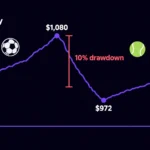
This structure removes a paid evaluation challenge from the route, but it does not remove trading conditions. Every account has the same percentage-based risk rules: a 2% maximum position size, a 10% maximum drawdown and 25% maximum exposure. Traders still need a process that fits those limits.
What does a $1,000 account actually mean?
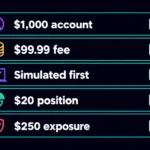
Example: a trader chooses the OddsFantasy $1,000 funded account and pays the $99.99 one-time platform fee. The account starts with simulated capital. Applying the published percentages to the starting balance gives these reference amounts:
- 2% of $1,000 is $20: the starting-balance equivalent of the maximum position size.
- 10% of $1,000 is $100: the starting-balance equivalent of the maximum drawdown.
- 25% of $1,000 is $250: the starting-balance equivalent of the maximum exposure.
These calculations explain scale; they do not establish how the limits change as the account changes. Account operation, including how drawdown is calculated, is governed by the Terms and Conditions published at trade.oddsfantasy.com. The $100 reference amount should not be mistaken for a separately withdrawable loss allowance.
For the business model, the key point is simpler: the $99.99 fee is platform revenue, while the $1,000 simulated balance is not another $1,000 of revenue or an immediate $1,000 live-capital outlay. Neither number tells you the firm’s profit after costs.
What changes when trading moves to live capital?
OddsFantasy moves funded traders who stay within the account rules and trade consistently up to live capital on prediction markets. On live capital, traders keep up to 90% of the profits they generate as performance rewards. “Up to” describes a maximum, not a universal reward rate or an income guarantee.
Continuing the account example, suppose it reaches live capital and generates $100 in profit. At a 90% reward share, $90 would go to the trader and $10 would remain before other business costs. That $10 is not necessarily firm profit. Live positions can also lose money, unlike a simulation’s purely recorded market outcome.
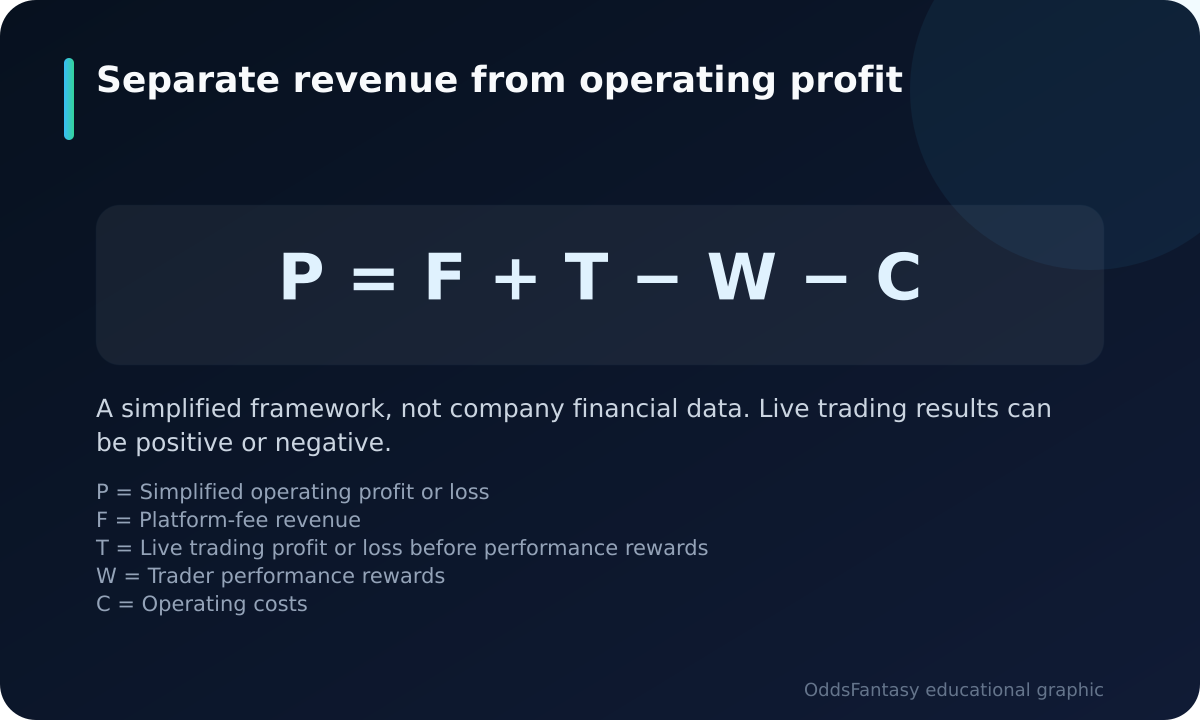
A simplified operating calculation is: firm result equals platform-fee revenue plus live trading profit or loss, minus performance rewards and operating costs. This separates the two engines of the business without assuming either one dominates. It is an analytical framework, not a statement of OddsFantasy’s private financial results.
How should you compare the incentives before paying?
- Identify the payment. Separate the initial fee from any recurring, reset or later-stage charges described by the program.
- Identify the capital. Establish whether the first account is simulated or live, and what must happen before that changes.
- Identify the reward conditions. A displayed account profit and an earned performance reward are not interchangeable.
- Check whether the rules fit your strategy. Position size, concurrent exposure and drawdown constraints matter more than the headline balance alone.
- Evaluate the immediate value. Decide whether the stated access, tools and education justify the fee without assuming future rewards.
The useful question is not simply whether a firm charges fees. It is whether the purchase is clear, the transition to live trading is understandable, and the incentives support the way you intend to trade. Keep platform access, simulated results and live performance rewards separate in your decision.
Frequently asked questions
Can you make money from prop trading?
It is possible to earn performance rewards, but they are not guaranteed. OddsFantasy traders start on simulated capital; traders who stay within the rules and trade consistently move up to live prediction-market capital, where they keep up to 90% of the profits they generate.
Is it possible to make $10,000 a month day trading?
A monthly income target is not evidence that it is achievable or sustainable. Account size, actual trading results, costs, risk limits and reward terms all matter. A $10,000 funded-account label describes account size, not monthly income.
Do prop firms make money when traders lose?
A firm can receive an access or evaluation fee regardless of the trader’s later outcome. A simulated loss is not automatically a cash gain for the firm, and a live trading loss is not fee revenue. Whether the firm profits overall depends on its revenues, trading results, rewards and costs.
Does a funded account always use real money?
No. A funded-account program can begin with simulated capital. OddsFantasy accounts are instant and have no evaluation challenge, but they start on simulated capital from day one. Live capital is a later stage for traders who stay within the rules and trade consistently.
Sources
- Commodity Futures Trading Commission: e7-3122 | CFTC
- National Futures Association (NFA): Rules | NFA
- OneUp Trader: Important Evaluation Info – OneUp Trader | Help Desk
- arXiv: Gate Design and Stage-Dependent Incentives in Retail Proprietary-Trading Evaluations: Why Passing Is Not Standalone Evidence of Skill, and Why the Product Fails to Pay Under Measured Trading Constraints
Trade responsibly: only trade what you can afford to lose. 18+.