

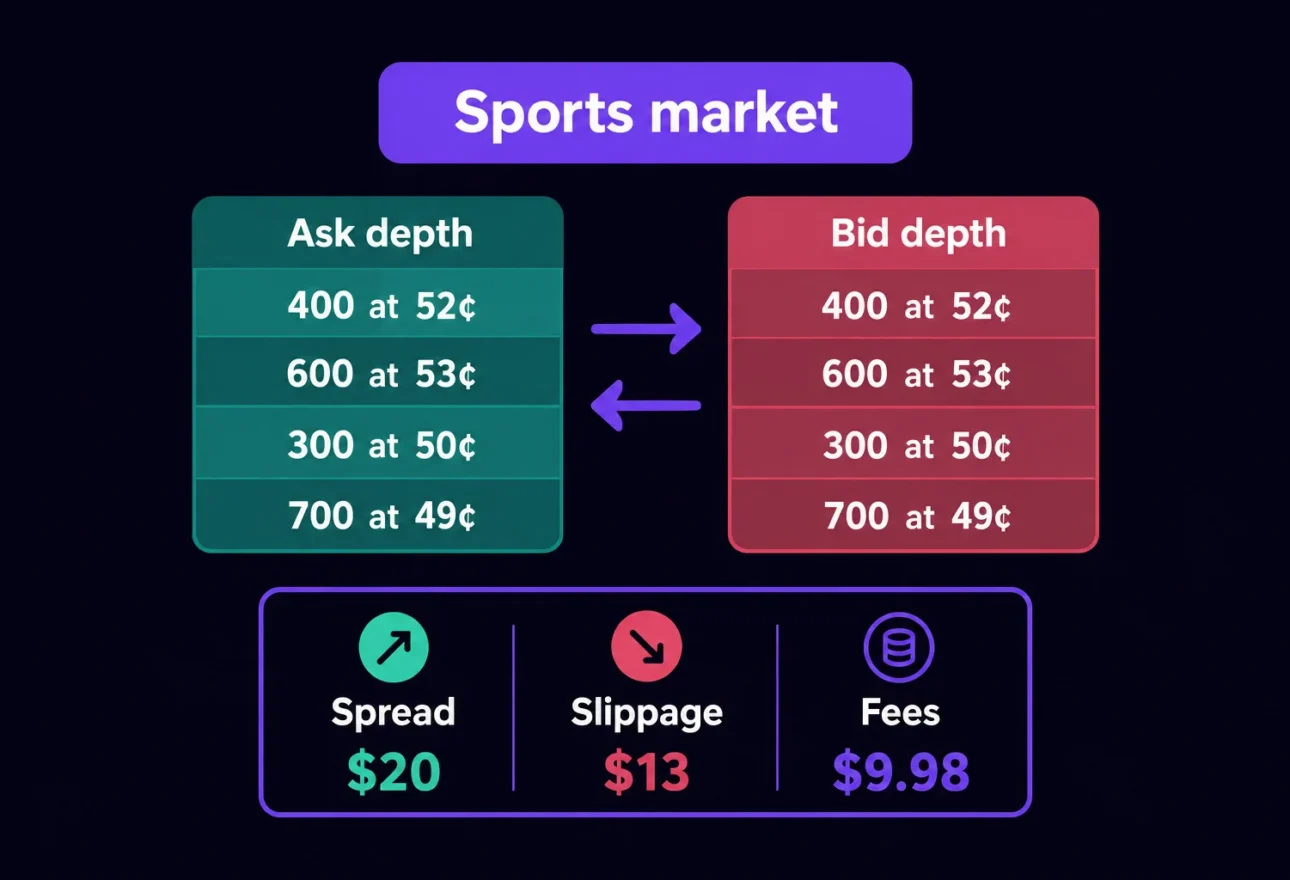
Polymarket spread trading starts with the gap between the highest bid and lowest ask: crossing that gap to enter and exit creates a cost before any favorable market movement. Your full round-trip cost also includes slippage through available liquidity and any applicable taker fees.
A tight-looking market can still be expensive for your position size. This guide shows how to inspect both sides of the order book and calculate the cost of getting in and out. For the broader planning framework, start with How to Build a Prediction Market Trading Strategy.
What does the bid-ask spread actually cost?
The bid is the highest displayed price a buyer offers; the ask is the lowest displayed price a seller requests. The bid-ask spread equals the ask minus the bid. A trader buying immediately typically takes available asks, while a trader selling immediately takes available bids.
With a 50¢ bid and 52¢ ask, the spread is 2¢ per share. Buying at 52¢ and immediately selling at 50¢ loses 2¢ per share before fees, assuming sufficient liquidity at both prices. The midpoint is 51¢, but it is a reference price—not an assurance that you can trade there.
Do not double-count the spread. Against an unchanged midpoint, buying at the ask costs half the spread and selling at the bid costs the other half. Together, those two crossings cost one full spread for an unchanged-size round trip.
Why does available liquidity matter more than the headline price?
The best quote describes only the shares available at that price. If your order exceeds that quantity, completing it requires additional price levels. The resulting average execution price can be worse than the quote you initially saw. Here, slippage means that shortfall against the best quote observed before submitting the order.
For a purchase, inspect the ask side; for a sale, inspect the bid side. These are the opposite sides your order must trade against. Large displayed buying interest does not supply the shares needed to fill your purchase.
The study Determinants of immediate price impacts at the trade level in an emerging order-driven market reports that larger trades, wider spreads and lower opposite-side liquidity can produce larger price impacts. It also finds a greater influence from opposite-side than same-side liquidity. This is research on another order-driven market, not a Polymarket-specific estimate of slippage.
Price impact and slippage are related but distinct. Price impact concerns how trading changes market prices; slippage compares your execution with a chosen benchmark. Neither can be estimated reliably from the spread alone: inspect quantities and gaps between price levels.
How does order choice change your costs?
An immediately executable order prioritizes access to existing liquidity. A resting limit order instead offers a price and waits for another trader to accept it. These choices exchange price control, execution uncertainty and exposure to changing information.
- Taking liquidity: you accept available opposing orders. Your average price depends on the depth consumed, and applicable taker fees add to the cost.
- Resting a limit order: you specify an acceptable price, but the order may remain unfilled or fill only partly.
- Using a marketable limit: a limit price can cap how far you will trade, but an immediately matching limit order still takes liquidity. A limit instruction does not automatically make you a maker.
Providing liquidity is not a free edge. A resting order may fill just as new information makes its price unattractive. Conversely, declining to cross the spread may leave you without the position you intended. Choose the trade-off deliberately rather than treating either order style as universally cheaper.
Which Polymarket fees belong in the calculation?
According to Polymarket’s Trading Fees documentation, certain markets charge taker fees when orders match. Makers are not charged fees. Geopolitical and world events markets have no Polymarket trading fees; do not assume that exemption applies to a sports market.
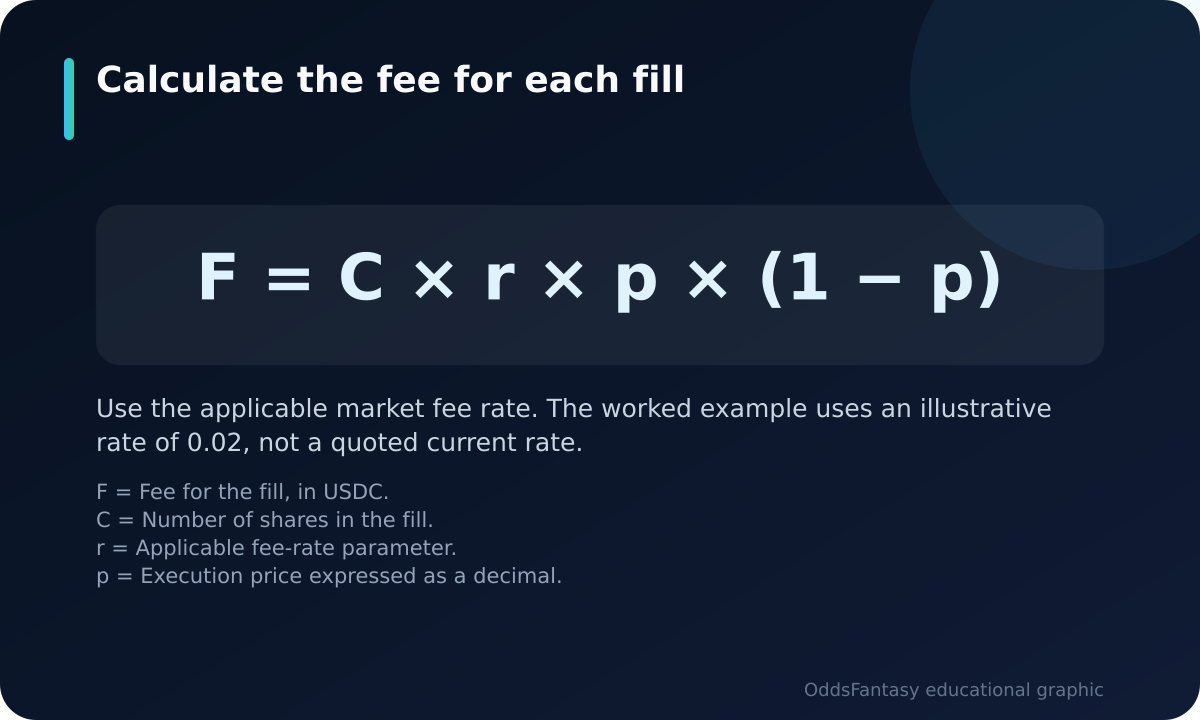
Polymarket gives the fee formula as fee = C × feeRate × p × (1 − p), where C is shares traded and p is the share price expressed as a decimal. Fees vary with price and are symmetric around 50%: equal-size trades at 30¢ and 70¢ have the same fee at the same fee rate.
For executions across multiple prices, calculate each fill’s fee and add the results. Check whether fees apply and the applicable rate before trading. Polymarket says these fees fund its Maker Rebates Program to encourage deeper liquidity and tighter spreads; that incentive does not guarantee depth for your order.
How do you calculate a complete round trip?
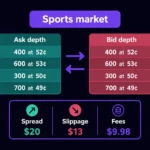
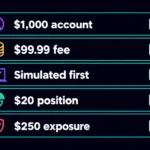
Example: a 1,000-share position in a sports prediction market. The following order book and 2% fee-rate parameter are illustrative, not live Polymarket quotes or a statement of any market’s current fee rate. Hold the reference quotes fixed and assume the listed exit bids remain available when you close.
- Best ask: 400 shares at 52¢; next ask: 600 shares at 53¢.
- Best bid: 300 shares at 50¢; next bid: 700 shares at 49¢.
- Reference spread: 2¢ per share; midpoint: 51¢.
- Entry and exit both take liquidity; the fee-rate parameter is 0.02.
What does entering the position cost?
Buying 400 shares at $0.52 costs $208. Buying another 600 at $0.53 costs $318. Total purchase cost before fees is $526, giving an average entry price of 52.6¢. Compared with buying all 1,000 shares at the best ask, entry slippage is $6.
The entry fee is (400 × 0.02 × 0.52 × 0.48) + (600 × 0.02 × 0.53 × 0.47) = $4.986. Keep the unrounded amount while calculating the total; displayed cents may differ because of rounding.
What does exiting the position cost?
Selling 300 shares at $0.50 returns $150. Selling the other 700 at $0.49 returns $343. Total sale proceeds before fees are $493, giving an average exit price of 49.3¢. Compared with selling all shares at the best bid, exit slippage is $7.
The exit fee is (300 × 0.02 × 0.50 × 0.50) + (700 × 0.02 × 0.49 × 0.51) = $4.9986. Combined entry and exit fees are $9.9846.
What is the total execution drag?
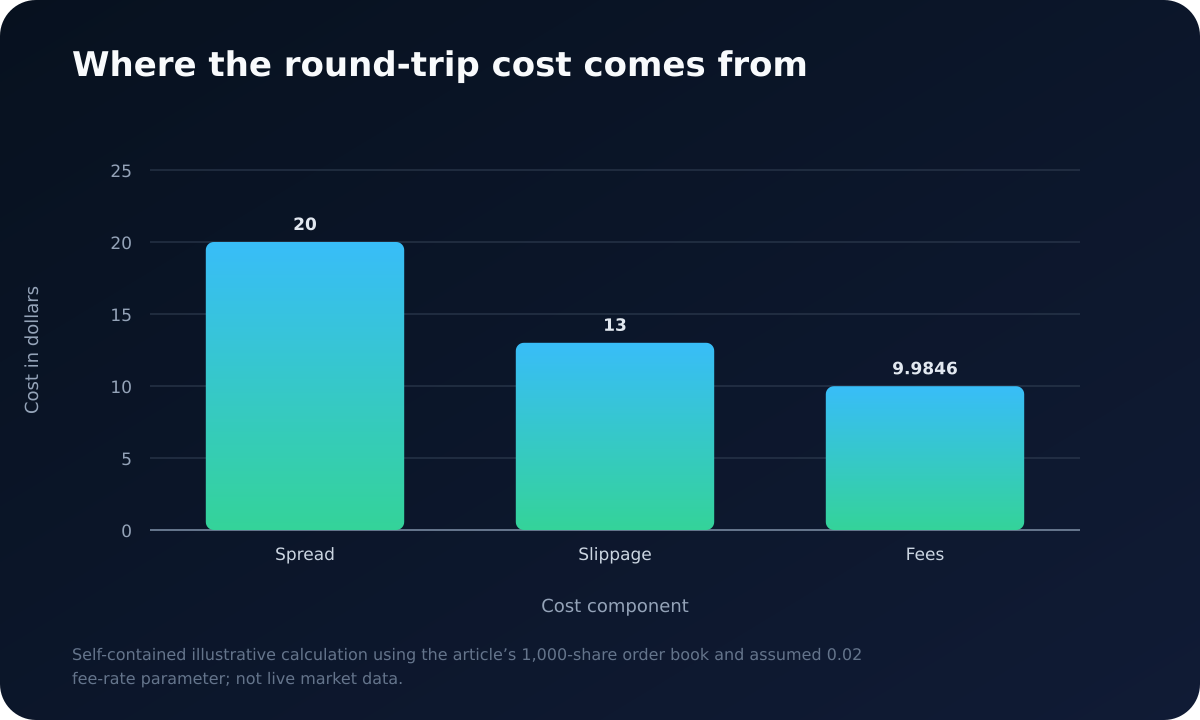
The round-trip loss is $526 − $493 + $9.9846 = $42.9846, or approximately $42.98. That consists of $20 in spread cost, $13 in additional slippage and approximately $9.98 in fees. The cost is about 4.30¢ per share despite no change in the reference quotes.
This decomposition isolates execution costs. A real exit can have a different spread, depth and market price. If you calculate profit or loss from actual average entry and exit prices, spread and slippage are already embedded: subtract fees, but do not subtract those execution components again.
How should you inspect a market before committing capital?
The OddsFantasy Polymarket trading terminal is free to use for sports prediction markets. Use market inspection to answer a specific execution question: can the available prices and quantities support your planned entry and a plausible exit? A terminal does not create an edge, preserve displayed liquidity or guarantee fills.
- Record the bid, ask and spread before placing the order.
- Add opposite-side quantities through your maximum acceptable price to estimate executable size and average price.
- Inspect the exit side separately; entry liquidity is not evidence of exit liquidity.
- Include applicable fees on both legs and compare the total cost with your reason for trading.
- Reduce size, wait or decline the trade when the execution budget does not fit. Recheck after a partial fill rather than assuming the remainder will execute similarly.
Position size should fit both your risk budget and the market’s depth. The practical discipline is to budget for the round trip before opening the position—not discover the cost when you need to leave.
Frequently asked questions
Does a limit order avoid Polymarket taker fees?
Not automatically. A limit order that immediately matches existing liquidity acts as a taker. Polymarket says makers are not charged fees, while takers pay fees on fee-enabled markets.
Can a tight spread still produce expensive execution?
Yes. A narrow spread may cover only a small quantity. If your order consumes additional price levels, its average execution price can be materially worse than the best displayed quote.
Are all Polymarket markets fee-free?
No. Polymarket charges taker fees on certain markets. Its documentation identifies geopolitical and world events markets as fee-free. Check the specific market’s fee status and rate.
Should I subtract spread and slippage from actual trading profit again?
No. Profit or loss calculated from actual average purchase and sale prices already includes the execution effects of spread and slippage. Subtract applicable fees separately, without counting those execution costs twice.
Is the OddsFantasy Polymarket trading terminal free?
Yes. The OddsFantasy terminal for sports prediction markets such as Polymarket is free to use. Free terminal access does not mean that the underlying market has no spread, slippage or applicable fees.
Sources
- Polymarket: Trading Fees | Polymarket Help Center
- arXiv: Determinants of immediate price impacts at the trade level in an emerging order-driven market
Trade responsibly: only trade what you can afford to lose. 18+.