

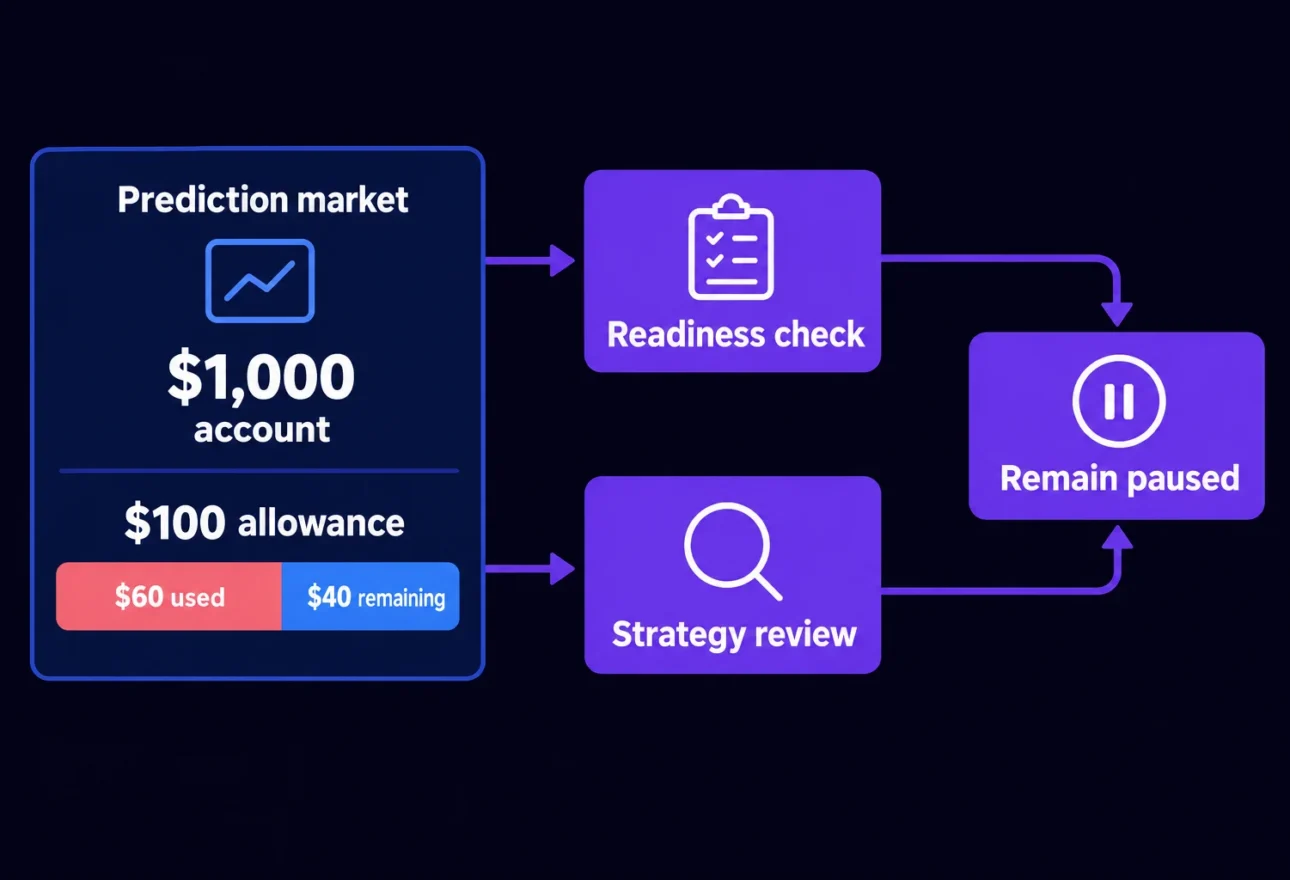
Discipline during a losing streak means pausing impulsive decisions, checking remaining risk capacity and reviewing whether your strategy still deserves capital. Emotional recovery and evidence of an edge are separate requirements: feeling calmer is not a reason, by itself, to resume trading.
For sports and prediction-market traders, a useful reset produces three outputs: an accurate account-risk snapshot, a journal-based explanation of the losses and a written decision to remain paused, test further or resume under defined restrictions. The objective is not to recover a particular amount. It is to make the next decision defensible.
Why should emotional recovery and strategy review stay separate?
A losing streak does not establish whether a strategy is broken. The arXiv paper You are in a drawdown. When should you start worrying? explains that previously profitable strategies can degrade, while unlucky streaks can also affect healthy strategies. Neither “it worked before” nor “I have lost several trades” settles the question.
Meanwhile, the urge to act can become its own problem. FINRA’s guidance on investing and social media warns that social sentiment tools can encourage emotionally driven decisions and that volatile markets can tempt investors into rash actions. Its guidance concerns investing, but the practical warning is relevant: crowd excitement is not a substitute for your own risk assessment.
Use two separate gates. The readiness gate asks whether you can follow your rules without chasing recovery. The strategy gate asks whether the method has enough supporting evidence to justify another position. Passing either gate alone is insufficient.
What should your losing-streak pause checklist include?
Choose pause triggers before the next session. They might include a predefined loss budget, a rule breach, unexplained execution differences or an urge to increase position size to recover losses. A trigger is a prompt for review, not proof that a particular number of losing trades means the strategy has failed.
- Stop initiating positions. Review pending orders and automated rules so they cannot add exposure unnoticed.
- Reconcile existing positions. Record open exposure, unsettled markets and outstanding orders separately.
- Check account limits. Record remaining drawdown capacity, maximum position size and exposure headroom before considering another entry.
- Remove pressure to recover. Close sentiment feeds and write down any urge to win back a specific amount.
- Preserve the evidence. Save entry prices, probability estimates, position sizes and the reasoning available when each trade was opened.
- Set a review appointment. Resume the decision process at that appointment, not automatically when the next attractive market appears.
Pausing new entries does not remove the risk in existing positions. Manage those positions under your established exit and risk rules; do not confuse stepping away from the screen with reducing exposure. Avoid inventing new exit rules solely because the latest result feels painful.
What belongs in a losing-streak trade journal?
The journal should distinguish an unsuccessful outcome from a poor decision. A winning trade can violate your process, and a losing trade can follow it. Record the original reasoning before settlement whenever possible, so the final result does not rewrite your memory of the entry.
- Market and method: event, contract, strategy version and the condition that justified entry.
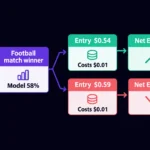
- Entry evidence: available price, estimated probability, estimation method and any costs included in the decision.
- Risk snapshot: position size, total exposure, related positions and drawdown capacity at entry.
- Execution and outcome: actual entry and exit, settlement result, costs and any deviation from the plan.
- Behaviour: urgency, recovery thoughts, outside influence and whether you followed the written rules.
Review trades by strategy version and market type rather than pooling everything into one result. Separate rule-following losses from execution mistakes and impulsive entries. If your probability estimates were never recorded, acknowledge that limitation: the journal cannot retrospectively demonstrate that the original entries offered positive expected value.
How do you check remaining drawdown and exposure?
Every OddsFantasy funded account has a 2% maximum position size, a 10% maximum drawdown and a 25% maximum exposure. Treat those limits as boundaries, not targets. A position can fit the size limit while still being inappropriate for your remaining loss capacity or the evidence behind your strategy.
Use the account’s applicable risk figures rather than guessing how drawdown is measured. For governing definitions and calculation details, consult the Terms and Conditions published at trade.oddsfantasy.com. The calculation below is a planning example, not a specification of the platform’s drawdown methodology.
What does a $1,000 account reset look like?
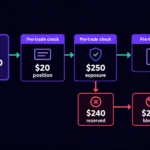
Example: a $1,000 account with a $100 drawdown allowance, $60 already used against that allowance and $180 of existing exposure. Using $1,000 as the percentage base for this calculation gives the following planning figures.
- Maximum position size: $1,000 × 2% = $20.
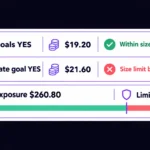
- Maximum exposure: $1,000 × 25% = $250.
- Remaining drawdown capacity: $100 − $60 = $40.
- Exposure headroom: $250 − $180 = $70; adding a $20 position would leave $50.
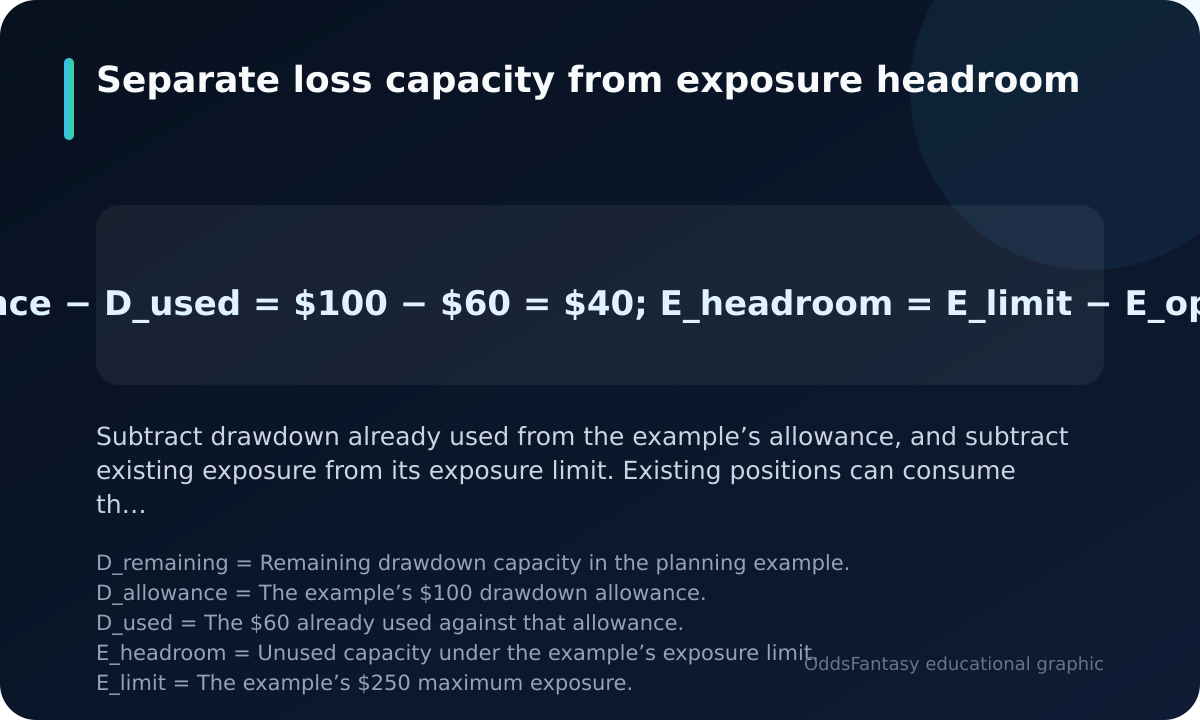
The $70 exposure headroom is not a $70 loss budget. Existing positions could consume the $40 of remaining drawdown capacity before a new trade settles. Review how positions could lose together, particularly contracts linked to the same match or underlying outcome. More market names do not necessarily mean more independent risk.
Make this check repeatable with a dated risk snapshot. The OddsFantasy Sports Trading Tools Suite includes exposure calculators, risk management utilities, trading simulators and a trading analytics dashboard. Use these tools alongside your journal to check calculations and review results; a tool output does not establish that your strategy has an edge.
How can you review the strategy without defending it?
Compare the drawdown with the strategy’s original assumptions, including its depth and duration. The arXiv paper notes that both can justify revising an assumed Sharpe ratio downward, and that investors and managers tend to underestimate drawdowns consistent with that ratio. Sharpe describes risk-adjusted performance; do not manufacture a reliable estimate from a small trade sample.
- Check process integrity. Did entries follow the documented method, or did discretion, execution and sizing change?
- Check the inputs. Are probability estimates, available prices, costs and settlement assumptions still credible?
- Check concentration. Are losses clustered in one market type, time window or group of related positions?
- Choose an evidence-based status. Keep the strategy paused, investigate a defined change or test the unchanged method further in simulation.
Write down what would change your conclusion before testing again. Otherwise, every favourable result can become an excuse to resume. When the sample is too small or the assumptions cannot be checked, “insufficient evidence” is a valid decision. Simulation can help investigate a method, but favourable simulated results do not guarantee future live performance.
When should you resume trading?
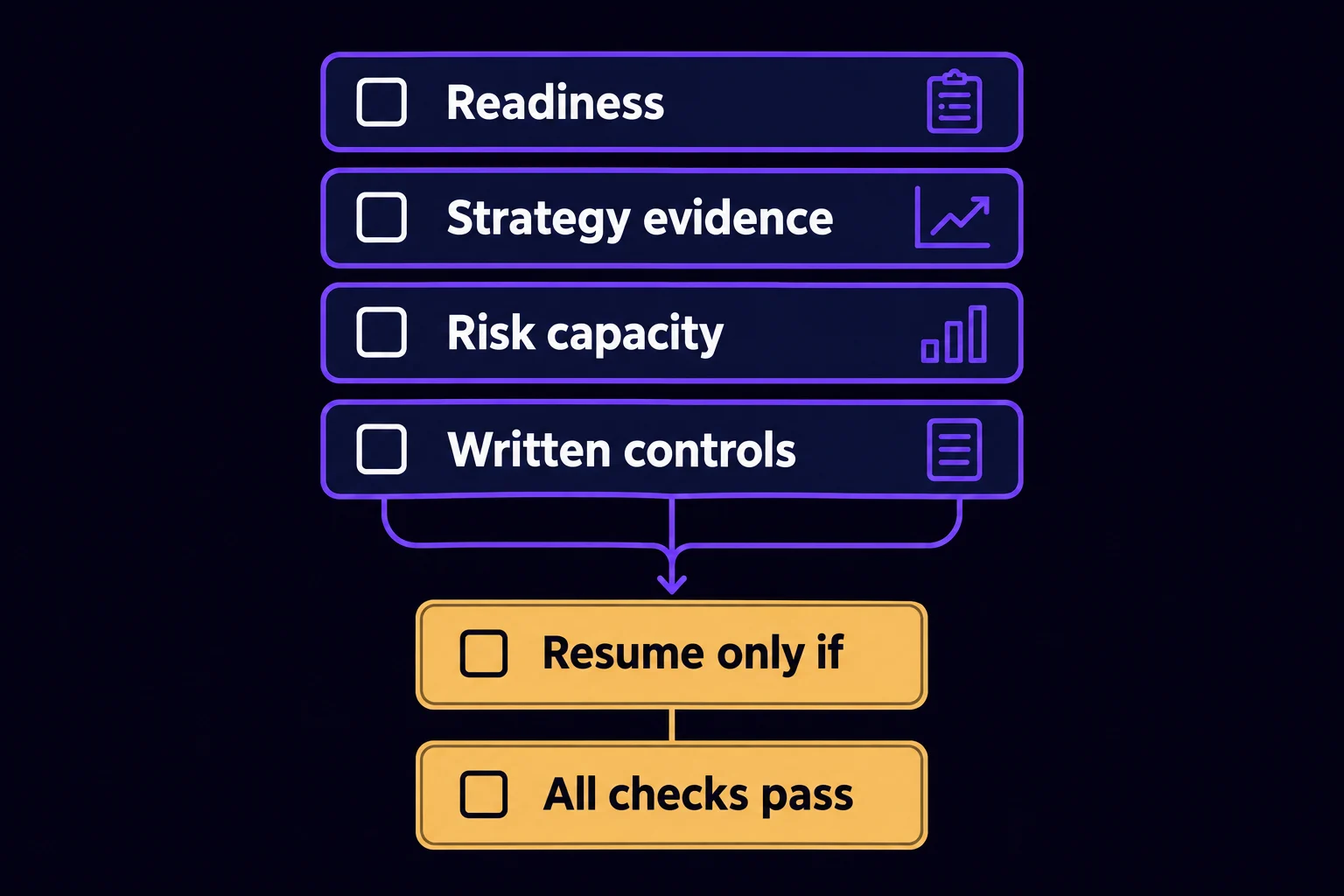
Resume only when both gates pass and the account has adequate risk capacity. FINRA recommends checking whether a decision aligns with your financial goals and a risk level you personally accept. Applied to a reset, that means your return plan must suit your objectives—not another trader’s tolerance or your desire to erase the drawdown.
- Readiness: you can accept another loss without changing size to chase recovery.
- Evidence: you can explain why the next entry qualifies, including the limitations of your estimate.
- Capacity: existing and proposed positions fit your risk budget as well as account limits.
- Controls: the return plan states position size, permitted markets, review timing and the next pause trigger.
Reduced size is a risk-control choice, not a repair for a missing edge. Automation is not a repair either. With the OddsFantasy AI Trading Agent, traders set rules once and the agent trades them automatically. Before reactivating automated trading, review those rules against the current strategy decision and risk budget.
How does this routine fit an OddsFantasy funded account?
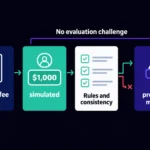
OddsFantasy funded accounts are instant, with no evaluation challenge, and begin on simulated capital from day one. Every account includes the trading terminal and full trading education library. The $1,000 funded account and larger sizes also include AI-assisted trading, Positive EV signals and premium support.
OddsFantasy moves traders who stay within account rules and trade consistently up to live capital on prediction markets, where they keep up to 90% of profits generated as performance rewards. The reset routine supports disciplined decision-making within those rules. Its success is not necessarily another entry: sometimes the correct output is to remain paused because the strategy has not earned further exposure.
Frequently asked questions
How many losing trades should trigger a pause?
There is no universal count that proves a strategy has failed. Set a pause trigger before trading using your loss budget, process breaches and signs of recovery-chasing. A sequence of losses should prompt review, not an automatic conclusion about the strategy’s edge.
Should I increase position size to recover a losing streak?
Do not make recovery the reason for increasing size. Check strategy evidence, remaining drawdown capacity and existing exposure first. OddsFantasy funded accounts have a 2% maximum position size, a 10% maximum drawdown and a 25% maximum exposure.
Does following my rules mean the strategy still works?
No. Process discipline and strategy validity are different questions. A trader can execute a deteriorating strategy consistently, so the review must examine the method’s inputs and assumptions as well as rule compliance.
Can simulation help after a losing streak?
Simulation can help test a clearly defined method without adding live exposure. Record the strategy version, assumptions and review criteria before testing. Favourable simulated results do not guarantee that the method will perform well in live markets.
Sources
- arXiv: You are in a drawdown. When should you start worrying?
- FINRA: Following the Crowd: Investing and Social Media | Syndication
Trade responsibly: only trade what you can afford to lose. 18+.