

Sports trading means taking positions on sporting outcomes at market prices, then closing those positions or holding them through settlement. For beginners, the essential skills are reading prices, understanding potential losses, executing orders carefully and following risk limits—not finding a supposedly certain winner.
What is sports trading, and how does it differ from picking winners?
A pick asks which outcome you expect. A trading decision also asks whether the available price is attractive, how much exposure to take and what would justify an exit. You can correctly predict an outcome but still pay too much relative to your estimated probability.
Exchange mechanics matter because you transact with other market participants. The Bristol Betting Exchange research paper describes sports-betting exchanges as closely related to exchange mechanisms in major financial markets. Its simulation models traders whose assessments change as races unfold; it is a research model, not evidence that a particular strategy earns profits.
How do you read exchange odds and prediction-market prices?
Decimal odds express total return per unit staked on a winning position, including the original stake. Odds of 2.00 imply a break-even probability of 1 ÷ 2.00 = 50%, before costs. A $10 position at those odds returns $20 if it wins: $10 of stake plus $10 of profit.
A binary prediction-market contract expresses the outcome differently. For a contract that pays $1 when YES wins and $0 otherwise, a 52¢ purchase price corresponds to a 52% break-even probability before costs. These are price conversions, not guarantees that the outcome’s true probability equals the market price.
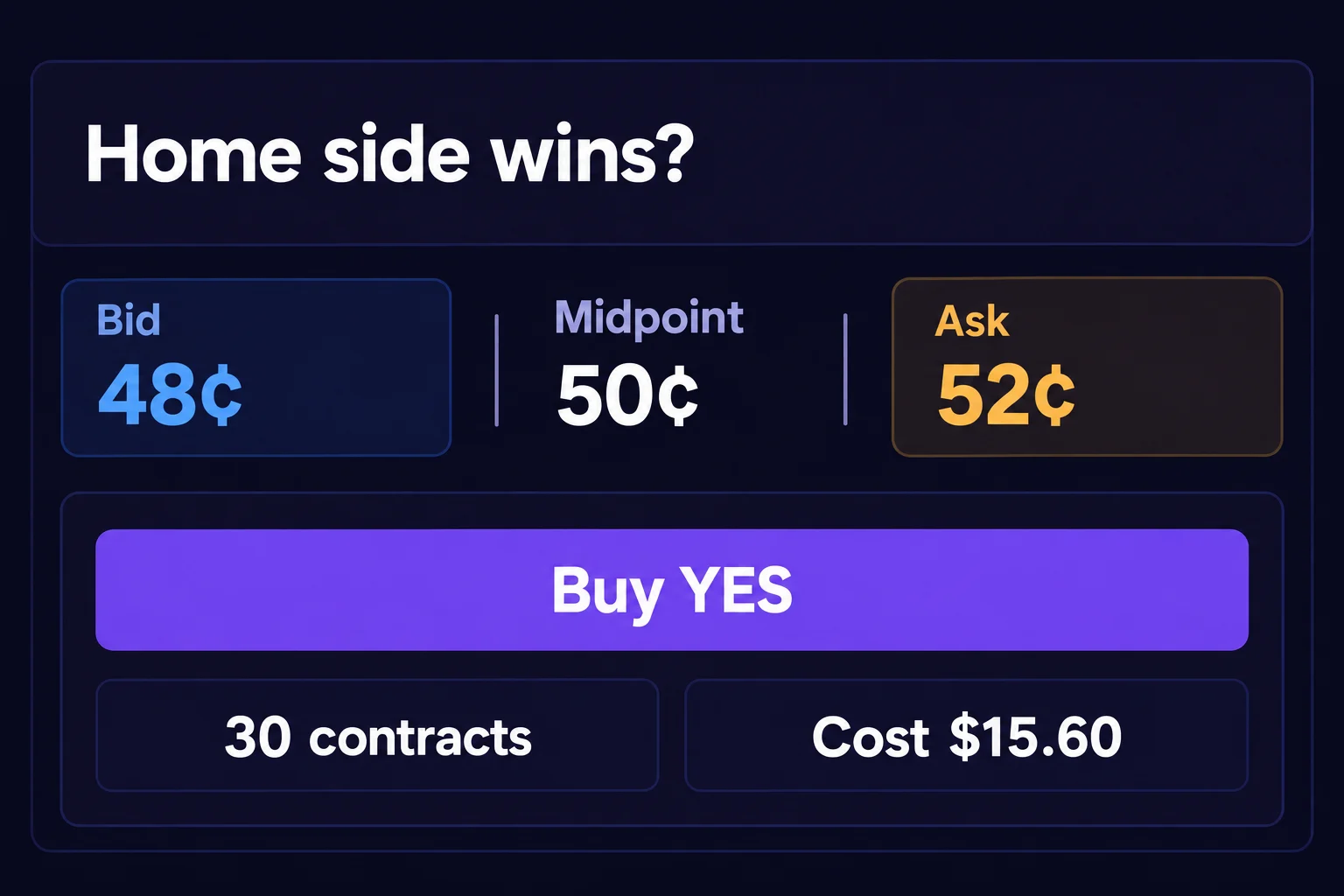
The displayed price may not be executable. According to Polymarket’s price explanation, its displayed prices generally use the midpoint between the bid and ask. When the spread exceeds $0.10, it uses the last traded price instead.
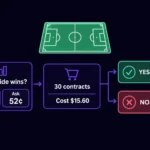
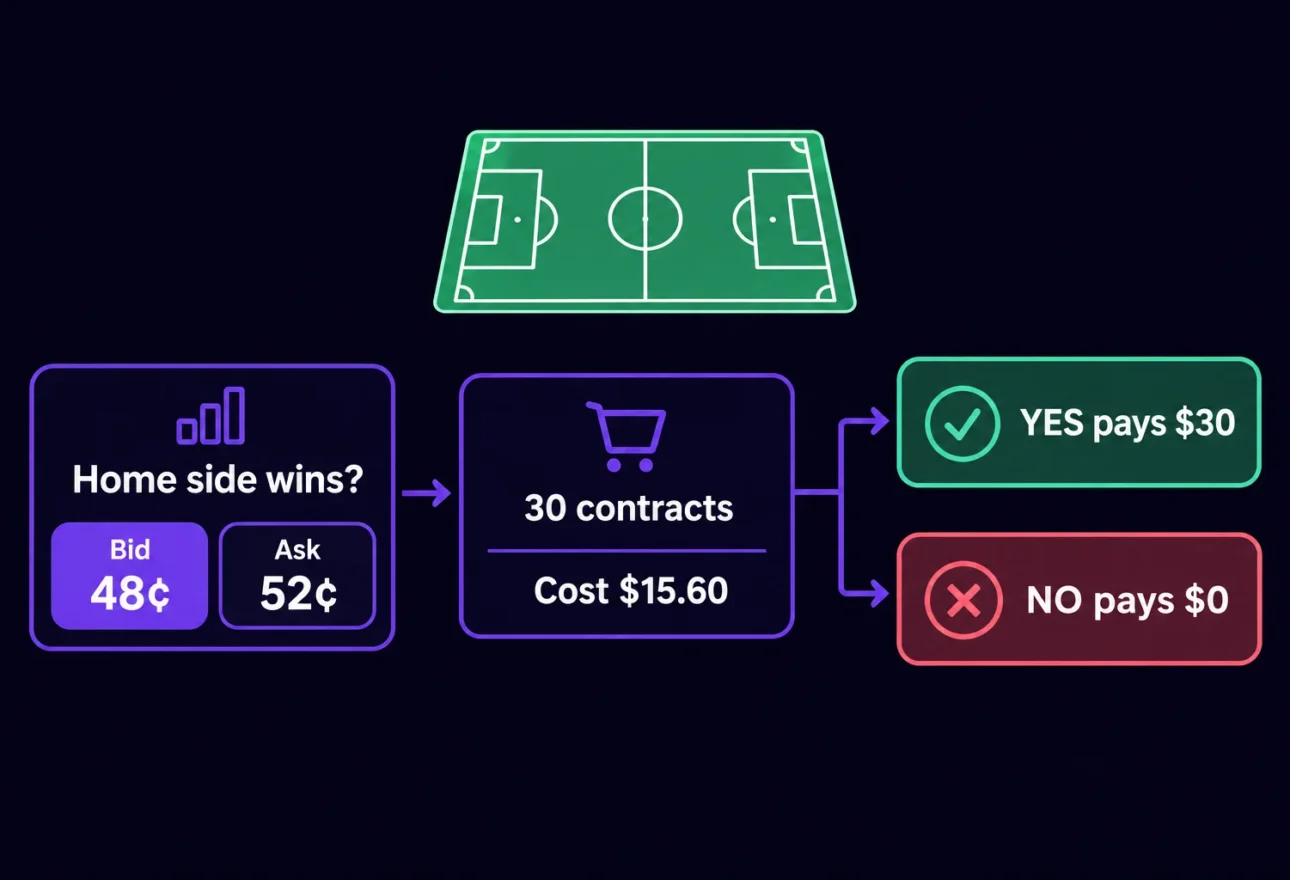
Worked example: consider a $1,000 account and a fictional football market, “Will the home side win?”, with YES contracts paying $1 if the outcome is confirmed. The best bid is 48¢ and the best ask is 52¢. The midpoint is 50¢, but buying at the available ask costs 52¢. All prices and outcomes in this walkthrough are examples, not live market data.
Prices emerge from orders, rather than appearing as fixed starting probabilities. Polymarket explains that a newly created market initially has no shares or predefined prices. Matching YES and NO buy orders can establish its initial price, while subsequent prices reflect supply and demand.
What position are you actually taking?
Buying 30 YES contracts at 52¢ costs $15.60. Under the example’s $1-or-$0 settlement terms, the purchase can lose its entire $15.60 cost. The position is not simply “backing the home side”: it is owning 30 contracts at a specific entry price with defined settlement conditions.
Traditional exchange positions use different language. Backing an outcome means taking the winning side; laying it means taking the opposing side. At lay odds of 2.50 against a $10 backer’s stake, the liability is $10 × (2.50 − 1) = $15. If the backed outcome wins, the layer loses $15; otherwise, the layer earns $10 before costs.
The practical lesson is to identify your possible loss, not just the stake or contract count. Several positions can also share the same underlying risk. Holding contracts on a team’s victory and its scoring performance may create overlapping exposure rather than genuine diversification.
How do you place an order without confusing price and execution?
A limit order states the price you are willing to accept. Polymarket’s help page describes traders placing limit orders for YES or NO shares at their chosen purchase price. Setting that price does not mean another participant must trade with you.
- Read the contract rules and check that the outcome matches what you intend to trade.
- Inspect the bid, ask and available quantity rather than relying only on the displayed price.
- Choose your quantity and calculate the total purchase cost or liability.
- Set your acceptable price and submit the order.
- Check whether the order filled, partly filled or remains open before making another decision.
In the football example, a 50¢ buy limit is below the 52¢ ask, so it may remain unfilled. Buying 30 contracts at 52¢ requires enough available quantity at that price. If only some contracts fill, your actual position is smaller than your submitted order. Review unfilled orders before adding new exposure.
What happens if you sell before settlement?
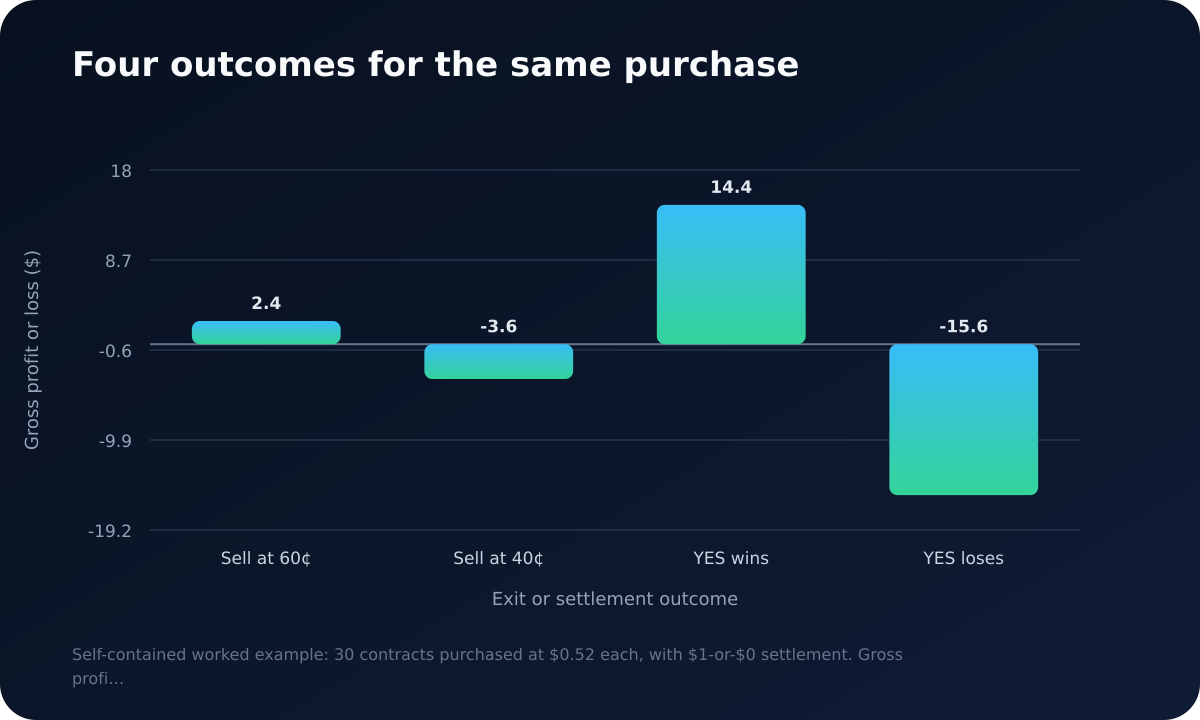
Suppose the 30 contracts bought at 52¢ can later be sold at an executable price of 60¢. Selling all 30 produces $18 in proceeds. The gross trading profit is $18 − $15.60 = $2.40, before any applicable costs. You have closed that position rather than waiting for the football result.
If you instead sell at 40¢, proceeds are $12 and the gross loss is $3.60. An intended exit price is not an assured execution price: you still need an available counterparty. A screen showing 60¢ does not establish that all 30 contracts can be sold there.
Holding through settlement produces a different payoff. If YES wins, the 30 contracts pay $30, giving a gross profit of $14.40. If YES loses, they pay $0 and the loss is $15.60. These settlement outcomes follow the example’s contract terms, not the size of the displayed price immediately before trading ends.
When does a sports market settle?
Settlement is the final resolution of the contract, not merely the end of a match. Kalshi’s Market FAQs state that a market settles after the official outcome is confirmed and finalized, with winning contracts paid into the trader’s cash balance.
Kalshi also distinguishes displayed close time from determination time. Trading can end before or after an event, and official confirmation may arrive later. Its guidance says settlement often occurs within a few hours after the outcome is known, but waiting for official data can cause delays. That guidance should not be treated as a universal settlement deadline.
Before entering, identify the official result source and the rules for postponements, cancellations or disputed results. Do not assume a broadcast score or final whistle alone resolves your contract. Include the possible settlement wait in your exposure plan rather than assuming the purchase cost immediately becomes available again.
How do you judge whether a price offers value?
Expected value combines your estimated outcome probability with the possible payoffs. If you estimate a 56% chance that YES wins, a $1-or-$0 contract bought for 52¢ has expected profit of 0.56 × $1 − $0.52 = $0.04 before costs. Across 30 contracts, that is $1.20—not a promised result.
The weak point may be your 56% estimate. Fees can reduce the margin, and changing the execution price changes the calculation. The OddsFantasy expected value calculator helps work through EV arithmetic, but no calculator validates your probability estimate. Keep the reasoning behind that estimate separate from the calculation.
Market activity is informative, but volume is not a trading signal by itself. A study in the UEA Digital Repository found trading volume predictive of fundamentals in horse-race exchange markets, with much of the relationship occurring during races. That finding does not establish a profitable rule for another sport or contract.
What risk habits should beginners establish first?
Trading terminology does not remove gambling risk. The National Council on Problem Gambling advises setting financial and time limits before gambling, stopping at those limits and never chasing losses. Money needed for rent, bills or savings should not fund trading or account fees.
- Write down your entry price, reason for the trade and maximum acceptable loss.
- Set a session time limit and a financial stopping point before opening positions.
- Track combined exposure, including positions tied to similar outcomes.
- Record actual fills and applicable costs, not just the prices you intended to obtain.
- After a loss, review the decision rather than increasing size to recover it.
Position-sizing tools belong after those decisions, not before them. The OddsFantasy Kelly criterion calculator can support sizing calculations, but uncertain probability estimates can produce unsuitable outputs. A calculated position must still fit your account rules and personal limits.
How does OddsFantasy funded trading fit into this process?
OddsFantasy funded accounts provide instant access without an evaluation challenge, and traders start on simulated capital from day one. This gives the beginner’s workflow a defined account structure; it does not remove uncertainty or make a weak trade worthwhile.
- $150 account: $19.99 one-time platform fee.
- $1,000 account: $99.99 one-time platform fee.
- $2,000 account: $199.99 one-time platform fee.
- $5,000 account: $499.99 one-time platform fee.
- $10,000 account: $999.99 one-time platform fee.
Every account has a 2% maximum position size, 10% maximum drawdown and 25% maximum exposure. On the OddsFantasy $1,000 funded account, those percentages correspond to $20, $100 and $250 respectively when applied to $1,000. These are ceilings, not targets; a smaller position may be appropriate.
OddsFantasy moves funded traders who stay within the rules and trade consistently up to live capital on prediction markets. On live capital, traders keep up to 90% of the profits they generate as performance rewards. Instant account access is not a promise of immediate live capital, rewards or income.
Every funded account includes the trading terminal and full trading education library. Accounts of $1,000 and larger also include AI-assisted trading, Positive EV signals and premium support. Compare the funded account options; for contractual details, including how drawdown is calculated, consult the Terms and Conditions published at trade.oddsfantasy.com.
Where should a beginner start?
The OddsFantasy trading terminal is free to use for sports prediction markets such as Polymarket. Begin by learning to distinguish the displayed price from the price you can execute, then calculate the cost and settlement payoff of a position before submitting an order.
For structured study, The Beginner’s Guide to Data-Driven Sports Trading is a $14.99 PDF downloadable straight after checkout. It covers odds and implied probability, positive EV strategies, bankroll and risk management, position sizing and exposure, market psychology, reading market movement and common mistakes.
- Choose one clearly defined market and read its settlement rules.
- Convert the executable price into a break-even probability.
- Calculate purchase cost or liability and check combined exposure.
- Decide whether to exit before settlement or hold, and record why.
- Review the execution and decision quality—not only whether the outcome won.
Frequently asked questions
Is sports trading the same as sports betting?
Sports trading still involves gambling risk, but it focuses on prices, execution and position management rather than only selecting outcomes. A trader may close a position before settlement or hold it until the official result resolves the contract.
Does a 50¢ displayed price mean I can buy at 50¢?
Not necessarily. The displayed price may be a bid-ask midpoint or a last traded price. Check the executable ask and available quantity before calculating the cost of a purchase.
Can I lose money on a prediction-market contract?
Yes. In the article’s example, buying 30 contracts at 52¢ costs $15.60. If the contracts settle at $0, the full purchase cost is lost. Selling earlier at a lower price can also realize a loss.
Are OddsFantasy funded accounts live from day one?
No. OddsFantasy funded accounts are instant and have no evaluation challenge, but traders begin on simulated capital. Traders who remain within the account rules and trade consistently move up to live capital on prediction markets.
What is the difference between the free terminal and the beginner’s guide?
The OddsFantasy trading terminal is free to use for sports prediction markets such as Polymarket. The Beginner’s Guide to Data-Driven Sports Trading is a separate $14.99 PDF covering trading fundamentals, downloadable straight after checkout.
Sources
- Polymarket Help Center: How Are Prices Calculated? | Polymarket Help Center
- Kalshi Help Center: Market FAQs | Kalshi Help Center
- National Council on Problem Gambling: National Council on Problem Gambling Reiterates Responsible Gambling Guidelines Ahead of Super Bowl LX – National Council on Problem Gambling
- UEA Digital Repository: The role of speculative trade in market efficiency: Evidence from a betting exchange – UEA Digital Repository
- arXiv: BBE: Simulating the Microstructural Dynamics of an In-Play Betting Exchange via Agent-Based Modelling
Trade responsibly: only trade what you can afford to lose. 18+.