


Prop firm drawdown rules limit how far an account can fall before it breaches a program’s loss boundary. To check whether your trading plan fits, identify the reference value, whether the boundary moves, which losses count and how much room your open positions could consume.
A published drawdown percentage is not enough to answer those questions. Sports and prediction-market traders also need to separate accumulated losses from position-size and exposure limits. For the foundations, start with Funded Account Position Sizing: Limits, Exposure and Drawdown; this guide focuses on interpreting the loss boundary.
What does drawdown actually measure?
Drawdown is the decline from a previous local peak to a subsequent trough. Maximum drawdown is the largest such decline over the period being examined, as explained by the CFA Institute’s discussion of maximum drawdown. The chosen period matters: a session, a month and an account’s full history can produce different measurements.
For a peak account value P and a later value V, dollar drawdown is P − V, and percentage drawdown is (P − V) ÷ P × 100. Maximum drawdown takes the largest peak-to-later-trough decline within the chosen measurement period.
A funded-account rule is an operating boundary, not just a historical performance metric. The CFA Institute’s drawdown research summary notes that maximum drawdown does not require assumptions about statistical distributions. That makes it useful for describing losses, but it does not tell you the probability of your next losing sequence.
How do daily, total, static and trailing limits differ?
Example: a $1,000 account. The following comparisons use explicitly defined calculation methods, not a claim that every funded program uses them. Daily and total describe the scope of a limit; static and trailing describe how its reference boundary behaves. An account can therefore have more than one of these rules.
What is a daily drawdown limit?
A daily limit restricts losses within a defined trading day. Suppose the example rule allows a $50 decline from the day’s starting value. A day beginning at $1,000 has a $950 floor; a later day beginning at $1,100 has a $1,050 floor. The allowance is fixed at $50 in this version.
A different method could calculate 5% of each day’s starting value: at $1,100, that allowance becomes $55 and the floor becomes $1,045. Neither method should be assumed from the phrase “daily drawdown.” Reset time, timezone and treatment of positions held across the reset are essential parts of the definition.
What is a total drawdown limit?
A total limit constrains losses over the account’s broader lifetime rather than resetting each day. With a fixed $100 loss allowance below the initial $1,000, the floor is $900. Losses of $30 on three separate days leave $910: a daily reset does not restore the total loss budget.
What is a static drawdown limit?
A static floor stays anchored to a specified reference value. With the $900 floor above, an increase to $1,200 does not move that floor. The distance from $1,200 to $900 is $300, although the original permitted loss below starting capital remains $100. Extra room is not a reason to increase position size automatically.
What is a trailing drawdown limit?
A trailing floor moves upward when the account records a qualifying new high. If it trails by a fixed $100, a rise from $1,000 to $1,200 raises the floor from $900 to $1,100. A subsequent decline to $1,110 leaves only $10 of room, despite the account remaining above its starting value.
A floor set 10% below the qualifying peak gives a different result: at a $1,200 peak, the floor is $1,080. Fixed-dollar trailing and percentage trailing are not interchangeable. You also need to know what qualifies as a high: an intraday equity peak, a settled balance or another specified observation.
Check whether the boundary stops trailing at any point and whether touching it, rather than falling below it, triggers a breach. Build your plan to stop before the boundary; an exact-limit calculation leaves no margin for additional losses or execution costs.
Do open positions count toward drawdown?
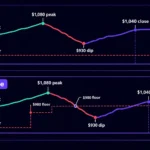
That depends on the account’s measurement method. Balance-based calculations track recorded results, while an equity-based calculation can include unrealized position values. If open positions temporarily lose $80 before recovering, the account can show $920 in equity and later return to $1,000. A settlement-only record would miss that interim decline.
- Identify whether the rule uses balance, equity or another account-value definition.
- Confirm whether unrealized losses and unrealized gains affect the boundary.
- Check whether fees and other trading costs reduce the measured account value.
- Find the observation frequency and any daily reset time.
- Establish how unresolved positions are handled across measurement periods.
Measurement frequency is not a minor detail. CFA Institute explains that drawdowns measured with monthly returns can be lower than those measured with daily returns. For your own stress test, record the worst value reached during a position, not just its eventual settlement result.
How do OddsFantasy’s three risk limits differ?
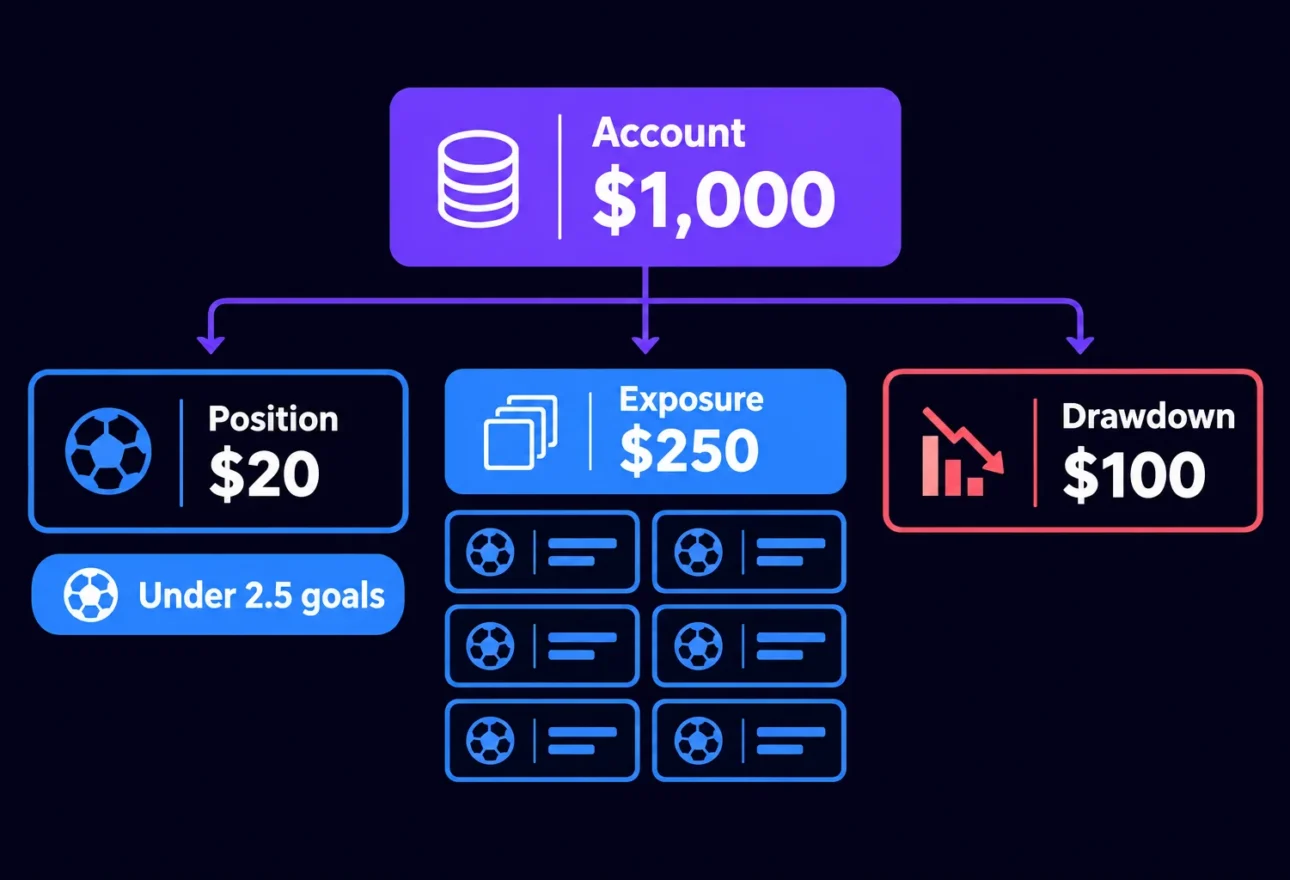
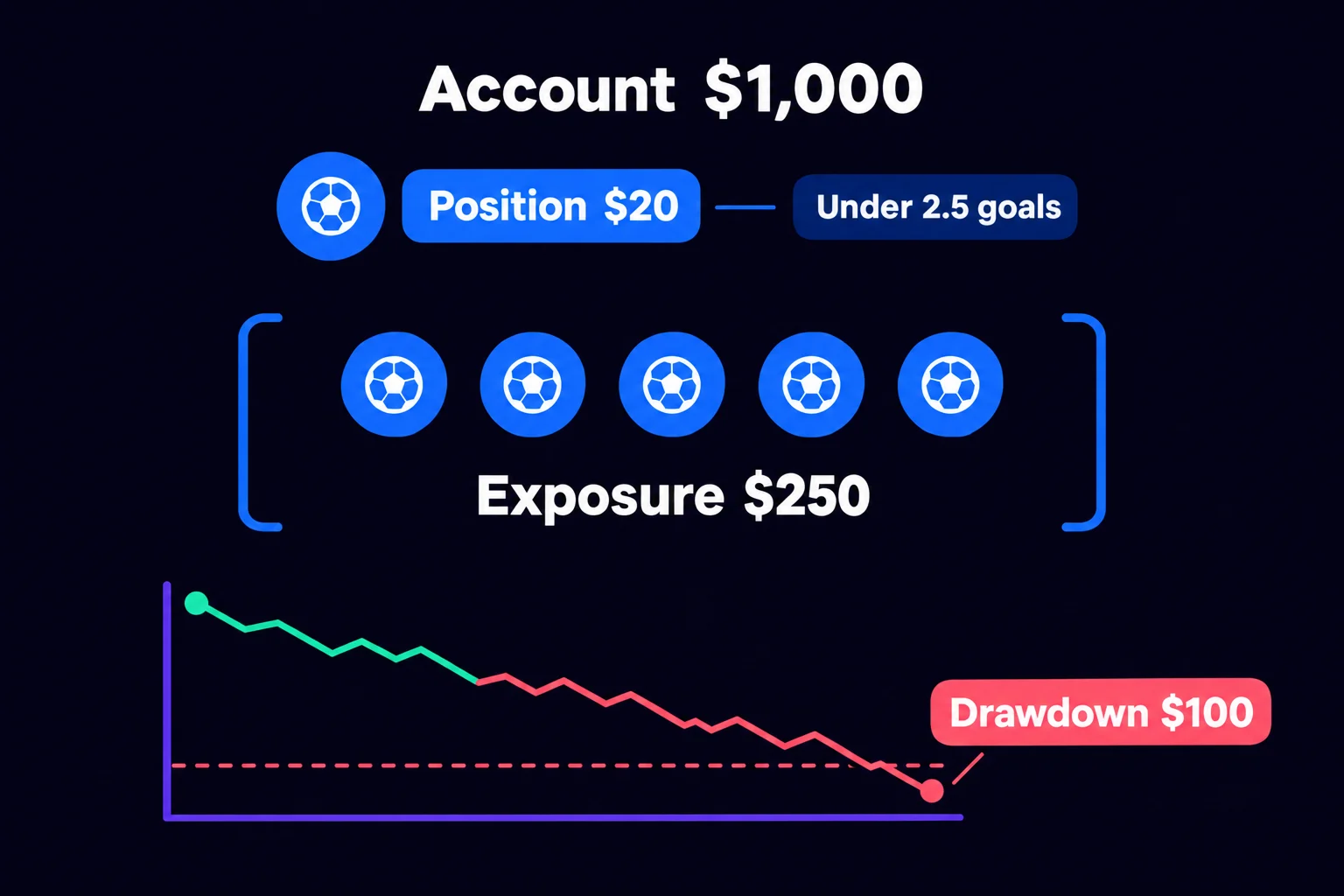
Every OddsFantasy funded account has a 2% maximum position size, a 10% maximum drawdown and a 25% maximum exposure. These are three separate constraints, not three ways of expressing the same allowance.
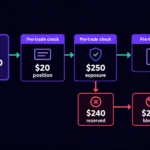
- Position size controls the size of an individual position. Two percent of the example’s starting $1,000 is $20.
- Drawdown controls accumulated decline under the account’s drawdown calculation. Ten percent of $1,000 is $100.
- Exposure controls aggregate positions. Twenty-five percent of $1,000 is $250.
These dollar amounts translate the percentages against starting capital for planning; they do not establish the program’s calculation basis. A $20 position in an “Under 2.5 goals” market can meet a position-size ceiling while adding to existing exposure. Repeated losses can consume drawdown room even when every individual position is small.
Use OddsFantasy’s Terms and Conditions, published at trade.oddsfantasy.com, for the governing definitions, including the drawdown reference, calculation basis, treatment of open positions and breach conditions.
How can you test whether your risk plan fits?
How much usable loss capacity remains?
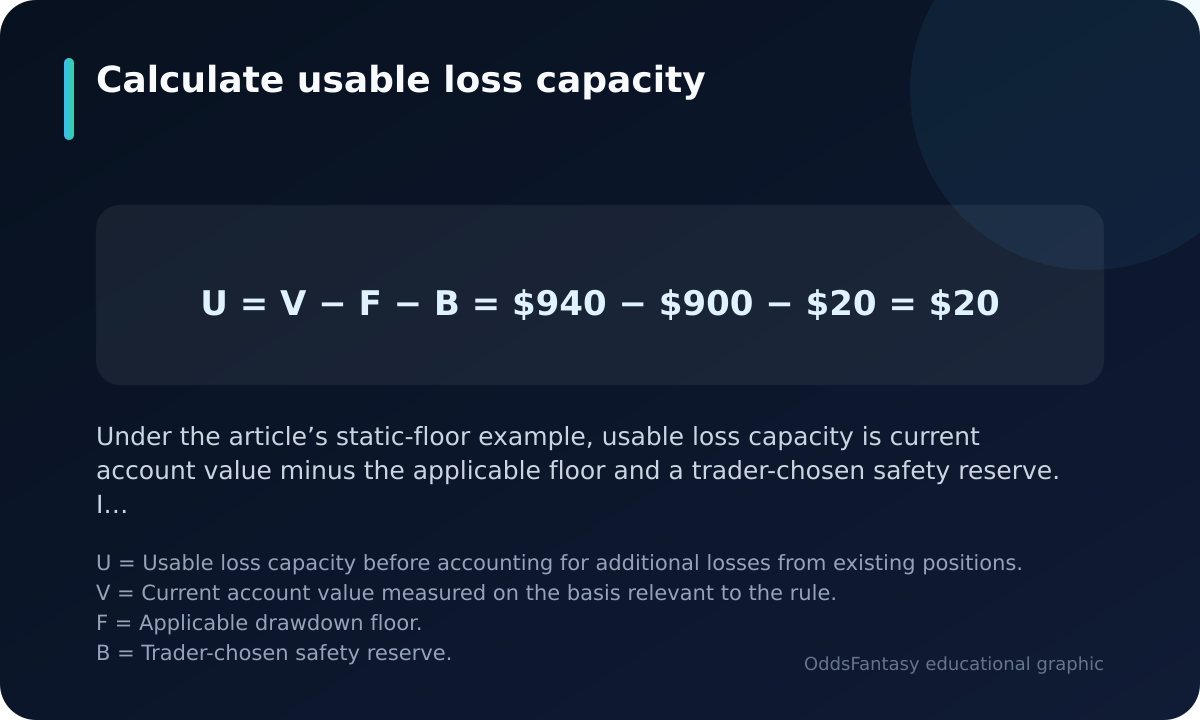
Start with the actual distance to the applicable floor, not the headline percentage. Under the static example, a current value of $940 and a $900 floor leave $40 of loss capacity. A position risking $20 would consume half that remaining capacity if it suffered its full planned loss.
Then subtract a personal safety reserve. With a $20 reserve, usable loss capacity is $940 − $900 − $20 = $20. At the original $1,000 value, the same floor and reserve leave $80. The reserve is your planning choice, not an additional OddsFantasy rule; its purpose is to keep normal trading decisions away from the breach boundary.
How many full-loss positions can your plan withstand?
With fixed $20 losses, five consecutive losses move the account from $1,000 to $900. That exhausts the example’s $100 allowance. With the $20 reserve, four losses leave $920 and no usable capacity for another full-loss position. A plan should define that stopping point before the sequence begins.
Reducing the planned full loss to $10 gives eight such losses before reaching $920. This is capacity arithmetic, not a forecast of how many losses will occur. Position amount and maximum possible loss also need to be distinguished when a market’s structure makes them different.
Recalculating size changes the path. If each loss is exactly 2% of the remaining account value, five losses leave $1,000 × 0.98⁵ = $903.92, while six leave $885.84. This calculation assumes sequential full losses, no other costs and continuous resizing; it is not a statement of OddsFantasy’s sizing method.
Could related positions breach the boundary together?
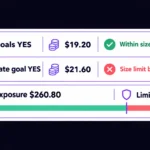
Under the starting-capital calculations, twelve $20 positions total $240, below the $250 exposure ceiling; thirteen total $260, above it. But passing the exposure test does not make twelve positions safe for the drawdown budget. Several markets tied to one football match may respond to the same goal or late match event.
If six positions each lose $20, their combined $120 loss exceeds the starting $100 drawdown allowance in the static example. Group positions by shared event and ask what happens if the whole group moves against you. An exposure ceiling is not a promise that the permitted exposure can be lost without breaching another rule.
Does an estimated edge override the loss budget?
No. An edge-based sizing estimate still needs to fit the account constraints. The study Analyzing Sequential Betting with a Kelly-Inspired Convective-Diffusion Equation models remaining bankroll across independent sequential bets and treats ruin probability as a possible constraint on other objectives. It also discusses fractional Kelly as a risk-reduction heuristic.
The OddsFantasy Kelly criterion calculator can help explore sizing estimates, but those estimates depend on your inputs. Fractional Kelly does not guarantee compliance with a drawdown boundary. Related sports positions also differ from the independent sequences in that study, so its model should not be treated as your account’s breach probability.
What should your pre-trade drawdown checklist include?
- Write down the current daily and overall floors that apply to your account.
- Calculate the smallest remaining distance to any applicable boundary.
- Subtract your safety reserve and losses that open positions could still create.
- Check the proposed position against the individual position-size limit.
- Add the position to total exposure and to its shared-event risk group.
- Reject or reduce the position if a plausible loss scenario consumes the usable budget.
Keep the calculation reproducible: record the account value, reference peak, floor, existing exposure and planned worst-case loss. The OddsFantasy Sports Trading Tools Suite includes exposure and ROI calculators, trading simulators, risk management utilities and a trading analytics dashboard. These support the checking process; a signal or automation rule does not remove the account limits.
When is a funded account a sensible fit?
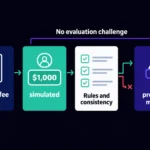
A funded account fits only if your strategy remains workable inside its loss and exposure boundaries. OddsFantasy accounts are instant, with no evaluation challenge, and begin on simulated capital from day one. The $1,000 funded account has a one-time platform fee of $99.99.
Every account includes the trading terminal and full trading education library; the $1,000 account and larger also include AI-assisted trading, Positive EV signals and premium support. Traders who stay within the rules and trade consistently move up to live capital on prediction markets, where they keep up to 90% of generated profits as performance rewards.
Before choosing an account, replay your intended positions against its actual boundaries, including unresolved losses and shared-event scenarios. If ordinary position sizes repeatedly consume most of the remaining cushion, reduce risk or reconsider the fit. The useful question is not how much capital appears on the account, but how much loss capacity your plan needs to operate.
Frequently asked questions
Is a 10% maximum drawdown the same as risking 10% on one trade?
No. Drawdown limits accumulated decline under the account’s calculation method, while position-size limits constrain individual positions. OddsFantasy has a 10% maximum drawdown, a 2% maximum position size and a separate 25% maximum exposure.
Can an account breach a trailing limit while still above its starting value?
Yes. In a fixed-$100 trailing example, a $1,000 account that reaches $1,200 has a $1,100 floor. A later decline can reach that boundary even though the account remains above its original $1,000.
Does a daily reset restore the total drawdown allowance?
Not in the separate daily and total limit example used here. A daily reset starts a new daily measurement period, but accumulated losses still reduce the remaining capacity under the total limit. The account’s governing definitions determine how its limits interact.
How many 2% losses exhaust a 10% loss allowance?
Five fixed losses equal to 2% of starting capital exhaust a 10% starting-capital allowance. If each loss is instead 2% of the remaining value, five losses reduce the account by about 9.61%, and six by about 11.42%. Neither calculation should replace the account’s actual rules or a safety reserve.
Does OddsFantasy publish a daily or trailing drawdown limit in these account rules?
OddsFantasy’s published account rules specify a 10% maximum drawdown, alongside 2% maximum position size and 25% maximum exposure. Do not infer a daily, static or trailing calculation solely from that percentage; use the governing Terms and Conditions.
Sources
- CFA Institute: Sculpting Investment Portfolios: Maximum Drawdown and Optimal Portfolio Strategy – CFA Institute Daily Browse
- CFA Institute: Performance Drawdowns in Asset Management: Extending Drawdown Analysis to Active Returns (Digest Summary)
- MDPI: Analyzing Sequential Betting with a Kelly-Inspired Convective-Diffusion Equation
Trade responsibly: only trade what you can afford to lose. 18+.

1 Comment
[…] traders, that distinction matters while positions remain open. Start with our broader guide to prop firm drawdown rules if you need the basics; here, the focus is the timing of calculation and […]