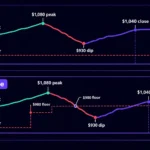


To be a consistent trader, follow a repeatable decision process, control exposure and measure whether you obeyed your rules—not whether your last few positions won. Discipline makes your decisions easier to evaluate; it does not create a profitable edge or guarantee returns.
For sports and prediction-market traders, that means defining acceptable trades before the market becomes emotionally demanding. If you still need to establish your approach, start with how to build a prediction market trading strategy. This guide focuses on executing and reviewing that approach consistently.
What does trading consistency actually mean?
Trading consistency means applying the same decision standards when circumstances meet the same conditions. It does not mean taking identical positions, trading every day or producing steady profits. A compliant trade can lose; a poorly justified trade can win. Neither outcome changes whether the original decision followed your plan.
Keep two separate records: process quality and financial results. Process quality shows whether you executed the intended strategy. Results help you investigate whether that strategy has an edge after costs. Strong rule adherence alongside persistent losses is a reason to examine the strategy, not simply congratulate yourself on discipline.
What should a repeatable trading plan contain?
A usable plan should let you decide whether a position qualifies without rewriting the rules to accommodate it. Put these five elements on one page:
- Market scope: specify the sports, events or prediction-market categories you understand and the information you need before trading.
- Entry conditions: state what evidence supports your probability estimate and what available price would make the position acceptable after costs.
- Position and exposure limits: define how much you may commit to one position and across open positions, including related outcomes.
- Management and exit conditions: decide whether you intend to hold through settlement, exit at a specified condition or reassess when defined information changes.
- Pause conditions: identify when stale information, unclear settlement terms, execution problems or inability to follow the plan require you to stop.
Replace vague instructions such as “enter when confident” with conditions you can verify. A confidence label is not a substitute for a probability estimate, a price comparison or a written explanation of why the market may be mispriced.
How do you turn account limits into everyday controls?
Every OddsFantasy funded account has a 2% maximum position size, a 10% maximum drawdown and a 25% maximum exposure. These are account constraints, not recommended targets. A trader can set stricter personal limits rather than routinely operating at the maximum.
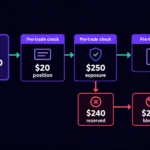
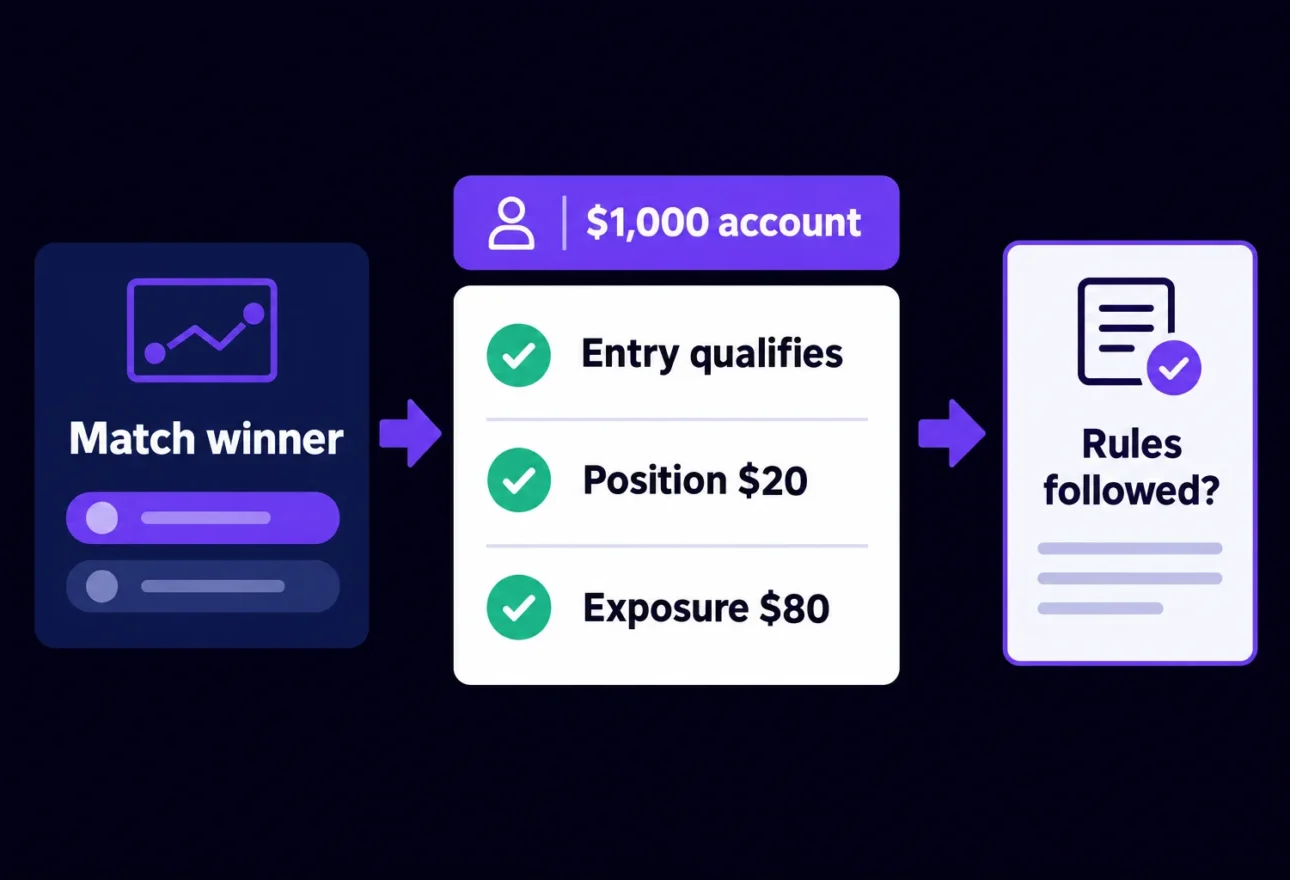
Example: a $1,000 account. Applying the published percentages to $1,000 gives these reference amounts:
- 2% maximum position size: $20.
- 25% maximum exposure: $250.
- 10% maximum drawdown: $100.
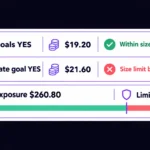
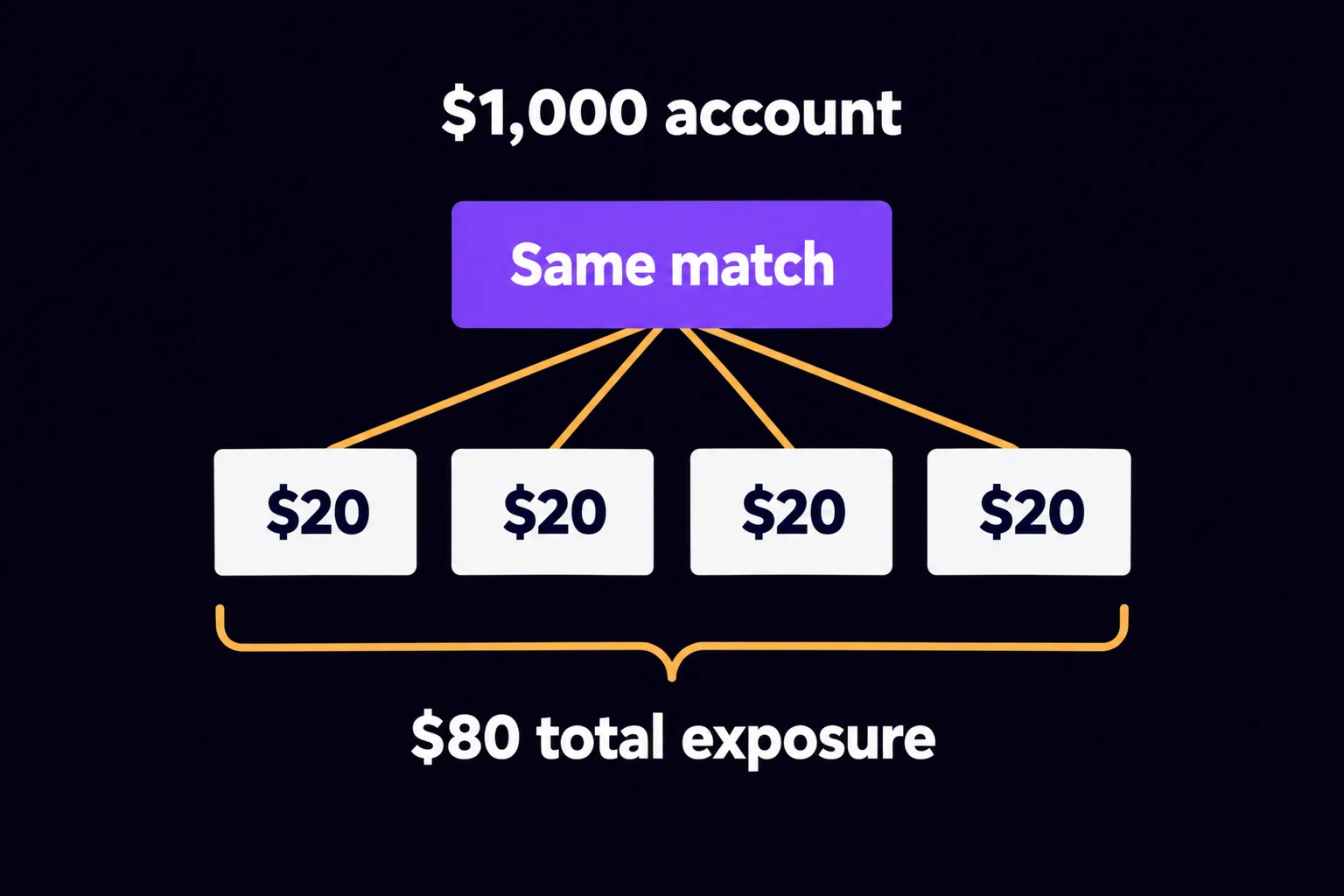
Four open $20 positions total $80 of exposure. But if all four depend on the same match developing in a particular way, they are not four independent ideas. Review the common underlying event as well as the total amount committed. Spare capacity under an account limit is not a reason to add another position.
For the governing definitions, including how drawdown is calculated, consult the Terms and Conditions published at trade.oddsfantasy.com. Use the account limits as hard boundaries and build your operating routine inside them.
What routine helps you follow the plan under pressure?
Use the same short sequence before every order. The purpose is to move important decisions out of the moment when a price change or match event makes immediate action feel necessary.
- Before the session: review open positions, remaining exposure capacity and the events or information updates that could affect them.
- Before entry: check the market’s settlement terms, current price, expected costs, position size and relationship to existing exposure.
- Before submission: record why the trade qualifies and how you will manage it. Do not write the justification after seeing the result.
- After execution: record the actual fill and costs, then check that the resulting position still fits the plan.
The OddsFantasy Sports Trading Tools Suite includes exposure calculators, risk management utilities and a trading analytics dashboard. Its AI Trading Agent can trade automatically after you set your rules. Automation can execute those rules; it cannot establish that the rules have an edge or are appropriate for every market.
Why should costs and trading frequency be part of the plan?
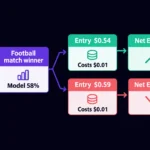
Evaluate the executable trade, not just the displayed price. According to Polymarket’s trading-fee documentation, certain markets charge taker fees at match time. Makers are not charged fees; taker fees are calculated in USDC and depend on the share price. Include applicable costs when assessing an entry or exit.
Lower costs also do not justify more activity by themselves. Chicago Booth Review’s discussion of cheaper stock trades describes research in which lower trading costs encouraged additional retail trading that could worsen returns. That evidence concerns stock traders, not a measured effect in sports or prediction markets.
The practical lesson is to require a qualifying setup for every additional trade. Do not use a daily trade quota, available exposure or a recent profit as the justification. An inactive session can be fully consistent with a plan when no acceptable opportunity appears.
How should you measure rule adherence?
Keep a trade log that captures what you knew at entry, your estimated probability, the price, expected costs, position size, existing exposure and planned management. Add actual execution details, the result and any rule breaches afterward. Preserve the original entry reasoning rather than editing it to fit the outcome.
- Setup compliance: did the position meet every required entry condition?
- Risk compliance: did position size and total exposure remain within the applicable limits?
- Management compliance: did you follow the exit or reassessment rule?
- Record completeness: was the decision documented before the result was known?
- Net result: what remained after applicable trading costs?
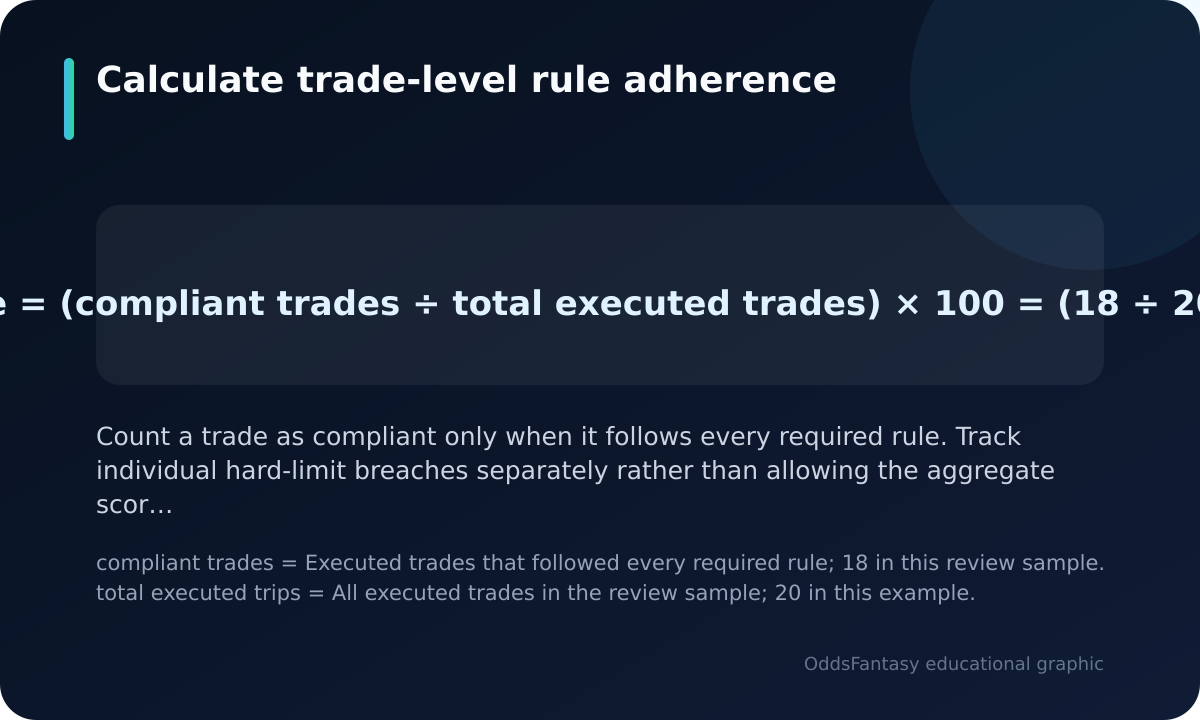
For a review sample of 20 trades, if 18 followed every required rule, trade-level adherence is 18 ÷ 20 × 100 = 90%. A profitable rule-breaking trade still belongs among the two failures. Record the specific breaches so the percentage does not conceal a recurring risk problem.
Review skipped opportunities separately: did you correctly reject an unsuitable trade, or miss a qualifying one? Do not force these decisions into the executed-trade denominator. Keep hard-limit breaches visible individually; a high overall adherence score does not excuse one.
When should you change the plan?
Choose a review schedule in advance rather than redesigning the strategy after each result. First separate execution errors from strategy questions. If you repeatedly break a clear rule, simplify the workflow or reduce discretionary decisions. If execution is consistent but results remain weak, investigate probability estimates, costs and entry conditions. Change one defined element at a time and record the reason. A small sample of wins or losses cannot establish that the revision works.
Where does a funded account fit into this process?
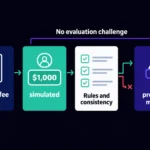
OddsFantasy funded accounts are instant, with no evaluation challenge: traders start on simulated capital from day one. OddsFantasy moves funded traders who stay within account rules and trade consistently up to live capital on prediction markets. On live capital, traders keep up to 90% of the profits they generate as performance rewards.
The $1,000 funded account has a one-time platform fee of $99.99. It includes the trading terminal, full education library, AI-assisted trading, Positive EV signals and premium support. Those resources support analysis and execution; they do not replace a tested approach or guarantee profitable trading.
Before choosing capital, make the process inspectable: write the rules, rehearse the checks and review your adherence. The useful question is not “How long is my winning streak?” It is “Can I explain and repeat my decisions while staying within the limits?”
Frequently asked questions
Does being disciplined make a trader profitable?
No. Discipline helps you execute and evaluate a strategy consistently, but the strategy can still lack an edge after costs. Review rule adherence and net results separately.
How can I measure trading consistency?
Track whether each trade met your entry, sizing, exposure and management rules. Divide fully compliant trades by total executed trades to calculate trade-level adherence, and record every hard-limit breach separately.
Should a consistent trader trade every day?
No. Trading frequency should follow qualifying opportunities, not a daily activity target. Taking no position is consistent with a plan when the available markets do not meet its conditions.
What are OddsFantasy’s funded-account risk limits?
Every OddsFantasy funded account has a 2% maximum position size, a 10% maximum drawdown and a 25% maximum exposure. These are limits, not targets for how much risk to take.
Do OddsFantasy funded accounts start with live capital?
No. OddsFantasy funded accounts start on simulated capital from day one, with no evaluation challenge. OddsFantasy moves funded traders who stay within the rules and trade consistently up to live capital on prediction markets.
Sources
- Polymarket Help Center: Trading Fees | Polymarket Help Center
- arXiv: Sports Betting: an application of neural networks and modern portfolio theory to the English Premier League
- PLOS ONE: Is There Any Overtrading in Stock Markets? The Moderating Role of Big Five Personality Traits and Gender in a Unilateral Trend Stock Market
- Chicago Booth Review: The High Price of Cheaper Stock Trades
Trade responsibly: only trade what you can afford to lose. 18+.