

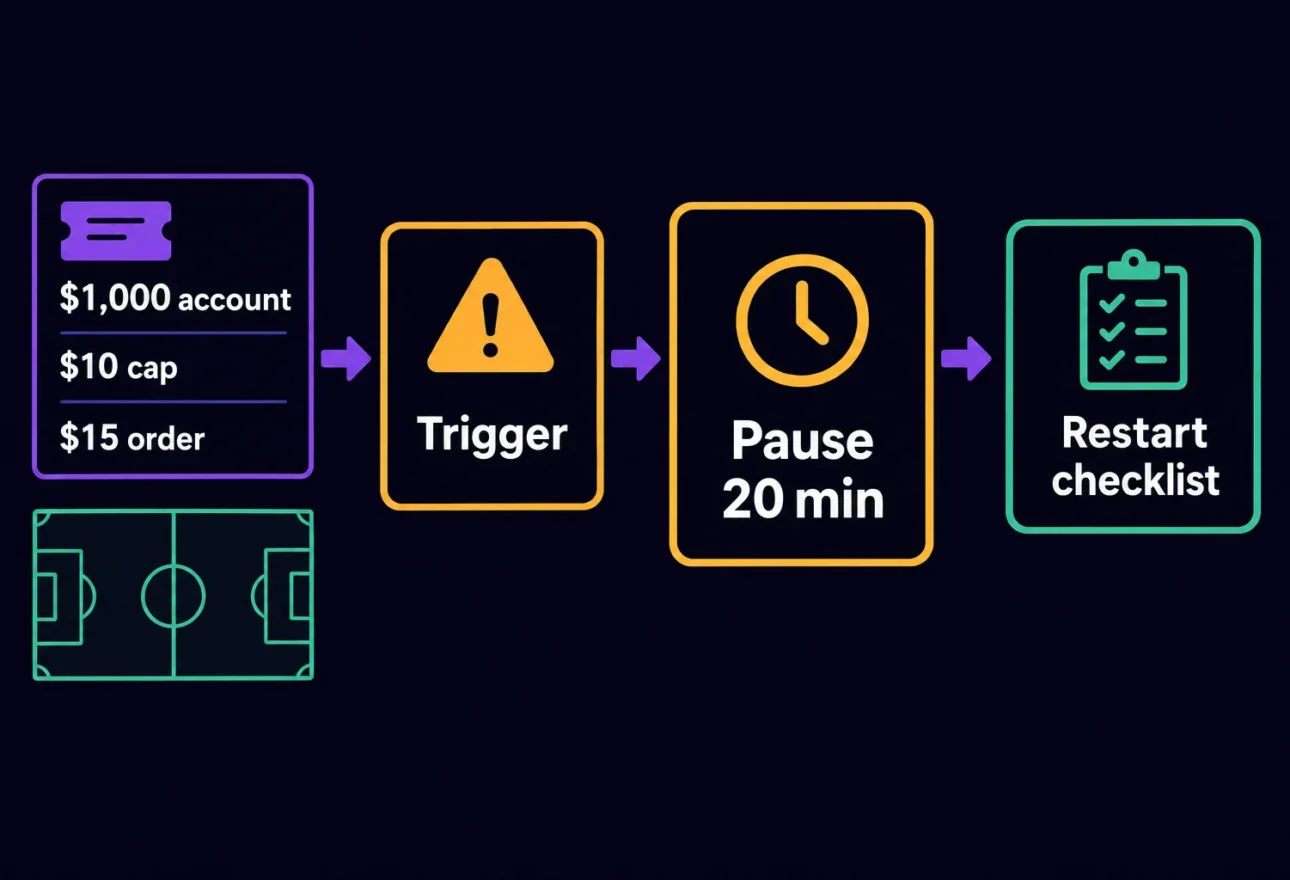
A trading tilt circuit breaker is a written rule that stops new positions when observable behaviour signals a loss of discipline, then permits a restart only after a mandatory pause and specific checks. It should operate before, and separately from, your account’s position, exposure and drawdown limits.
If you need the broader recovery process first, read How to Reset During a Losing Streak Without Assuming Your Edge Survives. This guide focuses on the narrower decision: what must interrupt you before the next order?
How is a tilt stop different from a drawdown limit?
A drawdown limit constrains account losses. A tilt stop constrains behaviour, even while the account remains inside every financial limit. You can be chasing after one loss, or follow your process through several losses. The trigger should therefore identify a broken decision process, not diagnose emotion from results alone.
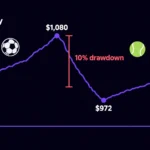
Every OddsFantasy funded account has a 2% maximum position size, a 10% maximum drawdown and 25% maximum exposure. These are account rules, not permission to keep trading until a boundary is reached. Consult the Terms and Conditions for calculation details and governing requirements.
A personal circuit breaker sits inside those boundaries. It cannot override them, restore lost account capacity or make an otherwise prohibited position acceptable.
Which observable behaviours should trigger a pause?
Choose triggers you can verify from an order ticket, written plan or activity record. “I feel tilted” is worth noticing, but it is too easy to negotiate away. For a starter policy, make any one of these events sufficient to stop new entries:
- You enter a position size above your written session cap, even if it remains within the account maximum.
- You prepare an order without recording the market, entry reason and condition that would invalidate the trade.
- You reopen a closed position without identifying fresh information or a prewritten re-entry condition.
- You change your size or entry criteria specifically to recover the session’s loss.
- You act on a social-media tip without completing your normal independent checks.
FINRA’s social sentiment bulletin warns that social sentiment information may prompt emotionally driven or impulsive investment decisions and should not be the sole basis for decisions. That is a reason to require an independent check, not a claim that every popular market is a bad trade.
What happens immediately after a trigger?
Use a predetermined response rather than deciding the penalty while frustrated. The following is a proposed operating policy, not a scientifically established cooling-off period:
- Stop new entries and additions immediately. Cancel pending entry orders and suspend automation that could create fresh exposure.
- Keep managing existing positions under their written exit rules. A pause is not permission to abandon open risk or close everything impulsively.
- Start a 20-minute timer. Close social feeds and stop searching for a recovery trade.
- Record the triggering action and complete the restart checklist after the timer expires.
- If another trigger occurs after restarting, end new entries for the session. Define the next session’s start time in advance; do not rename the current session.
The SEC’s investing guidance recommends taking time, reviewing goals and risk tolerance, and talking with trusted people before investing. A timer creates decision space; it does not prove that judgement has recovered.
How can risk utilities interrupt the next order?
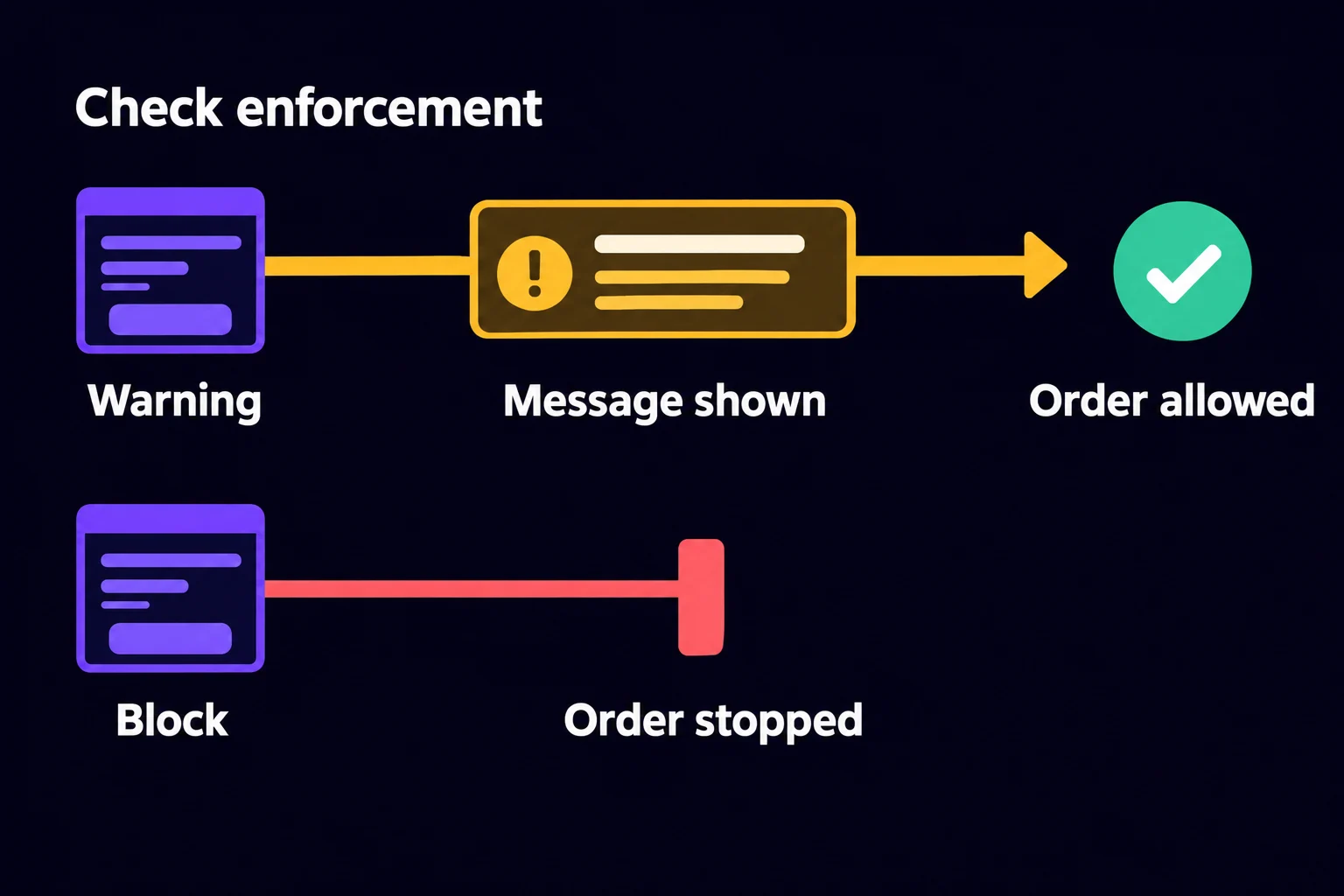
Separate a warning from a block. A notification tells you a condition was met but may still allow trading. A blocking restriction prevents an order under its configured conditions. General pre-trade restriction systems can use either approach; verify what your own software actually enforces.
Where available, use order-size restrictions and a clear trigger message: “New entries paused—complete restart checklist.” Do not assume an account-level setting covers every user or automated route. If your platform cannot enforce a pause, use a written sign-off and remove shortcuts to order entry without losing access needed to manage existing positions.
The OddsFantasy Sports Trading Tools Suite includes risk management utilities, exposure calculators and a trading analytics dashboard. Use these to check the numbers beside your checklist. The AI Trading Agent trades automatically according to rules you set; automation does not itself establish that your tilt triggers or restart checks are enforced.
What does a circuit breaker look like on a $1,000 account?
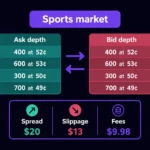
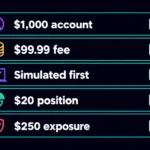
Example: a $1,000 account trading football goals markets. Set a personal position cap of 1%, or $10, below OddsFantasy’s 2% maximum position size of $20. The account’s maximum exposure is 25%, or $250. These ceilings serve different purposes: aggregate exposure capacity is not a reason to increase an individual position.
After a losing trade, you enter $15 on the next order ticket to recover faster. That breaches your personal $10 cap, even though it is below $20. Stop before submitting, begin the 20-minute pause and record “size increased to recover loss.” The circuit breaker has caught the behaviour before the account maximum.
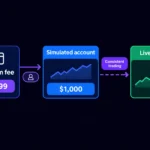
The OddsFantasy $1,000 funded account has a one-time $99.99 platform fee and starts on simulated capital immediately, without an evaluation challenge. Staying inside account rules still requires discipline; the absence of a challenge is not the absence of risk controls.
What must be true before you restart?
Require every item below to pass. A completed timer with an incomplete checklist means no restart.
- The full pause has elapsed, and the triggering behaviour is recorded.
- You can explain the next trade without referring to recovering money or rescuing the session.
- The market, entry reason and invalidation condition are written before opening the order ticket.
- Position size and total exposure fit both your personal plan and account rules.
- You would take the same trade at the same size if the previous trade had not happened.
- Any automation that could open positions has been checked against the current plan.
If a condition fails, remain paused; ending the session is acceptable. Afterward, review whether the trigger was caught before submission, whether the pause was honoured and whether a premature restart occurred. Judge the circuit breaker by adherence, not by whether the next trade won.
Frequently asked questions
Should consecutive losses automatically trigger a trading pause?
You can choose a loss-based review point, but consecutive losses alone do not establish tilt. Keep behavioural triggers separate: changing size to recover losses, skipping entry checks or reopening without a valid reason can justify a pause regardless of the losing streak.
How long should a trading tilt pause last?
This article proposes a mandatory 20-minute pause as a starter policy, not a validated recovery interval. Restart only when every written condition passes. If the checklist still fails, remain paused or end the session.
Does a tilt pause mean closing every open position?
No. Stop new entries and additions, cancel pending entry orders and prevent automation from creating fresh exposure. Continue managing existing positions under their written exit rules rather than abandoning them or making impulsive exits.
Do OddsFantasy risk utilities automatically block emotional trading?
OddsFantasy’s Sports Trading Tools Suite includes risk management utilities, exposure calculators and a trading analytics dashboard. These features should not be treated as a verified automatic tilt-blocking system. Check which controls are actually enforced and keep a separate written pause and restart policy.
Sources
- Interactive Brokers: Setting Trading Restrictions via Pre-Trade Compliance | IBKR Campus US
- FINRA: Investor Bulletin: Social Sentiment Investing Tools—Think Twice Before Trading Based on Social Media
- U.S. Securities and Exchange Commission: Things to Consider Before You Make Investing Decisions
Trade responsibly: only trade what you can afford to lose. 18+.